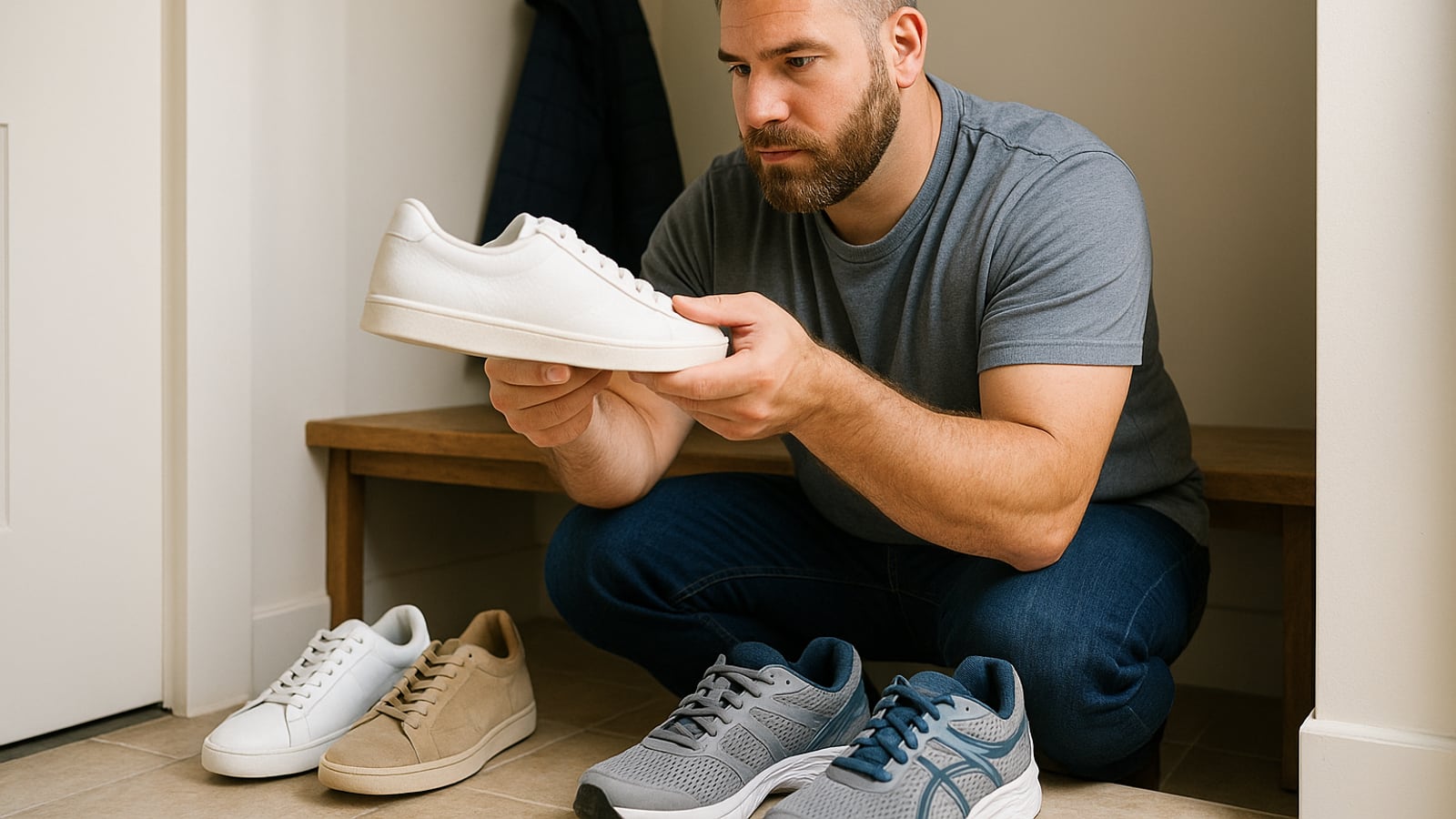
The quickest upgrade to how you look on a Saturday isn't a jacket. It's getting the neon off your feet.
A running shoe is a piece of athletic equipment. It has a thick foam midsole, a flared heel, mesh panels in three colors, and a logo you can read from a parked car. All of that's doing a job on a treadmill. None of it is doing anything for you at a school pickup, a Friday dinner, or your brother-in-law's backyard. The shoe screams "gear," and gear worn away from the activity always reads as a guy who didn't think about it.
You don't need to spend a fortune to fix this. You need a flatter sole, a narrower footprint, and a material that isn't mesh.
The four-part test for a shoe that leaves the gym
Hold the shoe up and look at it from the side. If the heel stack looks noticeably taller than the toe, it's a gym shoe. A shoe that works with normal pants sits low and close to flat.
Look at it from above. Running shoes flare out past the foot for stability. Street sneakers stay inside the outline of your foot, so they look like shoes instead of pontoons.
Count the colors. One is best. Two is fine if the second one is the sole. Three or more and you've got equipment.
Now find the branding. A small stamp on the heel or a stripe you have to look for is fine. A swoosh the size of your hand is a different kind of outfit, and it's an outfit that gets harder to pull off every birthday.
Almost every sneaker people call a "classic" passes all four. Stan Smiths, Sambas, Reebok Club C, Jack Purcells, Nike Killshots, Onitsuka Mexico 66, New Balance 574 if you keep it in one gray. They pass because they were designed before shoes got loud.
Fit first, and it's mostly the heel
Sizing across sneaker brands is a mess. Your size in one is half a size off in another, so throw out the number and use your feet.
Stand up in both shoes, laced. You want about a thumbnail's width between your longest toe and the end. Not a thumb. A thumbnail. Then walk ten steps and pay attention to the back of your heel. If it lifts, you're going to get a blister and a shoe that collapses at the counter in six months.
Canvas shoes tend to run roomy and stretch, which is why so many guys end up in a pair that slaps when they walk. Try a half size down before you commit. Leather stretches across the width but not the length, so buy the right length and let the width come to you over a week.
Width is the part men ignore. If your foot spills over the sole edge when you stand, you're in the wrong shoe, and no amount of lacing fixes it. New Balance sells real wide sizes and that alone makes them worth the trip.
The heel slip fix: use the extra eyelet at the top. Run the lace up through the last hole on the same side to make a small loop, cross the laces through each other's loops, pull down and tie. It's called a runner's loop and it locks your heel without choking the top of your foot. Two minutes, no cost, and it saves half the shoes men return.
Then the material
Leather is the workhorse. It holds its shape, it wipes clean, and a scuff buffs out with a damp cloth and ten seconds. White leather is the most useful single sneaker a man can own because it goes with jeans, chinos, shorts and a navy blazer. It also shows everything, which is the trade.
Suede is the one most guys skip and shouldn't. A dark brown or gray suede sneaker looks more expensive than it's and hides a lot of sins. It dies in a rainstorm unless you hit it with a spray protector before the first wear, and then twice a year. Keep a suede brush in the drawer. Ten strokes brings the nap back.
Canvas is summer only. It's cheap, it's light, and it looks great for about a season before the heel folds. Fine. Treat it as a seasonal buy and don't pretend it's an investment.
Mesh and knit stay in the gym bag. They stain, they can't be cleaned, and they never look like anything but athletic wear.
Brand comes last, and three pairs cover it
Pay for the leather and the sole, not the name on the tongue. The clean white minimalist sneaker that costs more than most car repairs is a genuinely nice shoe, and there are leather sneakers at a fraction of that with the same silhouette. You'll get the same result from ten feet away, which is the only distance anybody is looking from.
Three pairs handle your whole life outside of exercise. A white or off-white leather low-top. A dark suede or brown leather pair for fall and anything slightly dressier. A canvas or beat-up pair you don't care about, for yard work, the lake, and travel days.
Add a fourth only when one of those wears out. Rotate them so no pair goes two days in a row, because the inside of a shoe needs a day to dry out and a shoe worn daily dies in about half the time.
Your pants are half of this
A chunky sneaker under a narrow hem looks like a hammer. A slim sneaker under a wide puddle of denim disappears. Match the leg opening to the shoe.
For a low-profile sneaker, you want the hem to touch the top of the shoe and stop. No stack of fabric, no bunching. If your jeans break twice over the laces, get them hemmed. A tailor will do it for less than a tank of gas and it changes the whole line of you.
Socks: a plain dark sock, or no-shows with a silicone heel grip so they don't slide down and turn into a wad under your arch. The novelty socks with tacos on them are a choice you're allowed to make. Just know it's the loudest thing you're wearing.
Fixes worth knowing
Yellowed white midsoles. A melamine sponge and warm water, light pressure, in small circles. Don't scrub the leather with it. And don't put the shoes in the washing machine unless you want the glue to let go at the toe.
Toe box creasing. It's normal and permanent. You slow it by not lacing too loose and by putting a cedar shoe tree in when you take them off. Cedar also handles smell, which is the real reason to buy them.
Insoles. Most sneakers ship with a flimsy foam insert. A ten-dollar replacement insole makes a cheap shoe feel like a better one and is the single best money-per-comfort trade in footwear.
Laces. Flat cotton laces, replaced once a year, make old shoes look cared for. Gray laces on white shoes hide dirt.
Where they still don't belong
Funerals. Interviews, unless you've seen the office and you know. Any wedding where you're standing at the front. A charcoal suit with a tie wants a leather shoe with a sole you can hear, and no minimalist white sneaker has ever won that argument, no matter what the internet says.
Everywhere else, you're covered.
Buy the pair you'd be comfortable taking off at somebody's front door.
Dean Shaw
Gear & Garage
Tests things until they break, then reports what broke first. Trucks, tools, watches, and the cheap version that costs more.

Watch
Worth an hour of your evening
More from Style.
From channels we rate. Plays on YouTube.
Read next