Getting into HVAC without wasting two years first
The card you legally need, the three ways in, and the part of the job that makes most guys quit in July.
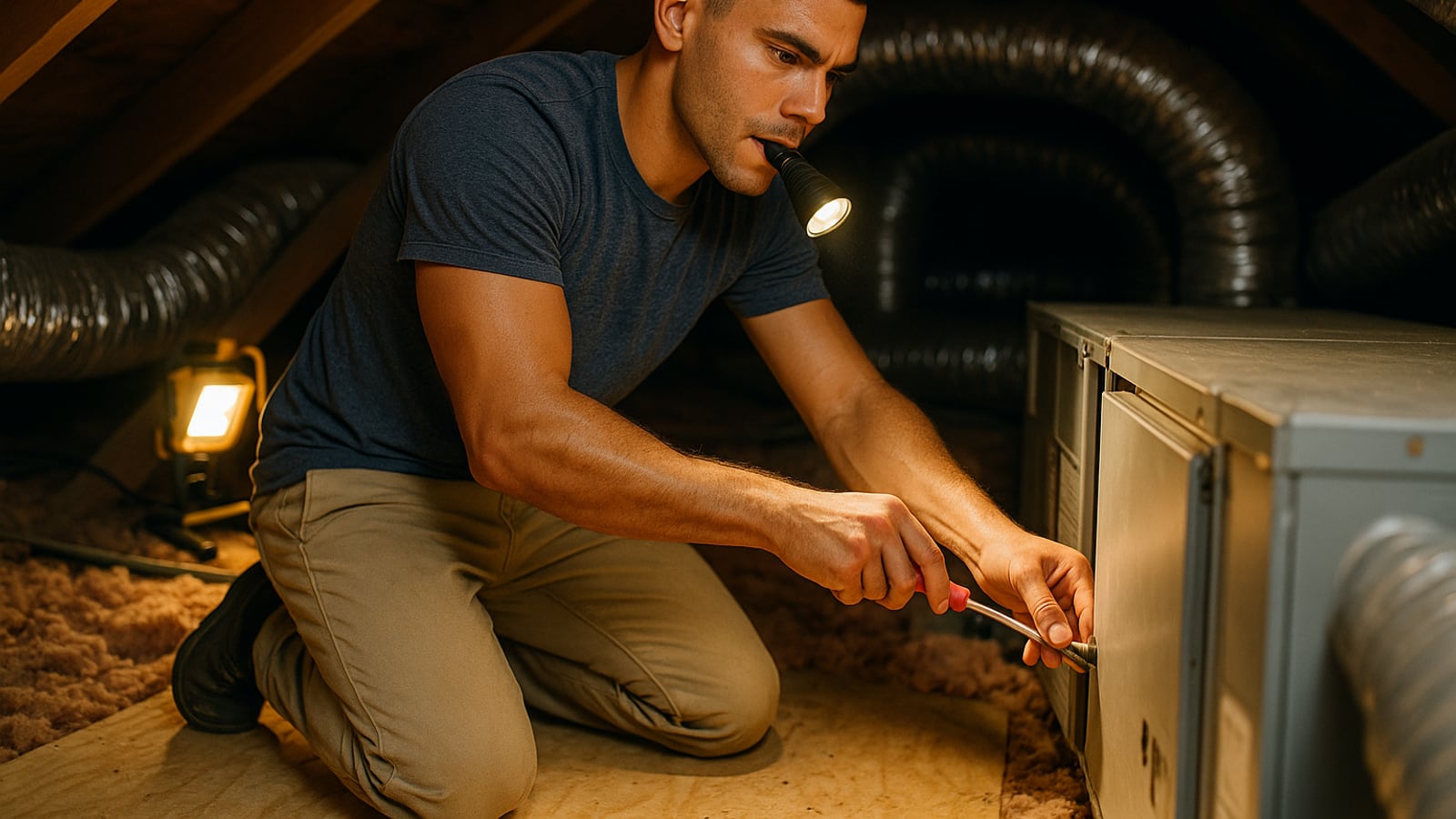
It's 2:40 on a Tuesday in July. You're kneeling on a ceiling joist in an attic that feels like the inside of a parked car, sweat running into your eyes, holding a flashlight in your teeth while you pull the cover off an air handler. Downstairs there's a woman with a newborn and a thermostat reading 88.
Twenty minutes later you're back down the ladder with a swollen capacitor in your hand, the blower's running, and she's looking at you like you pulled somebody out of a river.
That's the job. The attic is the price of admission, and most guys who wash out of heating and air don't wash out over the math. They wash out over the attic.
The card you need before anybody hires you
Federal law says you can't buy or handle refrigerant without EPA Section 608 certification. No card, no gauges, no refrigerant, no real work. It's the gate.
There are four flavors. Type I covers small appliances. Type II is high-pressure equipment, which is most of what you'll touch in homes. Type III is low-pressure chillers. Universal is all three, and Universal is the one you want, because it costs the same to study once as it does to study twice.
You can get it before you have a job. Nobody's stopping you. Type I can usually be done remotely, but Types II and III have to be proctored, so you'll go sit in a room somewhere with a test administrator. The fee is less than a good pair of work boots.
Walk into a shop in March with a Universal card already in your wallet and you've just made yourself cheaper to hire than the guy standing next to you. Owners notice that. It says you did something without being told to.
Three doors, and they don't lead to the same place
Install helper. You call residential companies in February, before the spring rush, and you ask for the install crew. You'll carry equipment, pull line sets, hang duct, and sweep the garage. Pay starts low. You'll learn faster than anybody in a classroom because you'll see forty systems go in before Labor Day. The risk is real, though: some shops will use you as a mule for two years and teach you nothing. If you're eight months in and nobody's let you touch a manifold set, that's your answer. Leave.
Union apprenticeship. Sheet metal locals and the UA run programs where you earn while you go to class at night. Structured, slower, and you come out the other side with something portable. The catch is the calendar. Locals take applications in windows, sometimes once a year, and if you miss it you wait. Call the training center in your city and ask when the list opens. Then actually write down the date.
Community college program. A year or so, hands on trainers, and you come out with the fundamentals and usually your 608. It costs money and time you could have spent getting paid. It's the right call if you interview badly, if nobody in your area is hiring green, or if you want to go straight at commercial work.
None of these is the smart-guy option. Pick the one that fits the shops in your zip code.
The lanes pay differently, so know which one you're in
Residential service is what most people picture. You drive to houses, you diagnose, you fix, and you talk to homeowners all day.
Install is heavier and more physical, and it's where most guys start.
Commercial refrigeration pays more, and it pays more for a reason. A walk-in cooler goes down at 11 p.m. at a restaurant and there's thousands of dollars of product about to spoil, so you're going. Those guys work nights and holidays and they get paid like it.
Building automation and controls is the lane nobody tells young men about. It's laptops, network drops, sequences of operation, commissioning. Cleaner, cooler, and it rewards a guy who likes figuring out why the logic isn't doing what the drawing says.
Learn the four things that separate techs from parts-changers
Anybody can swap a capacitor. Learn to actually find the fault.
- Read a wiring diagram. Ladder logic, sequence of operation, where the 24 volts goes and where it stops. This is the single biggest divider in the trade.
- Pull a real vacuum. Nitrogen purge while you braze so you're not sending scale through the system. Micron gauge, pull to 500 microns, and let it sit to prove it holds. Guys who skip this make warranty calls for the next five years.
- Measure static pressure. Most residential duct systems are choked, and the equipment gets blamed for it. A manometer and two test ports will tell you more than an hour of guessing.
- Talk to the customer like a grown man. Explain the failed part without making somebody feel dumb for not knowing what it was. That skill is worth more money than any tool in your bag, and it's the reason a homeowner asks for you by name next time.
You're walking in during a refrigerant change, and that's your advantage
R-22 is done. New residential systems are shipping with A2L refrigerants like R-454B and R-32, which are mildly flammable and come with their own handling rules, leak detection requirements and equipment.
Twenty-five year veterans are relearning it right now. You get to learn it as the normal way things work. That's a genuine head start, and it won't come around again in your career. Read the manufacturer's install instructions on A2L systems cover to cover, once, on your own time. You'll be ahead of half the truck fleet.
Don't finance a truck's worth of tools in your first six months
Most shops supply gauges, recovery machines and vacuum pumps. You'll buy hand tools, and you'll buy them slowly.
The two things worth spending on early are a good multimeter and a good flashlight. Cheap meters lie, and a lying meter will have you replacing a board that was fine.
Everything else can wait until you know whether you're a residential guy, a refrigeration guy or a controls guy. Those bags don't look the same.
Protect your knees now, because you'll want them at fifty
Kneeling pad. Every time, even for the two-minute job. Guys who skip it at 20 are limping at 45, and there's no skill that replaces being able to get into a crawlspace.
Set the ladder right, tie it off, and never trust a roof hatch you haven't tested. Keep a gallon of water in the truck and drink it before you feel thirsty, because heat exhaustion in an attic is how people fall through ceilings. Wear the hearing protection around rooftop units. Your future grandkids will talk quietly and you'll want to hear them.
Where it goes after the wrench
Five or six years in, the doors open. Service manager. Field trainer. Manufacturer rep, which is a suit and a car and a territory. Inspections. Teaching nights at the same college you might have started at.
Or you buy a van, get licensed and insured in your state, and hang your own name on it. Understand what that trade actually is: you'll stop being a technician and start being a guy who does payroll, sales and scheduling, and who fixes the things the new kid couldn't. Some men love it. Some men hate it and go back to working for somebody else, and that's not a failure, that's information.
Either way, the trade doesn't care where you went to high school. It cares whether the system's running when you leave.
And it will be 9:15 at night, and the house will be cooling down, and the woman with the baby on her shoulder will mouth thank you through the screen door while you coil your hoses in the dark. Nobody claps. You just drive home knowing you were the guy who could.
Sam Ortiz
Dads & Family
Father of three. Writes about presence, discipline and the long game, without pretending any of it's tidy.

Read next