Your first car should be boring, and that's a compliment
The insurance call, the ten-minute walkaround, the inspection a seller will try to talk you out of, and the four words that end a bad deal.
Set the number before you look at a single listing, because once you've seen a clean black sedan with the right wheels, your budget becomes a suggestion.
The number isn't the sticker. It's the monthly total of everything the car costs you: payment, insurance, gas, and a set-aside for repairs. On a used car, budget something every month for repairs whether or not anything breaks, because eventually something breaks and it always picks the week rent is due. Tires, brakes and a battery aren't surprises. They're a schedule.
Run it as plain arithmetic. If you can live on $450 a month of car, and insurance quotes you $180, and you burn $120 in gas, you've got $150 left for payment plus repair savings. That's a cash car or a small loan on a cheap one. That math is unromantic and it's the most useful thing on this page.
Call insurance before you fall in love
Get quotes on the specific year, make and model you're considering, in your name, at your address, before you shake a hand. Insurance on a 22-year-old male is the plot twist nobody warns you about, and two cars with the same price tag can quote hundreds apart.
Two-door versions of the same model often cost more to insure than four-door. Turbo versions cost more than the base engine. A car that's popular with people who drive like they're being chased costs more than a car that's popular with people who drive to church. You'll find that out in about fifteen minutes of phone calls, and those calls may change which car you buy.
While you're at it, ask what liability limits you're actually getting. The state minimum is the floor, not the recommendation. If you hit a new truck and a chiropractor, the state minimum evaporates and the rest follows you.
Get your own money before you get their money
If you're financing, walk in pre-approved by a credit union or your own bank. Not because dealer financing is always worse. Sometimes it's better. But a pre-approval gives you a rate to compare against, and it turns the conversation from "what can you afford monthly" into "what does this car cost."
That's the whole trick. A finance office can hit almost any monthly payment you name by stretching the term. Seventy-two months, eighty-four months, and suddenly a $16,000 car costs $22,000 and you're upside down for four years. Negotiate the out-the-door price of the car. Then talk terms. Never both at once, because when you mix them you lose track, and losing track is the business model.
Say the total price out loud. Say the interest rate out loud. Say the length of the loan out loud. If a number you say gets a vague answer, ask again.
Boring is the flex
The best first car is a four-cylinder sedan or small SUV from a brand with cheap parts on every shelf in America. A Corolla, a Civic, a Mazda3, a Camry, a CR-V. Nothing German, nothing with air suspension, nothing where the recommended oil comes in a boutique bottle.
The trap is the used luxury car. A ten-year-old 5 Series costs the same as a four-year-old Corolla, and the guy who buys it feels like he won for about five months. Then a control arm goes, and the shop quotes a number that starts with a nine, and he learns that a cheap German car is just an expensive German car with the depreciation already gone. Parts don't know what you paid.
Here's where I'd argue against myself. If your commute is 60 miles a day and losing the car means losing the job, buying newer with a factory warranty left on it can be the smarter call even at a higher payment. Reliability you can schedule beats cheap you can't.
And I'd happily pay a thousand dollars over a comparable listing for a car with one owner, a folder of receipts, and dealer oil changes every 5,000 miles. Records are the cheapest warranty on earth.
The ten-minute walkaround
Go in daylight. Never in the rain, never at night, never under those white lot lights that make everything look freshly painted.
- Crouch at each corner and look down the side of the car. Ripples, mismatched paint texture or a door that catches the light differently mean bodywork.
- Check the gaps. Hood, doors, trunk. Uneven gaps mean a hit.
- Look at all four tires. Same brand? Worn evenly? Feathered or scalloped tread points at alignment or suspension. Flip the date code on the sidewall. Tires older than six years are old no matter how much tread is left.
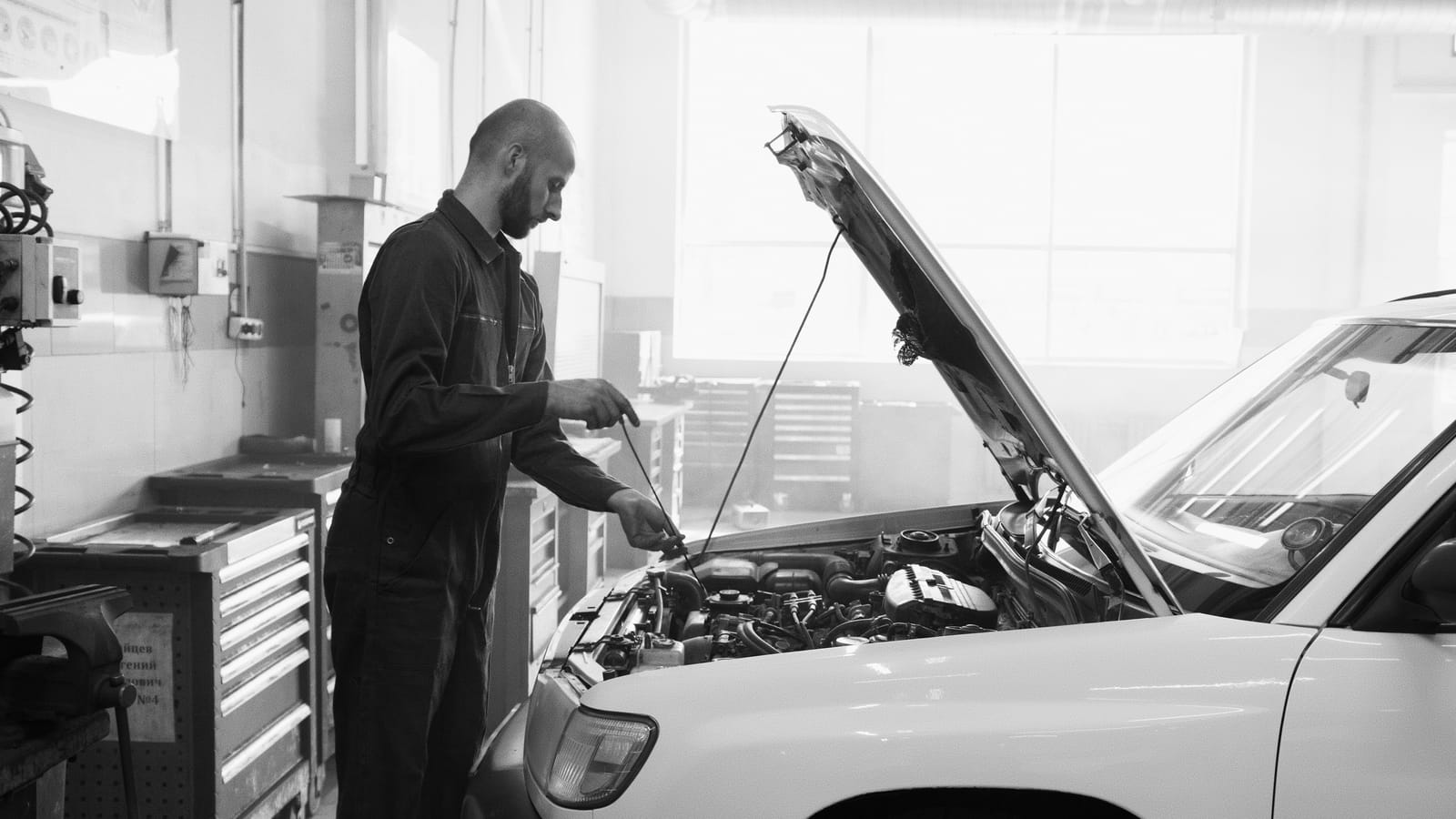
- Pull the oil dipstick. Should be brown or black and smell like oil, not gasoline or burnt toast.
- Pop the oil filler cap and look for milky sludge.
- Open the trunk and lift the carpet. Water, rust, or a spare that's missing tells you who owned this car.
- Turn the key to ON without starting and watch every warning light come on, then go off when it starts. A check engine bulb that never lights up has been removed on purpose.
Then get under the hood with your phone flashlight and look for wet, shiny, or crusty spots. Leaks are honest. They show themselves.
Drive it on real roads
A lap around the block proves nothing. Take it on the highway to 65, hands loose, and feel for shake. Find an empty stretch and brake hard once. Find a rough road and listen for clunks. Turn the wheel lock to lock in a parking lot with the windows down and listen for grinding.
Turn the radio off for the whole drive. Run the AC on max, then the heat on max. Test every window, the wipers, the turn signals, the reverse camera if it has one.
Cold start matters more than anything. Ask the seller not to warm it up before you get there. If you arrive and the hood's already hot, that's information too.
Pay somebody to tell you no
Take the car to an independent mechanic for a pre-purchase inspection. Call two shops, ask what they charge, and book the one that gives you a written list. It costs a fraction of one repair you'd otherwise inherit.
If the seller won't let the car leave for an hour with your mechanic, that's your answer. Thank them and go. Nobody with a good car is afraid of a lift.
Also run the VIN through a history report and match the title in your hand to the VIN on the dash and the door jamb. Salvage, rebuilt, or flood branding isn't automatically a dealbreaker on a cheap car, but it slashes what you should pay and it can complicate insurance. A clean report isn't proof of anything either. Plenty of damage never gets reported. The report tells you about the paperwork. The mechanic tells you about the car.
The paperwork is where the money actually moves
Ask for the out-the-door price in writing before you agree to anything. Tax, title, registration and doc fee are real. Everything after that's a menu.
VIN etching, nitrogen in the tires, paint sealant, fabric protection, an extended warranty sold in the same breath as the payment. You can decline all of it. If a fee appears that nobody mentioned, ask what it is, and if the answer is a shrug, use the four words that end more bad deals than any negotiation tactic ever invented:
"Thanks, I'll keep looking."
Then actually leave. There's another Corolla.
Buying private? Meet at the seller's bank or yours, do the transfer inside where there are cameras and a notary, and get a signed bill of sale with the odometer reading, the VIN, the price and both names. No cash in a parking lot at dusk. Never hand over money for a car whose title you haven't held in your hands with the seller's name on it.
The first week
Change the oil, even if they swear it's fresh. Write the mileage on a piece of tape in the glovebox. Buy a $25 code reader so the next check engine light is a question you can answer yourself. Put the registration and insurance card in the same place they'll live forever.
Then go sit in it in your driveway for a minute, because you picked it, you checked it, you paid for it, and nobody had to come with you.
Sam Ortiz
Dads & Family
Father of three. Writes about presence, discipline and the long game, without pretending any of it's tidy.

Watch
Watch how it's done
Picked for this article.
From channels we rate. Plays on YouTube.
ChrisFix
How to Test Drive and Buy a Used Car
The Car Care Nut
Don't Make These Mistakes When Buying a Used Car!
Read next