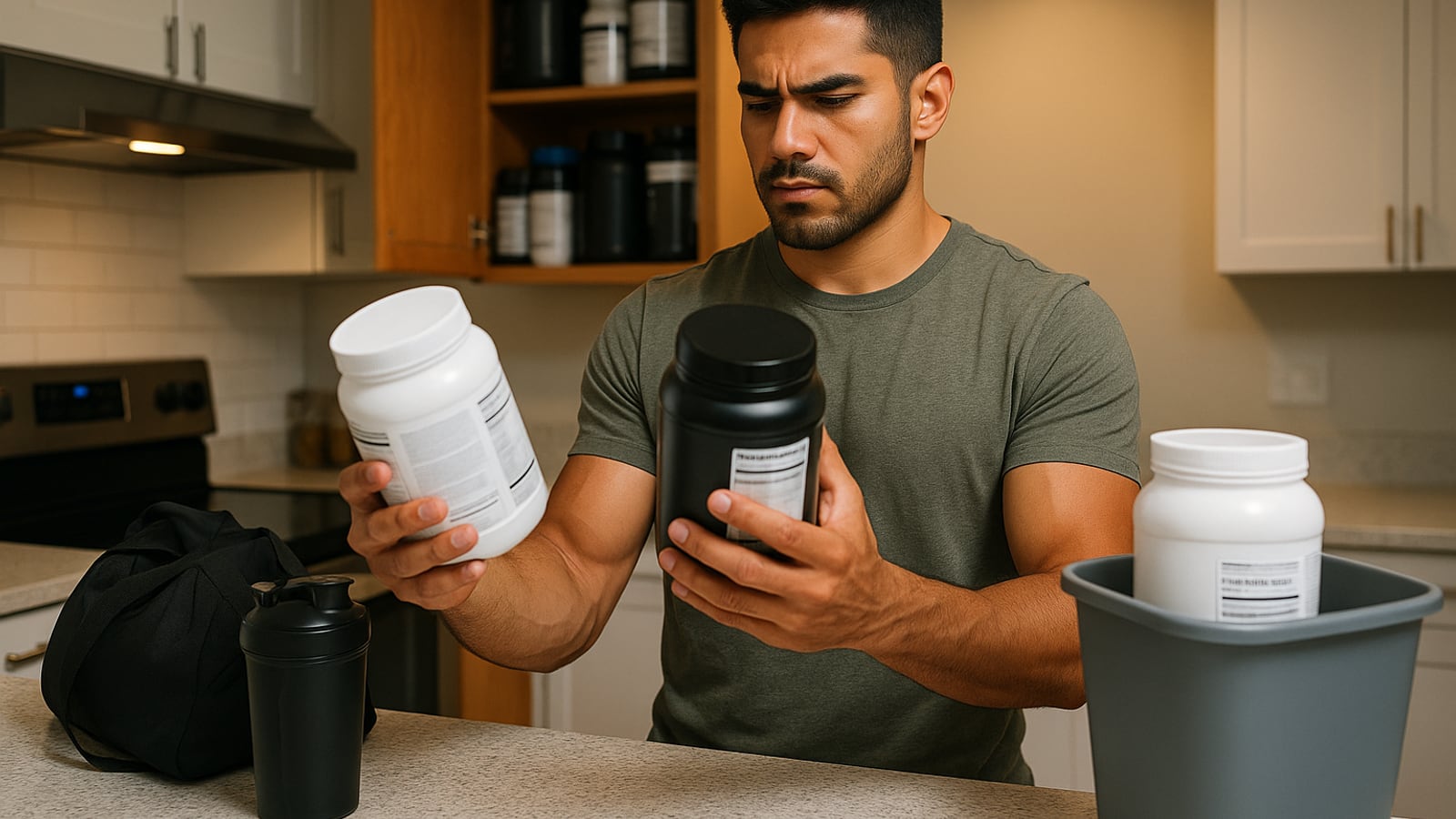
You can spend $80 a month on the supplement wall and not change a single rep. I've watched blokes do it for years. The tub sits on the kitchen counter, half full, going hard and clumpy, until it gets binned during a cupboard clear-out and replaced with something in a better color.
The short version: about four things are worth your money, most of the rest is expensive flavouring, and the label will tell you which is which if you know the two lines to read.
The pattern to look for
The hardest-sold products share a shape. They target a problem you can't measure at home, they promise a result that takes months to disprove, and they come in a category where nobody expects an instant effect.
You can't feel your testosterone. You can't feel "cellular recovery". You can't feel your immune system. So if the product does nothing at all, you'll never catch it. Compare that to caffeine, which either works in twenty minutes or doesn't, and which costs about thirty pence a serving as coffee.
The second tell is the ingredient count. A supplement with one active ingredient at a full dose is making a falsifiable claim. A supplement with nineteen ingredients is making none. Nineteen ingredients at a meaningful dose each wouldn't fit in a scoop.
BCAAs
Branched-chain amino acids were sold for a decade as the thing that stops muscle breakdown during training. The awkward bit: they're already in every complete protein you eat. Whey is loaded with them. Chicken, eggs, milk, beef, all of it.
If you're hitting a sensible protein target across the day, you're taking BCAAs already, and you're taking them with the other amino acids your body needs to actually build something. Adding a scoop of three of them to water is buying a slice of the pizza separately.
The exception people raise is fasted training. If that's you, a bit of whey or a glass of milk does the same job and costs less.
Testosterone boosters
This category is enormous and the evidence isn't. Tribulus, D-aspartic acid, fenugreek, various root extracts with impressive packaging and a silhouette of a man on the front.
Think about it from the other end. A compound that reliably and meaningfully raised testosterone in healthy men would be a controlled medicine, prescribed by a doctor, with monitoring and a blood test. It wouldn't be next to the protein bars.
What genuinely affects your levels is dull. Sleep. Body fat. Alcohol. Training. If you actually suspect something's wrong, that's a GP conversation and a blood test, not a purchase.
Fat burners
Read the panel and you'll usually find caffeine doing all the visible work, surrounded by green tea extract, a pepper derivative and something with "thermo" in the name.
The caffeine is real. The dose is often the equivalent of three or four coffees, which is why people report feeling like something's happening. Whether that translates into fat loss you'd notice at the end of twelve weeks is a different question, and the honest answer is that it's small next to what you eat.
If you're paying for a fat burner and also drinking coffee, you're double-dosing a stimulant without meaning to. Watch that around 3pm if you want to sleep.
Proprietary blends
This is the line that should stop you at the shelf. "Proprietary blend, 6,400mg" followed by a list of twelve ingredients in no stated amount.
Legally, ingredients in a blend are listed by descending weight. That's all you know. The blend could be 6,300mg of the cheapest filler and a dusting of everything else. Companies don't hide doses that flatter them.
Put the tub down. Buy the version that prints a number next to each ingredient.
Glutamine, mass gainers and greens
Glutamine has genuine clinical uses in hospital settings. For a healthy adult who lifts twice a week and eats normally, it's been sold far beyond what it does.
Mass gainers are usually maltodextrin and sugar at four times the price of the same calories from oats, whole milk and peanut butter. I'll concede the one case where they earn their keep: if you're on shifts, appetite is gone, and drinking 800 calories is the only way they're going in, buy the tub. Just know you're buying convenience, not magic.
Greens powders are the polite one. They're not a health risk and some people like them. They're not a substitute for vegetables, they don't contain the fiber, and a bag of frozen spinach costs about a pound.
What's actually worth buying
Creatine monohydrate. The most studied supplement in sport, and the cheapest thing on this list. Plain monohydrate powder, unflavoured. The standard labelled dose is 3 to 5g a day, taken whenever suits you. Ignore the fancier forms with better marketing and worse value. If you have kidney problems or take regular medication, ask your GP or pharmacist first.
Protein powder. Not a supplement so much as a convenience food. It's useful when you've got twelve minutes between the school run and a meeting. It isn't better than chicken, it's just faster.
Caffeine. Works, cheap, and you already know your own tolerance. Keep it off the back end of the day.
Vitamin D, if you need it. Plenty of people in northern latitudes are low over winter. The word doing the work there's "if". Get it tested through your GP rather than guessing, and let them tell you the dose.
That's the list. Four items, and one of them is coffee.
Two lines on the label
First, servings per container against scoop size. A tub advertising sixty servings at two scoops each gives you thirty actual uses, and the price per use doubles quietly.
Second, third-party testing. Supplements are regulated as food, not as medicine, which means nobody checks the contents before it reaches the shelf. Programs like Informed Sport and NSF Certified for Sport batch-test products. If you're a serving member, a tested athlete, or anyone who'd face consequences for a positive result, buy only from a tested batch. Contamination happens and "I didn't know" isn't a defense.
The part nobody wants
Supplements are attractive because they're a purchase, and a purchase is a decision you can make tonight at 21:40 with a card in your hand.
Sleep isn't a purchase. Two sessions a week for the next three years isn't a purchase. Protein at breakfast instead of at 9pm isn't a purchase. All three beat everything on that wall combined, and none of them come in a tub with a man's face on it.
Take the $60 you'd have spent on the fancy stack. Buy creatine for the year, a decent protein you'll actually drink, and put the change towards a blackout blind for the room where you're trying to sleep.
Marcus Vale
Editor-in-Chief
Twenty years in magazines, most of it deciding what to cut. Writes about work, discipline and the decisions that compound.

Watch
Worth an hour of your evening
More from Fitness.
From channels we rate. Plays on YouTube.
Read next