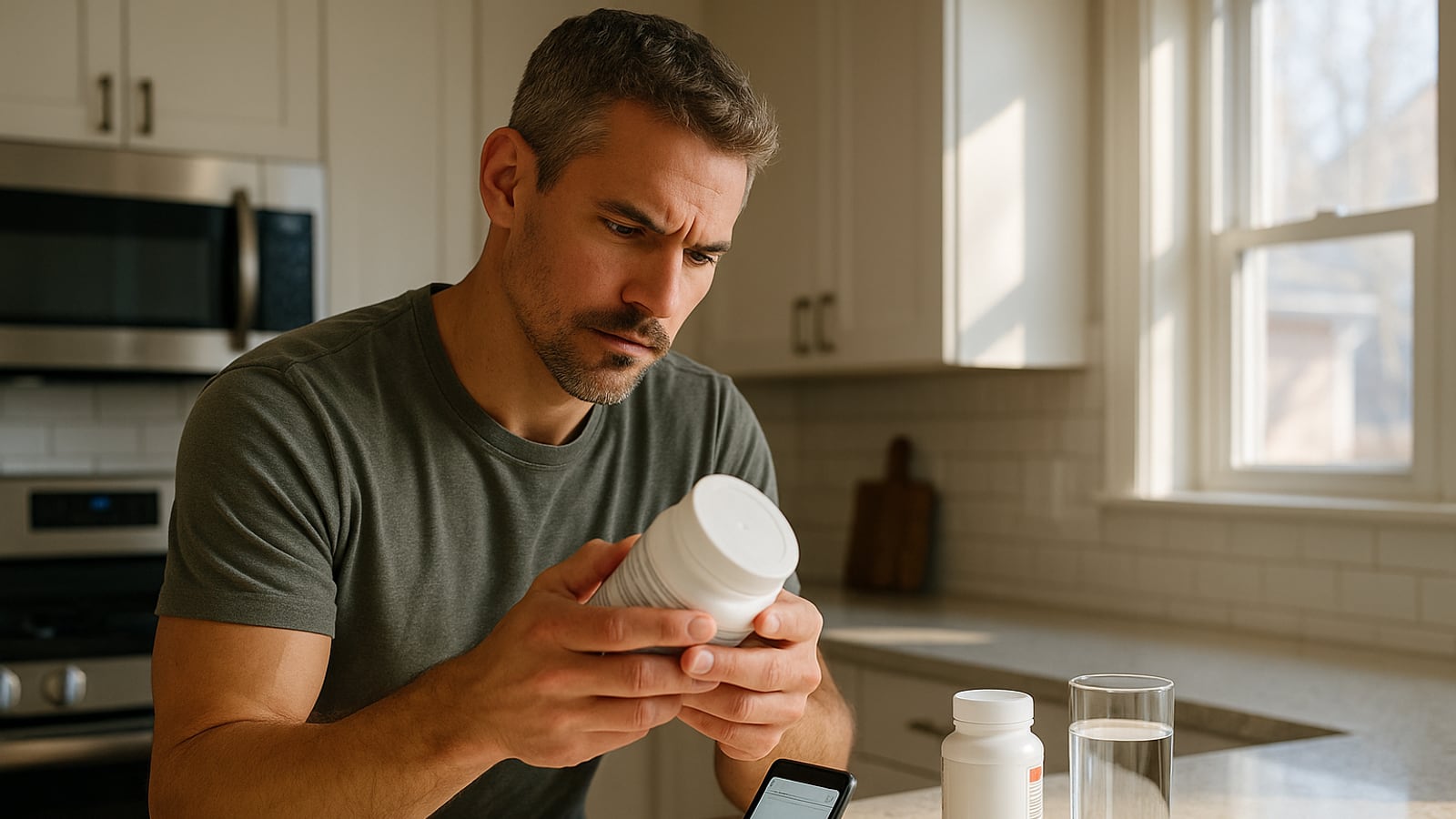
Flip the tub over, find the batch or lot number, and type it into the certifier's own database. That's the whole trick. The logo printed on the front is a claim. The entry in the database is the evidence. If you can't find the batch, you've learned something useful in under two minutes.
The reason this matters comes down to a law passed in 1994. Under the Dietary Supplement Health and Education Act, supplements in the US don't need approval before they go on sale. The FDA can act after the fact, once something's already in cupboards. That's not a conspiracy, it's just how the category is regulated. It means the burden of checking sits with the manufacturer, and the only way you find out whether they took it seriously is if somebody independent looked.
The four marks that carry weight
NSF Certified for Sport. The strongest mark in common circulation. It covers batch-level testing for substances banned by the major sports bodies, label accuracy, contaminant screening, and audits of the facility where the stuff is actually made. NSF publishes a searchable list of certified products and runs an app for it. If you're drug tested for work or sport, this is the default.
Informed Sport. Run by LGC, a UK lab. Every certified batch is tested before release and the batch numbers are published online. Note the sister program, Informed Choice, isn't the same thing. Informed Choice pulls samples off the shelf periodically rather than clearing every batch. It's better than nothing. It isn't batch assurance.
USP Verified. The US Pharmacopeia mark leans toward vitamins, minerals and single nutrients rather than sports products. It checks that what's on the label is in the bottle at the stated strength, that the tablet dissolves, and that contaminants are within limits. If you buy a daily multivitamin or a magnesium your wife also takes, this is the mark to look for.
BSCG Certified Drug Free. Smaller program, similar purpose to NSF's, screening against a wide banned-substance panel. Less common on shelves, entirely legitimate when you see it.
One more, narrow but worth knowing: IFOS for fish oil. It tests oxidation as well as contaminants. Rancid fish oil is the most common quality failure in that category and you can't reliably taste it through a capsule coating.
The phrases that mean nothing at all
"Lab tested." By whom? Their own lab, on one batch, three years ago, counts.
"Manufactured in a GMP-certified facility." Good manufacturing practice is a baseline requirement, not an achievement, and the phrase describes the building rather than the product in your hand. A certified facility can still put out a badly formulated product.
"Third-party tested" with no third party named. If the lab isn't named and the result isn't findable, treat the words as decoration.
"Clinically studied ingredients." The ingredient may have been studied. Usually at a dose several times higher than what's in the blend. This phrase is doing an enormous amount of work in the weight-loss and "energy" aisles.
Proprietary blend. Total weight only, no individual doses. There's exactly one reason a formulator hides the split, and it isn't to protect a secret recipe.
Reading a certificate of analysis without being fooled
Plenty of brands will email you a COA if you ask. Most people glance at it and feel reassured. Check four things instead.
- Does the lot number on the COA match the lot number on your tub? A COA for a different batch tells you about a different batch.
- Who signed it? An independent lab has a name and an address. In-house results aren't worthless, but they're marking your own homework.
- Is the lab accredited to ISO/IEC 17025? That's the standard for testing laboratories, and it's normally stated on the document.
- What was actually tested? Identity and potency, heavy metals, microbials, and for sports products a banned-substance panel. A COA showing only heavy metals doesn't tell you the dose is right.
If the document is a PDF with no lot number and no lab letterhead, it's a graphic.
Where to spend the extra money
Certification isn't free and brands pass the cost on. So rank your risk instead of certifying everything.
Highest risk sits with anything sold on how it makes you feel. Pre-workouts, "energy" formulas, testosterone boosters, fat burners, anything with a long botanical ingredient list. These are the categories where unlisted stimulants and designer compounds turn up, and they're the ones most likely to end a career if you're tested. If you're active duty, a police officer, a firefighter, a college athlete or a competitive lifter, buy certified in this category or don't buy at all.
Middle risk: melatonin and other sleep products, herbal extracts, anything in gummy form. Gummies are genuinely hard to dose evenly, and melatonin is measured in milligrams, so a small absolute error is a large relative one. If you've got one bottle sitting in a kitchen drawer that the kids can reach, make it that one you check.
Lowest risk: plain creatine monohydrate and plain whey from a large manufacturer. Single-ingredient, high-volume products made by companies with a lot to lose. Creatine has a useful shortcut too. Creapure is a branded monohydrate from a single German producer, and products carrying the mark trace back to that supply. It's not a substitute for batch certification, but it tells you where the powder came from.
The honest trade-offs
Certified products cost more and the range is narrower. You'll lose a flavor you like. Some small, careful brands simply can't afford the program fees, so the absence of a mark isn't proof of anything bad. And a certification tells you what's in the tub, not whether the contents do anything. NSF will happily certify a product built around an ingredient with no meaningful evidence behind it. Accurate isn't the same as effective.
I don't buy everything certified. Creatine, no. Whey, usually not, because I buy the same brand my gym has sold for years. Anything that promises a feeling, always. That's the line I'd suggest, and it's a judgment call rather than a rule.
The other thing worth saying plainly: none of this addresses whether a supplement interacts with a medication you're already taking. Certification doesn't touch that question. Your pharmacist will answer it in five minutes at the counter and won't charge you.
Go and open the cupboard tonight. Pick three tubs, find three lot numbers, and search them. If two of the three come back with nothing, you now know which brands were counting on you never looking.
Marcus Vale
Editor-in-Chief
Twenty years in magazines, most of it deciding what to cut. Writes about work, discipline and the decisions that compound.

Watch
Worth an hour of your evening
More from Fitness.
From channels we rate. Plays on YouTube.
Read next