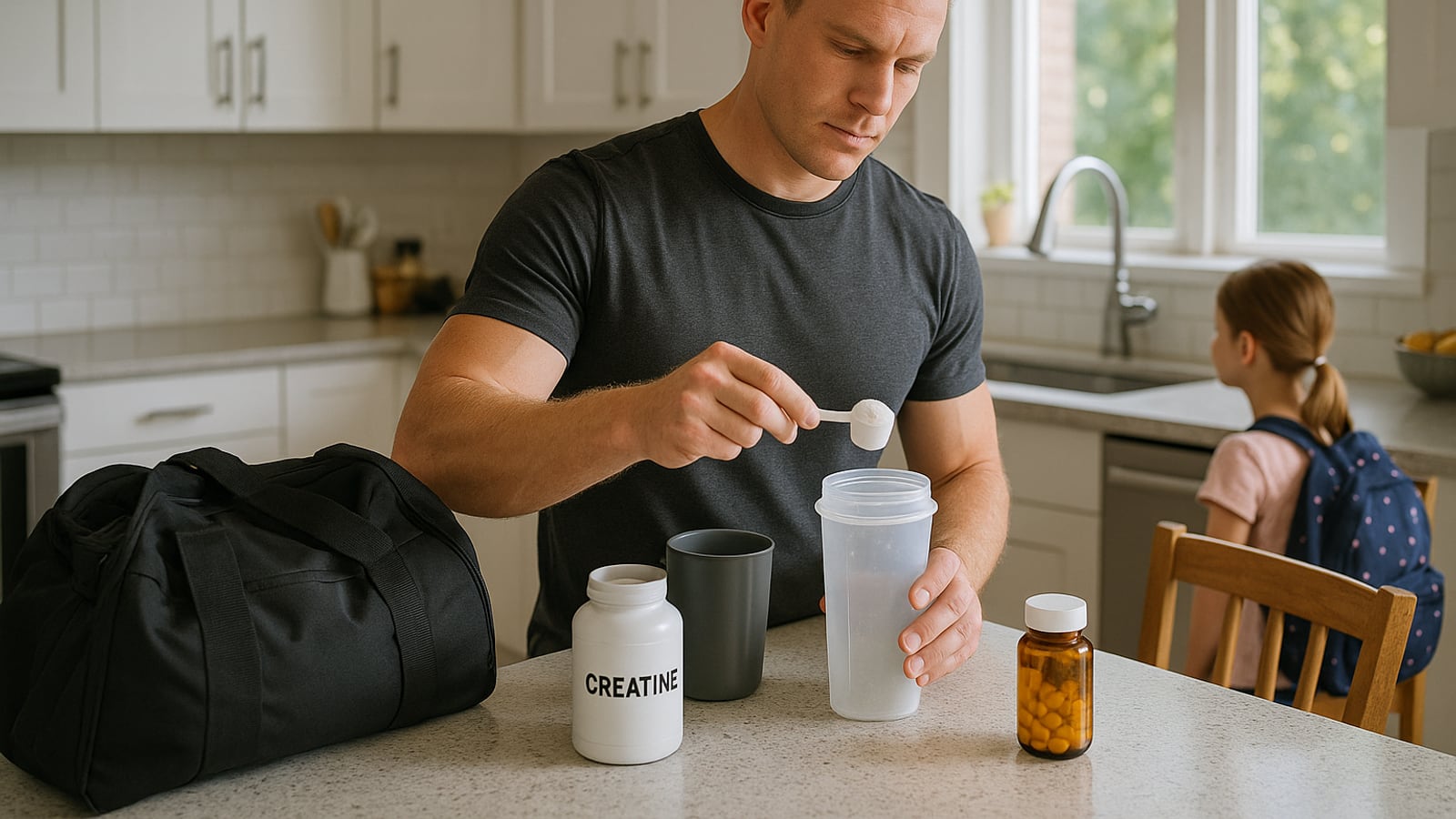
If you want the whole answer in one line: creatine, caffeine, protein powder, and vitamin D if a blood test says yours is low. That's the list that earns its shelf space for most working parents who train two or three times a week.
Everything else is either situational, unproven, or marketing with a tub around it.
I'm not a doctor and this isn't medical advice. If you take prescription medication, have a kidney or liver condition, or you're pregnant or breastfeeding, talk to your doctor or pharmacist before adding anything. Pharmacists are underused for exactly this and they'll usually answer in five minutes for free.
Tier one: buy it, use it, stop thinking about it
Creatine monohydrate. More studied than anything else in the category, and still the cheapest thing in most shops. It helps with strength and repeated hard efforts, and there's a growing body of work on cognition and fatigue that's interesting without being settled.
Three to five grams a day. Any time of day. With food or without. You don't need to load, you don't need the expensive "HCL" or "buffered" versions, and you don't need to cycle off. Plain monohydrate powder in a tub. If the label lists anything other than creatine monohydrate, you're paying for flavouring.
The weight gain people panic about is water inside the muscle. It's not fat and it's not bloating in any meaningful sense.
Caffeine. The most reliable performance aid available without a prescription. It makes hard training feel less hard, which matters enormously when you're lifting at six in the morning after a night of broken sleep.
Coffee counts. So do tablets, which are easier to dose precisely. Research commonly uses somewhere around three to six milligrams per kilogram of bodyweight, though plenty of people get what they need from far less.
The rule that actually protects you: nothing after early afternoon. Caffeine has a long half-life, and the dose that gets you through a 3pm meeting is still in your system when you're trying to fall asleep. Trading sleep for training energy is a losing trade every single time.
Protein powder is food, not a supplement
Whey, casein, or a pea and rice blend if dairy doesn't sit well with you. It's not magic. It's a convenient, cheap, shelf-stable way to hit a protein target you'd otherwise miss because your day got away from you.
A common target for people training regularly is somewhere around 1.6 grams per kilogram of bodyweight per day. Most men hitting the gym after work are nowhere near that, and it's almost always breakfast and lunch that are the problem, not dinner.
Two scoops in milk closes the gap in about ninety seconds. That's the entire value proposition.
Buy on price per serving and taste. Fancy isolates matter if you're lean and cutting hard. For most people, concentrate is fine.
Vitamin D, but only if you actually test
This one comes with a condition attached. Vitamin D is worth supplementing if you're deficient, and plenty of people who work indoors in northern climates are. It's not worth taking in large doses on a hunch, and it's fat-soluble, so you can overdo it in a way you can't with vitamin C.
Ask your doctor for a blood test. If you're low, they'll tell you what to take and for how long, and they'll recheck. If you're fine, you've saved yourself a standing order and a shelf full of tubs.
Same logic applies to iron and B12. Test, don't guess. Supplementing iron when you don't need it's genuinely bad for you.
Tier two: defensible, situational, not essential
Omega-3 (EPA and DHA). Reasonable evidence for general health, weaker and messier evidence for anything training-specific. If you eat oily fish twice a week you probably don't need it. If you never eat fish, a fish oil or algae-based capsule is a sensible thing to take. Check the label for the actual EPA and DHA amounts rather than the total oil weight — the difference is often large.
Magnesium. Popular for sleep and cramps. The evidence is thinner than the internet suggests, and most of the benefit shows up in people who were short to begin with. It's cheap and low-risk, so if you try it and sleep better, keep going. Glycinate or citrate forms are gentler on the stomach than oxide.
Beta-alanine. Real effect, narrow application. It helps with efforts in roughly the one-to-four-minute range — hard intervals, high-rep sets, rowing pieces. Useless for heavy triples. Causes a harmless skin tingle that alarms first-time users. Typical use is three to six grams daily, split up, and it takes weeks to build up.
Beetroot or nitrate products. Decent evidence for endurance. Irrelevant if your training is three compound lifts twice a week.
The stuff you can walk past
- BCAAs and EAAs. If you're eating enough protein, you've already got them. Expensive flavoured water.
- Testosterone boosters. If your testosterone is genuinely low, that's a medical conversation with a doctor and a blood panel, not a tub with a silhouette on it.
- Fat burners. Caffeine plus a stimulant blend plus a large markup. Some are genuinely risky.
- Glutamine. Well studied, consistently unimpressive for healthy people.
- Greens powders. Not harmful, not vegetables. They're mostly a tax on guilt.
- Most multivitamins. Fine as insurance if your diet is a mess. They don't fix a mess.
How to buy without getting burned
Supplements aren't regulated like medicines. What's on the label isn't guaranteed to be what's in the tub.
Look for third-party testing. NSF Certified for Sport and Informed Sport are the two programs that actually mean something, and they're worth insisting on if you're drug-tested for work or competition, or if you're a police officer, a serviceman, or anyone else who can't afford a contaminated batch.
Beyond that: fewer ingredients is better. Anything sold as a "proprietary blend" is hiding the doses, and it's hiding them because they're too small to work.
What this actually looks like on a Tuesday
Coffee at six. Creatine goes in whatever you're already drinking, because you'll forget it otherwise. Protein shake mid-morning if breakfast was a slice of toast eaten standing up. Vitamin D with dinner in the winter months, if your doctor said so.
That's it. Four things, no ritual, no shelf, no tracking app.
The failure mode I see most often in men in their thirties and forties isn't taking the wrong supplement. It's buying supplements as a substitute for the boring work — eating enough, lifting twice a week for years instead of six weeks, and being in bed before eleven.
A tub of creatine costs less than a takeaway. Going to bed on time costs nothing at all, and it'll do more for you than everything on this list combined.
Marcus Vale
Editor-in-Chief
Twenty years in magazines, most of it deciding what to cut. Writes about work, discipline and the decisions that compound.

Watch
Worth an hour of your evening
More from Fitness.
From channels we rate. Plays on YouTube.
Read next