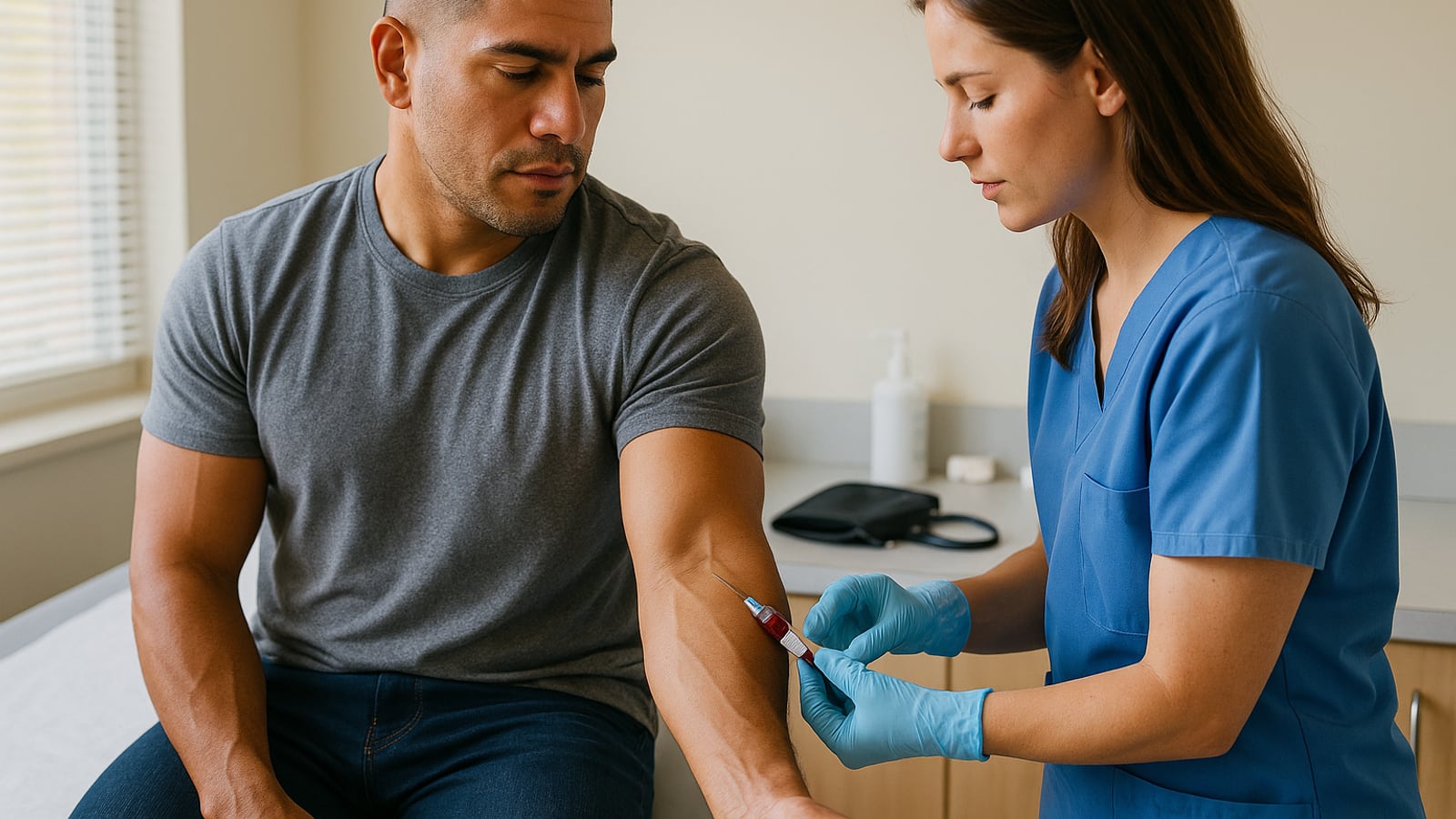
Book the draw, then book the next one six months out. That's the whole trick. A single blood panel is a dot on a graph. Two dots make a line, and the line is what tells you something. Most people get one panel, see one value flagged in bold, spend a week worrying about it, and never repeat the test. That's the worst of both worlds — the cost and the anxiety, none of the information.
If you're forty, you've got kids, you sleep less than you'd like and you train around a work schedule, a blood panel is the cheapest useful data you'll ever get about your own body. Better than a sleep score. Better than a readiness ring. It's just less fun to look at.
So learn what's on it.
The three panels you almost certainly already get
A routine physical usually pulls three things. Ask for the printout, not the phone call that says "everything's normal."
Complete blood count (CBC). Red cells, white cells, platelets, hemoglobin, hematocrit. This is the panel that catches anemia, some infections, and a handful of things you'd rather catch early. If you're dragging through workouts and your hemoglobin has drifted down over a couple of years, that's worth a conversation.
Comprehensive metabolic panel (CMP). Glucose, electrolytes like sodium and potassium, kidney markers (creatinine, BUN, eGFR) and liver enzymes (ALT, AST, ALP). It's a broad sweep of whether your plumbing is working.
Lipid panel. Total cholesterol, LDL, HDL, triglycerides. The heart disease conversation lives here.
Those three cover a lot. They also miss several things that matter enormously to how you feel day to day, and nobody will run them unless you ask.
The add-ons worth asking for
Write these down before the appointment. A physician is far more likely to order something you've named than something you've gestured at.
- HbA1c. A rolling average of your blood sugar over roughly the past three months, rather than the single fasting snapshot a CMP gives you. It's the better number for spotting metabolic trouble building slowly, and the one that tends to move when your diet and training actually change.
- Ferritin and a full iron panel. Ferritin is stored iron. You can have a normal hemoglobin and still be running on empty stores, which shows up as fatigue, poor recovery and a training ceiling you can't explain. This matters especially for women, and for anyone who's given blood regularly or eats little red meat.
- Vitamin D. Common to be low if you work indoors and live somewhere with real winters.
- B12. Worth checking if you've cut back on animal products, or if you've been on certain long-term medications. Ask your doctor whether yours is one.
- TSH, and free T4 if TSH is off. Thyroid function. Low-grade thyroid issues produce exactly the symptoms a tired parent writes off as normal life: cold, flat, gaining weight, sleeping badly.
- ApoB, if your doctor is willing. It counts the number of cholesterol-carrying particles rather than the cholesterol inside them, and a lot of cardiologists now consider it the more useful marker. Not every practice orders it routinely. Ask.
Testosterone, handled properly
If you're a man in your forties with persistent low energy, low mood, poor recovery and a genuinely changed sex drive, testosterone is a fair question to raise with your physician. Two rules make the test mean anything.
First, timing. Draw it in the morning, fasted, because levels move through the day. Second, repeat it. A single low reading proves very little. A doctor investigating this properly will retest and will also look at LH, FSH and SHBG to work out why, not just whether.
Take that conversation to your family physician or an endocrinologist. Not to a website that sells the treatment it's diagnosing you for. A clinic whose business model depends on the answer being yes isn't the right place to ask the question.
How to make the numbers mean something
Half the "abnormal" results people panic about are artifacts of how the blood was drawn.
Fast if you're told to — usually eight to twelve hours, water only. Hydrate the morning of, because a dehydrated sample can skew several values. Go in the morning, and go at roughly the same time each round so you're comparing like with like.
And don't train hard the day before. A heavy leg session or a long run can send creatine kinase, ALT and AST up and make your liver panel look alarming when all you did was squat. Creatinine can read higher in people carrying a lot of muscle, too, which occasionally sends a perfectly healthy lifter down a kidney-scare rabbit hole. Mention your training to whoever reads the results. It changes the interpretation.
Use the same lab each time if you can. Reference ranges differ between labs, and so do the assays. Your own trend line is more informative than where you sit inside a population range.
Reading your own results without losing the plot
Every lab prints a reference range beside each number. That range is where most people in a broad population fall. It isn't a target, it isn't personalized, and sitting just outside it on one value isn't a diagnosis.
Three questions are worth asking about any flagged result:
- Has it moved, and in which direction, compared with last time?
- Is it slightly out, or dramatically out?
- Does it match how I actually feel?
A ferritin at the very bottom of the range in a woman who's exhausted is a more interesting finding than a single liver enzyme one point over the line in a man who deadlifted on Tuesday.
Then stop diagnosing yourself. Take the printout to your doctor with your three questions written on it. Fifteen minutes with someone who trained for a decade beats four hours of reading forums, and it's the only route to anything that's actually about you rather than about people in general.
What not to do with the results
Don't start a supplement for a number you haven't confirmed is low. Vitamin D and iron are both things you can genuinely overdo, and iron in particular isn't a casual self-prescription.
Don't chase one marker in isolation. Bodies aren't dashboards. Raising or lowering a single value while everything driving it stays the same rarely does much.
And don't let the panel replace the obvious. If you're sleeping six hours, drinking most evenings, eating lunch at your desk and training twice a month, the blood panel will tell you exactly that, at a cost, in a way you already knew for free. The numbers are most useful when the basics are already handled — then they catch the thing the basics can't explain.
Keep a folder. Paper or a scanned PDF, doesn't matter. Every panel, dated, in one place. In ten years that folder is worth more than any single test you'll ever have, and it takes you four seconds a year to maintain.
Your kids have a full record of their height, their vaccinations and their teeth. You've got nothing. Start the file.
Cal Brennan
Fitness
Strength coach. Trains fathers, tradesmen and desk workers, which means programmes that survive a bad week.

Watch
Worth an hour of your evening
More from Fitness.
From channels we rate. Plays on YouTube.
Read next