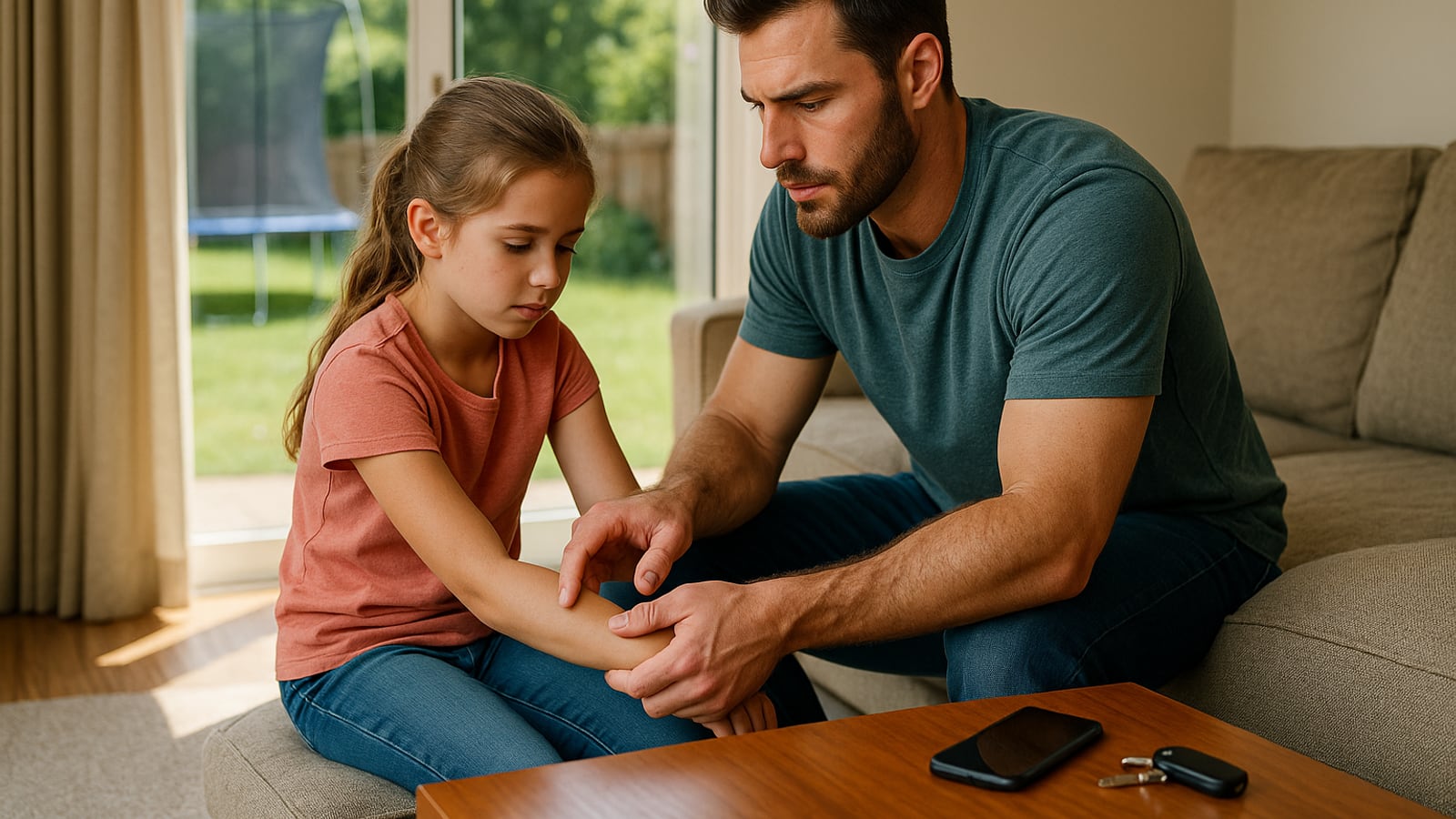
Saturday, 7:10 p.m. Your eight-year-old came off the trampoline wrong and her forearm has a bend in it that forearms don't have. You've got a car, a phone, and about forty seconds before everybody in the house decides you're panicking. Pick the door.
That's the skill. Not diagnosis. Door selection. Most of us are decent at knowing something's wrong and terrible at knowing where to take it, so we default to whatever's closest or whatever's cheapest, and both defaults get people hurt in different ways.
None of what follows is medical advice for your specific situation. It's a way to think, plus the stuff nobody tells you until you're standing at a check-in kiosk at 9 p.m. wondering why the wait says three hours.
Three questions, in this order
One: is time the problem? Some conditions get permanently worse by the hour. Blocked blood flow to the heart or brain, a swelling airway, bleeding that won't stop, a testicle or an eye that suddenly hurts a lot. With those, the cost of waiting isn't discomfort. It's tissue you don't get back.
Two: can the fix happen in a clinic? X-ray, stitches, a splint, a strep swab, a urine dip, a breathing treatment, draining an abscess, antibiotics for a hot red patch of skin spreading up a shin. Urgent care handles this category all day long and does it faster and for less money than a hospital.
Three: if neither, what breaks by Monday? Usually nothing. A rash that isn't spreading. A cough on day three. A knee that hurts but holds your weight. Monday morning with your own doctor beats a stranger with no chart, every time.
If question one is yes, stop reading and go. Call 911 rather than driving when the answer involves the chest, the brain or breathing, because the ambulance starts treatment in your driveway and the ER knows you're coming.
The 911 list, memorized
Chest pressure, tightness or pain that won't quit, especially with sweating, nausea, or pain moving into the jaw, neck or an arm. Sudden trouble breathing. Face droop, arm weakness or garbled speech that came out of nowhere. The worst headache of someone's life, arriving all at once. A seizure in somebody who doesn't have seizures. Confusion you can't explain. Bleeding that soaks through pressure. Any real fall from height, any car wreck with speed in it, any head injury that knocked someone out.
For stroke and heart attack, don't negotiate with yourself. The classic mistake is the forty minutes spent deciding whether it's heartburn. That forty minutes is the whole ballgame.
Poison or a wrong dose of something? The national Poison Control line is 1-800-222-1222, it's staffed around the clock, and it's free. Call before you drive. They'll tell you whether this is a watch-at-home situation or an ER situation, and they're right far more often than the internet.
What urgent care is actually good at
Cuts that need closing. Sprains and probable simple fractures. Ear infections, sore throats, pink eye, sinus misery on day ten. Urinary symptoms. Mild asthma flares. Poison ivy that's gone from annoying to ridiculous. Tick removal and the conversation that follows. Shallow burns on a small patch of skin.
Call first, or check the website, and ask one question: do you have X-ray on site today? Plenty of urgent cares do. Plenty don't, or the tech leaves at 6. If you show up with a wrist injury at a clinic with no imaging, you've spent an hour to be told to go somewhere else.
Two other things worth asking. Can they splint a fracture, or do they only refer? And do they see kids under two? Some don't.
What urgent care can't do, and this is the part people learn the hard way
No admission. If your problem turns out to need a hospital bed, urgent care becomes a very slow waiting room with a transfer at the end.
Usually no CT scan. That matters for head injuries, bad belly pain, suspected kidney stones and anything where somebody says the word "rule out."
No surgery, no reduction of a badly displaced fracture or a dislocated shoulder in most places, no IV fluids in many, no blood work beyond a small panel, and limited ability to watch you for a few hours to see which way you drift. Observation is an underrated ER service. Sometimes the answer is genuinely "we don't know yet, sit here."
Belly pain in the lower right side that's getting worse, with fever or vomiting, is an ER problem. So is a fever in an infant under about three months, which is an ER problem even if the baby looks fine. So is a diabetic with vomiting who can't keep fluids down. So is anybody on a blood thinner who hits their head, no matter how minor it looked.
The Monday list
Fatigue. A mole you noticed last month. Back pain without leg weakness or bladder trouble. A lump that's been there a while. Refills. Knee or shoulder pain that's been building for weeks. Congestion on day four. Most rashes. Blood pressure you saw on a drugstore cuff and didn't like.
Your own doctor has your history, your medication list, and the ability to order the test that actually answers the question instead of the test available at 11 p.m. A walk-in clinic treats the episode. Your doctor treats you.
Use the middle path more. Most insurance plans include a 24-hour nurse line, and a lot of practices have same-day telehealth slots or a portal message that gets answered before lunch. A three-minute call at 8 p.m. has saved a lot of people a four-hour night.
The wallet part, told straight
An ER visit costs dramatically more than the same care at urgent care. That's not a scandal, it's what a building with a trauma bay and a surgeon on call costs to keep open.
One trap: freestanding emergency rooms with bright signs and short waits look exactly like urgent care from the parking lot and bill like a hospital. Read the sign. If it says "emergency," it's an ER. Pull up your insurer's app and find the two or three in-network urgent cares nearest your house before you need them, then screenshot the list.
And here's the concession, because it's an important one. If you're standing there genuinely unsure whether it's the heart, the brain or the airway, go to the ER and eat the bill. Being wrong about a panic attack costs money. Being wrong about a heart attack costs more than money. Nobody in an emergency department thinks less of you for showing up and being fine. That's the job.
Make the decision easier before you need it
Keep a photo of both sides of each insurance card in your phone, in a shared album your wife or husband can reach too.
Keep a note with names and doses of every medication in the house, including the supplements, plus allergies and past surgeries. That note saves fifteen minutes and prevents real mistakes.
Write down the nearest in-network urgent care, whether it has X-ray, its actual closing time, and the nurse line number. Tape it inside a cabinet door. The 7 p.m. version of you isn't a good researcher.
Your kid off the trampoline, by the way: if the arm has an obvious deformity, that's the ER, because getting it set properly is a hospital skill. If it's swollen and sore but straight and she'll wiggle her fingers, urgent care with an X-ray machine is the better bet.
Pick the door in forty seconds. Then drive like a person who isn't in the movie.
Cal Brennan
Fitness
Strength coach. Trains fathers, tradesmen and desk workers, which means programmes that survive a bad week.

Watch
Worth an hour of your evening
More from Fitness.
From channels we rate. Plays on YouTube.
Read next