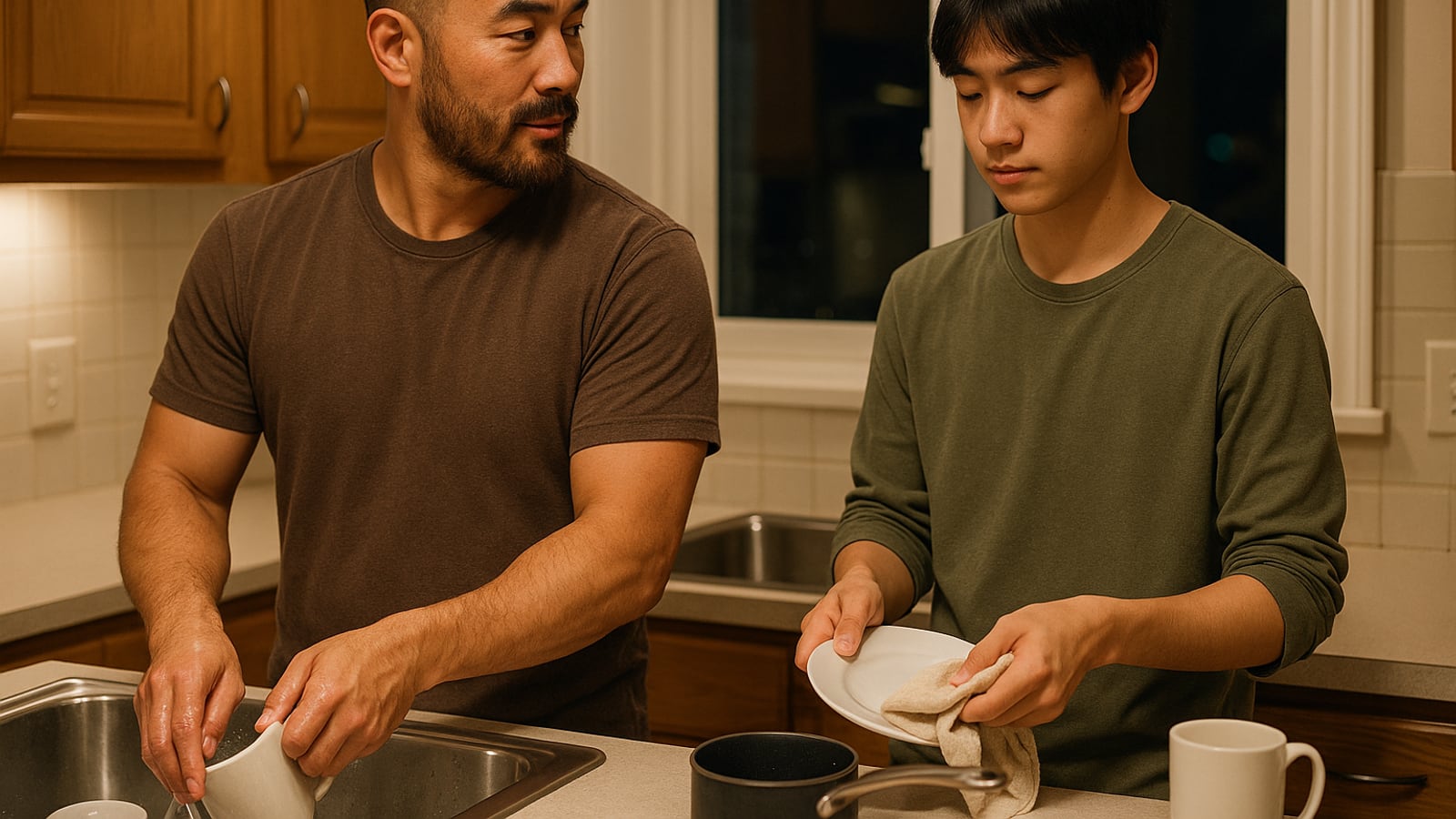
The dinner table is the worst place to get a teenager talking. Face to face, everybody listening, a direct question, an audience for the answer. You've built an interview. Then you're surprised you're getting interview answers.
Move instead. Get in a car. Stand at the sink with them. Walk the dog. Drive them somewhere twenty minutes away and don't put the radio on. Almost every real conversation I've had with a teenager happened shoulder to shoulder with something else going on, and almost none of them happened when I sat down opposite and said we needed to talk.
That's the mechanical fix. The rest of it is harder, and slower, and worth doing properly.
First, work out which silence you've got
Most teenage silence is normal. They're building a self that isn't yours, and the first step is closing the door so you can't watch the construction. It's annoying. It's also supposed to happen.
Some silence isn't that. Watch for withdrawal that isn't aimed only at you — friends dropping away, a sport or an instrument abandoned with no replacement, sleep going strange in either direction, appetite changing, grades falling off a cliff rather than sliding. Watch for giving things away. Watch for any language about being a burden, or about people being better off.
If you're seeing those, you don't have a communication problem. Ring your family doctor this week, or the school counsellor, or both. Say the words out loud to your kid: I've noticed, I'm worried, we're going to get you somebody to talk to who isn't me. Don't research it for a fortnight first.
Everything below is for the ordinary kind of quiet.
Side by side beats face to face
Hands busy, eyes forward. That's the format.
Washing up. Splitting wood. The drive to practice and the drive back, which are different conversations. Passing tools under a car. Waiting in a queue. The common thread is that they can stop talking any time without it being an event, and they can look at something other than your face while they say the hard bit.
The car is the best room in the house. No exit, no eye contact, a natural end point. If your kid has stopped talking, start driving them places you used to make them get to themselves.
They talk on their schedule, and it's late
Teenagers open up at about half ten at night, in the kitchen, when they came down for cereal and you happened to be there.
So be there. Not every night. Two or three nights a week, stay up past the point where you want to, with a book and no agenda, in the room they pass through. Don't pounce when they appear. Don't ask where they've been. Say something about nothing and let them decide.
The cost of this is sleep, and the sleep is worth it. The window doesn't open on your timetable and it doesn't stay open long.
Your face on the first hard thing decides everything
This is the whole game.
The first time they tell you something real — a friend in trouble, something they did, something that was done to them, something they're frightened of — your reaction sets whether there's ever a second time. Not your words. Your face, in the first second and a half.
So go flat. Not cold, flat. "Right. Thanks for telling me." Then a question that shows you're still in the room rather than already sentencing: "How long's that been going on?"
Don't make policy in the moment. You can take the phone off them on Tuesday. If you take it off them thirty seconds after a confession, you've priced honesty and they'll never pay it again. Say you need to think. Then actually think, and come back when you said you would.
And don't repeat it at dinner. If you and their mother share everything, fine, but agree in advance that you don't hand it back to them in front of their brother.
Ask about the third thing
"How are you feeling" is a closed door with a handle painted on it.
Ask about somebody else. What's going on with Danny lately. Is the new coach any good or is he all noise. What did people think about the thing that happened at school. Opinion questions, not feeling questions. Teenagers will tell you enormous amounts about themselves while apparently discussing somebody else, and they know that's what they're doing, and the fiction is what makes it possible.
Then shut up. Count to five before you fill the gap. Most fathers I know, myself included, talk over the exact silence the kid was about to use.
Bring your own material
Don't only extract. Deposit.
Tell them about something that went badly at work. A call you got wrong. A person you handled clumsily and how you're going to fix it Monday. Keep it short and don't land it as a parable, because they can smell a lesson from the next room and it'll cost you the whole evening.
What you're demonstrating is that in this house, adults say true things out loud and nothing bad happens. That's a much stronger signal than telling them they can always come to you.
Keep the standards while the door is shut
You don't buy conversation by going soft. A dad who drops the curfew to be liked gets neither the respect nor the talking.
Hold the line. Deliver consequences flat and brief — the sentence, the reason, done, no speech. Then be normal inside the hour. Make them a sandwich. Ask about the match. The consequence is for the behavior and it ends; the relationship doesn't run on the same clock, and your kid learns that by watching you do it, not by being told.
Warmth and firmness aren't a trade-off. They're the same posture.
Text like a man who doesn't need a reply
Short. No question mark. Nothing that demands anything.
A photo of something they'd find funny. "Saw a lad in your shirt at the petrol station, thought of you." A two-word thing about their team. No reply needed and no sulking when none comes.
You're keeping a wire live. That's all. When they do need you at eleven on a Friday night, they'll use the channel that's already warm.
What working actually looks like
Not long talks. Twelve honest seconds in the car, twice a week, for three years.
You're not trying to reopen them by Christmas. You're trying to be the person they ring at twenty-two when something's gone badly wrong, and that person is built now, in small unimpressive deposits, mostly while doing something else.
If you've already blown it — if you shouted at a confession, or repeated something you shouldn't have — apologize once, specifically, and without self-pity. "I overreacted when you told me about the party. That was on me. I'll do better." Then don't ask them to say it's fine. Just go back to being available and let time do the rest.
Stay up. Leave the light on in the kitchen. They come down eventually.
Cal Brennan
Fitness
Strength coach. Trains fathers, tradesmen and desk workers, which means programmes that survive a bad week.

Watch
Worth an hour of your evening
More from Dads.
From channels we rate. Plays on YouTube.
Read next