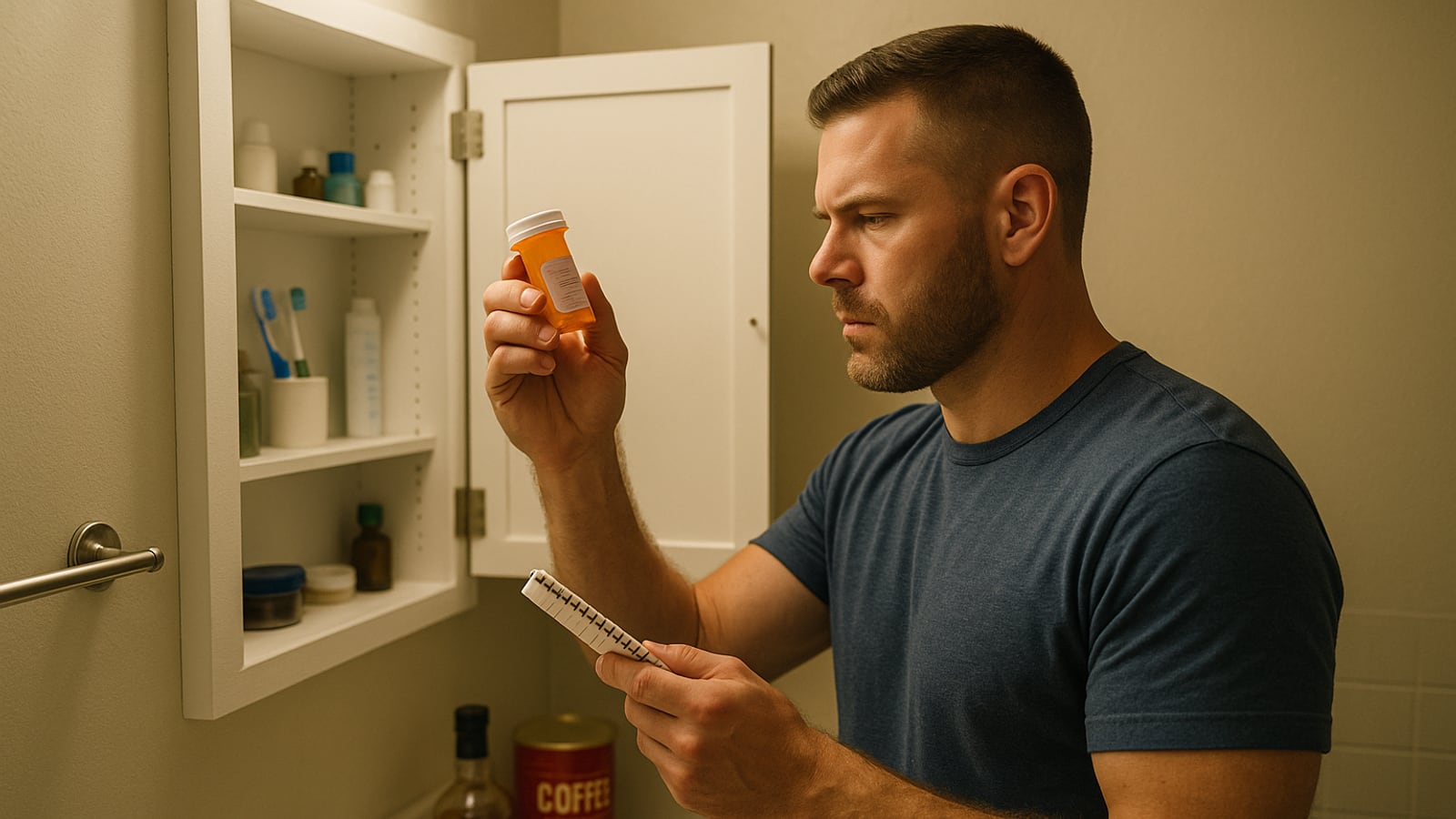
The twenty dollars you keep in the coffee can is a better detector than your nose. So is the count on the bottle of hydrocodone left over from your shoulder surgery, the one sitting in the bathroom cabinet behind the cough syrup. Kids who are experimenting usually get caught by arithmetic long before they get caught by smell, because smell is the one thing they already know how to fix. Body spray fixes smell. Nothing fixes a missing forty bucks.
So start there. Not with a confrontation. With an inventory.
Count what's in your own house tonight
Go look at your medicine cabinet right now and read the labels. Leftover painkillers from a surgery or a dental job. A kid's ADHD prescription. Anything with a benzodiazepine in it. Then look at your liquor, and don't just look at the bottles you drink from, look at the ones you don't. The bottle of rum from a vacation four years ago is the one that gets watered down, because nobody checks it.
Write down what you have. Lock the pills in a cheap combination box, twenty bucks at any hardware store, or take them to a pharmacy take-back. You're not doing this because you suspect your kid. You're doing it because the easiest supply in any teenager's life is the supply in an adult's bathroom, and because knowing your own numbers is what turns a vague worry into a fact you can act on.
While you're at it, know what the hardware looks like now. It isn't a rolled joint in a shoebox. It's a vape pod that looks like a flash drive, a cartridge with amber oil in it, a small pen-shaped thing in the pocket of a hoodie you're about to put in the wash. Eye drops in a backpack where no eye drops belong. Gum, constantly. A burnt spoon is a very late sign and you'll probably never see one.
The signs that actually mean something
One sign on its own means nothing. Teenagers are moody, exhausted, hungry, and weird. That's the job description. What you're looking for is a cluster, and a change from that specific kid's baseline.
The friend group changing fast is the loudest one. Not a new friend. A whole new set, dropped in over a month, with the old ones suddenly not mentioned. Kids don't usually replace their entire social circle unless the old one wouldn't go along with something.
Watch for these together, not alone:
- Sleep flipping hard. Awake until 3 a.m., dead until noon, and defensive about it.
- Money behavior. Asking for cash more, or suddenly having cash and being vague about where it came from.
- Locked-down phone habits that are new. Screen flipped face-down, stepping out of the room to answer, a passcode change.
- Grades sliding in the classes they used to carry, plus a coach or a teacher who says "he's just not himself."
- Smell management. A kid who never cared about cologne now wears it into the kitchen at 11 p.m.
- The mood swings running on a schedule. Great on Tuesday, unreachable every Friday and Saturday night.
And the plain physical stuff: red eyes, pupils that don't match the light in the room, a stumble that isn't a stumble, slurred consonants on the back half of a sentence.
Here's the honest caveat. Every one of these has an innocent explanation. A kid can drop his friend group because one of them got cruel. Grades slide because of a girl, or because Algebra II is hard. You aren't building a legal case. You're deciding whether to have a conversation, and the bar for that should be low.
Don't have it at midnight
If your kid walks in impaired, the conversation isn't happening tonight. Nothing useful is said to a teenager who can't track a sentence, and nothing useful is said by a dad who just got scared. Get water in them, get them in bed on their side, and if anything about their breathing or responsiveness worries you, that's a 911 call, not a parenting moment. Be the guy who overreacts on that one.
Then do it the next day. Mid-morning, not after dinner. Side by side, not across a table. The truck is the best room in the house for this because nobody has to make eye contact and nobody can leave.
Open with a fact, not a question
The single biggest mistake is asking a question you already know the answer to. "Were you drinking last night?" invites a lie, and the second they lie you've got two problems instead of one, and the lie becomes the thing you fight about for a week.
State what you know. Flat, no volume.
"I found a cart in your jacket pocket. I'm not asking whether it's yours. I want to know how long, and what else."
Then stop talking. Count to fifteen in your head. The silence is doing work that your next sentence would undo. Most kids fill it. What comes out first is usually a minimizing version of the truth, and that's fine, take it. You're not getting the full picture today. You're establishing that this house is a place where the subject gets discussed out loud.
Three things need to land in that first conversation, and none of them is a punishment.
One: you're not going anywhere, and this doesn't change who he's to you. Two: your concern is what the stuff does to a developing brain and what it does to his judgment on a Friday night, not that he's embarrassed you. Three: there's a next step, and you'll talk about it tomorrow.
Then actually wait until tomorrow. Splitting the truth-telling from the consequences is the trick almost nobody uses. If confessing and getting sentenced happen in the same twenty minutes, you've taught him that honesty is what triggers the hammer, and he'll never volunteer anything again.
The 2 a.m. rule, and the objection to it
Give him a standing deal. He can call you from anywhere, at any hour, and you will come get him, no interrogation in the car, no yelling that night. The conversation happens the next day, and the deal doesn't erase consequences, it just delays them by eight hours.
Plenty of good dads hate this. It sounds like a license. I'd argue the opposite. The thing that kills teenagers isn't usually the drink, it's the ride home with a seventeen-year-old who's had four. You're not buying his approval. You're buying a phone call, and a phone call is cheap.
The one place I wouldn't be flexible at all is pills. Anything in tablet form that came from a friend, a party, or a phone gets treated as a different category entirely, because counterfeit pills pressed with fentanyl are real, the DEA has warned about them for years, and there's no such thing as a safe experimental dose of something you can't identify. Say that out loud to your kid in those words. Not as a scare speech. As information he's allowed to have.
Then the part that isn't a conversation
Search the room. Tell him in advance you'll do it, and why, so it's a standard rather than an ambush. Your house, your rules, and a sixteen-year-old doesn't have a privacy interest that outranks your job.
Get eyes on him more. Not surveillance, presence. Be in the kitchen when he gets home. Drive him to practice for a while instead of letting him drive himself. Boredom and an empty house are the two best friends this problem has.
And if it's more than experimenting, if there's withdrawal, if it's daily, if it's tangled up with a kid who's already dark and shut down, call the pediatrician this week and ask for a referral to an adolescent substance counselor. That's not a white flag. You'd call an orthopedist for his knee.
He'll be sullen for about two weeks. He'll tell you nothing. Then some Thursday you'll be pumping gas and he'll say something true from the passenger seat, and you'll realize the first conversation was never the important one. It was just the one that made the fourth one possible.
Cal Brennan
Fitness
Strength coach. Trains fathers, tradesmen and desk workers, which means programmes that survive a bad week.

Watch
Worth an hour of your evening
More from Dads.
From channels we rate. Plays on YouTube.
Read next