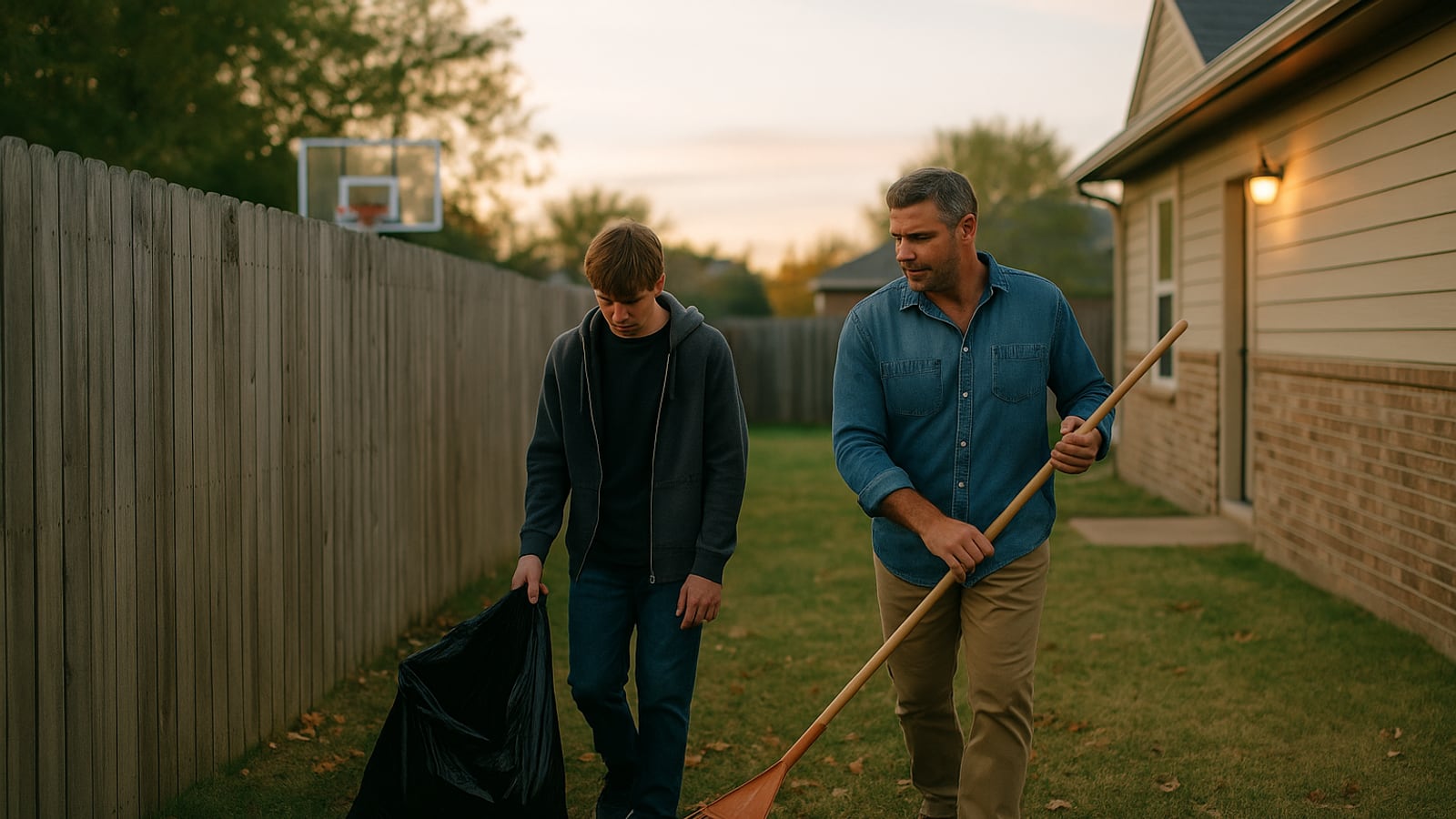
Start with this: "I saw the grades. I'm not angry. I want to know what's actually going on."
Then stop talking. Count to ten in your head if you have to. The silence will feel unbearable to you and it'll feel like oxygen to him.
That's the whole opening. No preamble about how much the school costs, no reference to his brother, no story about your own senior year. Just the fact, your position on it, and a question that can't be answered with "fine."
The reason this works is simple. A kid who's failing and knows he's failing has already run the lecture in his own head, hundreds of times, in a harsher voice than yours. Your version adds nothing except the confirmation that you think he's a disappointment. Everything useful you can do starts after you've taken that fear off the table.
Pick the time and the geometry
Not the night the report card lands. Not at dinner with everyone watching. Not in his doorway while he's mid-game and you're standing over him.
Side by side beats face to face. Driving somewhere, walking the dog, cleaning out the garage. Teenagers talk more honestly when they don't have to hold eye contact. There's less pressure to perform a reaction, and there's a natural exit — the car arrives, the dog gets home — so the conversation doesn't feel like an interrogation with no end.
Give it twenty-four to forty-eight hours after you find out. Long enough that you're not reacting, short enough that he doesn't spend a week waiting for the axe.
And go in with one goal: information. Not a plan, not an apology from him, not a commitment. Just an accurate picture of what's happening. You can't fix a problem you've only diagnosed from the outside.
The four things that shut it down
"I'm so disappointed in you." He already knows. All this does is tell him the conversation is about managing your feelings, which means he'll start managing them instead of telling you the truth.
"You're smart enough to do this." Sounds like encouragement. Lands as an accusation — if he's smart and he's failing, the only variable left is character. Now he's lazy, and lazy is an identity, and identities are hard to climb out of.
"When I was your age." He's not you. The comparison invites him to argue, and he'll win, because you've forgotten most of what actually happened.
"What's your plan?" Too early. He doesn't have one. Asking makes him invent something to get you off his back, and then you've got a fake plan you'll both pretend to believe in until the next report card.
Get underneath "I don't know"
"I don't know" usually means one of four things, and they need completely different responses.
I don't understand the material. He's been lost since a specific point — a unit in algebra, a chunk of chemistry — and every week since has been built on sand. This is the most fixable version and the most common.
I understand it but I can't make myself start. Assignments sit untouched until they're too late to save, then avoidance becomes shame becomes more avoidance. The work isn't hard. Beginning is.
Something else is eating the room. A friendship that collapsed. A breakup. Anxiety that's gotten loud. Something happening online he can't tell you about. School is the symptom.
I don't care about this, and I've decided that's fine. Rarer than it looks. Usually a defense built over the top of one of the first three.
Ask the narrowing question: "Was there a point where it stopped making sense, or was it never the understanding part?" That single question sorts most kids into the right bucket.
Make the plan smaller than feels serious
The instinct after a bad report card is a dramatic response. Tutoring three nights a week, phone confiscated, study hours enforced with a timer. It feels proportionate to the problem. It fails in about nine days.
Pick one subject. Not all five. The one where the smallest effort produces the most visible movement, which is usually the one with the most missing assignments rather than the lowest test scores.
Then pick one mechanism. Twenty minutes at the kitchen table, same time every day, phone in the other room. Or a Sunday-night ten-minute check of what's due that week. One thing, done consistently, beats a system that collapses under its own weight.
Write down what "working" looks like and when you'll check. "By the end of the month, the missing assignments in history are turned in." That's a target you can both see. "Trying harder" isn't.
Consequences without theater
There's a difference between a consequence and a punishment. A consequence protects the plan. A punishment makes you feel like you did something.
Taking the car for a month is a punishment. Requiring that homework's done before the car goes anywhere is a consequence. The first one just removes something he cares about and gives him a month of nothing to lose. The second keeps the incentive live every single day.
Same logic on the phone. A flat confiscation turns it into a war. Phone lives in the kitchen from seven to nine on school nights, for everyone in the house including you, is a rule about the house rather than a verdict on him.
And be honest with yourself about what you're actually enforcing. If you won't hold the line in week three, don't announce it in week one. A rule you drop teaches him that your rules expire.
Do the boring follow-up
This is where most fathers lose it. The big conversation happens, everyone feels better, and then nothing happens for six weeks until the next crisis.
Ten minutes. Same day each week. Not a performance review — a check of the one thing you agreed on. Did it happen or not. If not, what got in the way. Adjust the mechanism, not the target.
Keep your face neutral when the answer's bad. The week he tells you the truth about a bad week is the week the system's actually working. Punish that and he'll start managing you again.
Praise the mechanism, not the outcome. "You sat down every day this week" is something he controls. "You got a B" isn't, entirely, and praising it teaches him that your approval floats on results he can't guarantee.
Know when it's not a school problem
If he's sleeping twelve hours and still exhausted. If he's stopped seeing the friends he used to see. If things he loved a year ago now bore him. If the self-talk has gone from "I messed up" to "I'm worthless." If he's not eating, or he's eating in a way that's changed.
That's not a discipline conversation. Talk to your doctor, and call the school counselor — they see the kid five days a week and they know things you don't.
Bringing in help isn't a failure of fatherhood. It's a father recognizing the difference between a kid who needs structure and a kid who needs care.
The thing you're actually building
He may not pull the grade up this semester. Some kids don't. The transcript's a snapshot of one bad stretch, and he'll survive it — the world is full of people doing fine work who had a terrible junior year.
What he'll remember, ten years from now, isn't the number. It's whether the man who found out he was failing came at him or came alongside him.
You get to decide which one you were. This week.
Cal Brennan
Fitness
Strength coach. Trains fathers, tradesmen and desk workers, which means programmes that survive a bad week.

Watch
Worth an hour of your evening
More from Dads.
From channels we rate. Plays on YouTube.
Read next