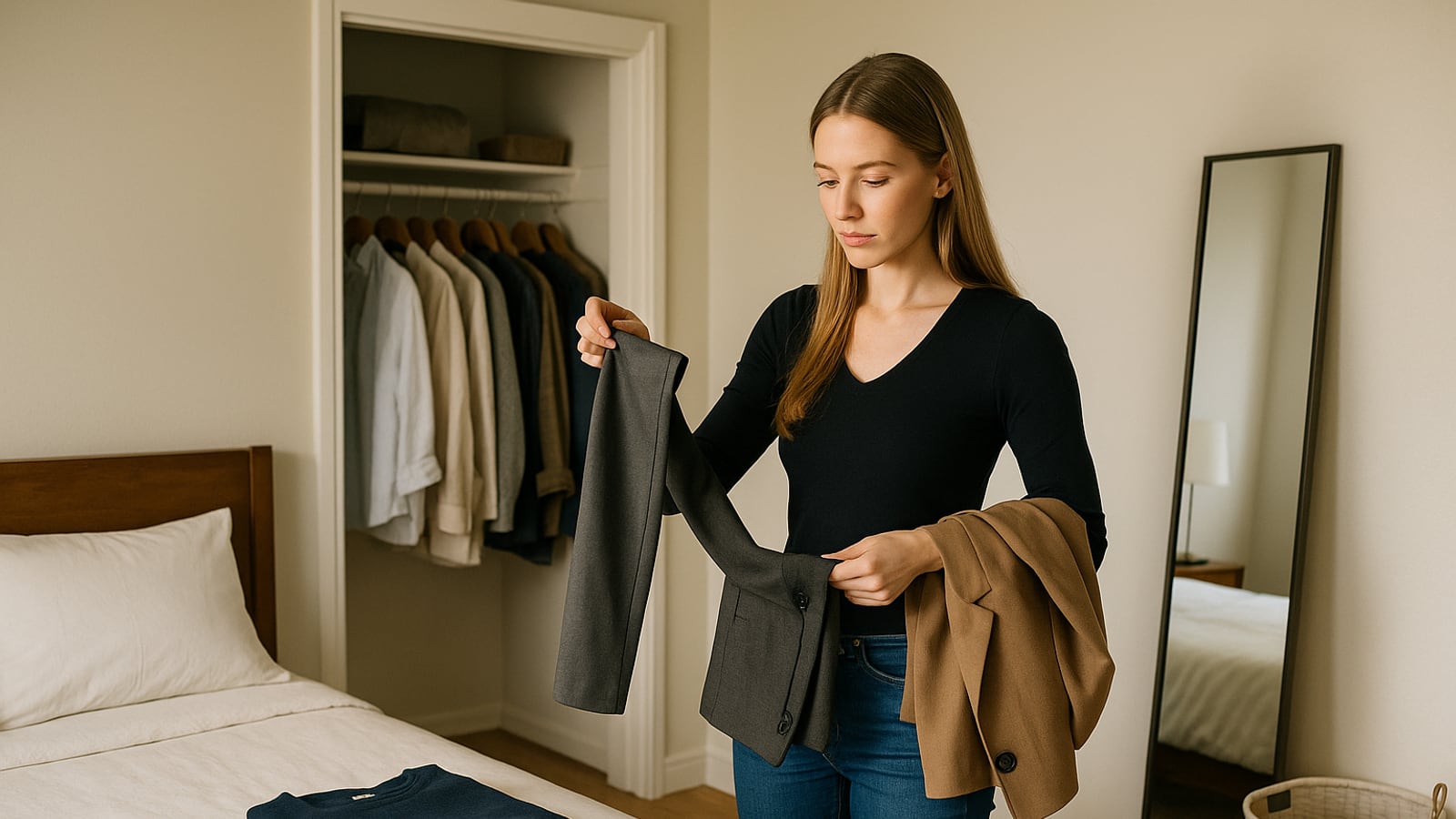
Count what you actually wore last month. Not what's hanging up. What went on your body, out the door, and into the hamper. For most women it lands somewhere between nine and fourteen items, and the other fifty things in the closet are there to make you feel bad on a Sunday night.
So we're building the fourteen. Plus the pieces that keep it from getting boring. Twenty-four total, which sounds austere until you do the math on how many outfits twenty-four pieces make when they all share a color spine.
Pick two neutrals and stop negotiating
Every piece you buy has to work with at least four others. That only happens if you commit to a limited palette, and the palette decision is the whole game.
Pick two neutrals. Navy and camel. Black and gray. Olive and cream. Brown and ivory. Then add exactly one accent color you look forward to wearing, and buy it in tops and one dress only, never in pants or shoes.
The mistake isn't buying cheap clothes. It's buying a burgundy skirt, a cobalt blazer and forest green pants in the same year, and then owning three outfits that each require one specific other item to exist.
Write the two neutrals on a note in your phone. When you're standing in a Goodwill aisle holding something teal and wonderful, the note wins.
The twenty-four
- Bottoms (5): one pair of dark straight-leg jeans, one pair of trousers in neutral one, one skirt at a length you'll actually sit down in, one pair of jeans you don't mind wrecking, one pair of knit pants or leggings for real life.
- Tops (8): three good tees or shells, two button-front shirts (one white, one pattern or accent), two knits with sleeves, one long-sleeve layering top.
- Warmth (3): one cardigan in neutral two, one crewneck or pullover sweater, one denim or utility jacket.
- Dresses (2): one you can wear to church, a funeral or a work lunch without thinking, and one you can wear to a cookout.
- Structure (1): one blazer in a neutral. Not the statement one. The boring one.
- Outerwear (2): one real coat for your climate, one rain shell.
- Shoes (3): one flat you can walk a mile in, one boot, one dressy low heel or loafer.
That's twenty-four, not counting underthings, workout clothes, or whatever your job requires. Scrubs don't count. Barn boots don't count.
What to spend on, what to thrift
Spend on the things that carry weight. Coat, boots, and the bra situation under everything. A cheap coat is obvious from across a parking lot and a cheap boot is a blister with a zipper.
Thrift the rest, and thrift on purpose. Secondhand racks are full of the stuff that was built better fifteen years ago, so hunt the labels that used to mean something: Talbots, Pendleton, Lands' End, L.L.Bean, Brooks Brothers, older Eileen Fisher wool. Weekend donations usually hit the floor early in the week, so a Tuesday morning beats a Saturday afternoon.
Then check four things before it goes in the cart.
Pull the side seam gently. If you can see daylight through the stitching, it's done. Look at the armpits and the inside of the collar for the yellowing that never washes out. Run the zipper the whole way twice. And read the tag.
Read the tag like it owes you money
Fabric content predicts how a garment ages better than price does.
Cotton, linen, wool and silk breathe and hold shape. A knit at 95 percent cotton with 5 percent elastane keeps its neckline. Viscose and rayon drape beautifully and wrinkle like a paper bag. Polyester belongs in a coat shell and a jacket lining, not in a summer blouse unless you enjoy being warm in a way you can't fix.
Two hard rules. Anything that says dry clean only goes back on the rack unless it's a coat or a blazer, because a $9 blouse with a $12 cleaning bill costs $45 by March. And anything with buttons sewn on flat, no thread shank underneath, will lose one within a month. Not a dealbreaker. Just know you're signing up for ten minutes with a needle.
The tailor is the budget hack nobody uses
This is where the whole thing turns from "secondhand clothes" into "she dresses well."
Buy for the shoulders and the hips, which are hard to change, and pay someone to fix the rest. A pants hem runs somewhere around fifteen to twenty-five dollars in most towns. Taking in a waistband or side seams, twenty to thirty-five. Shortening blazer sleeves costs more, often forty and up, because buttonholes are involved, so buy blazers with sleeves that already land at your wrist bone.
A twelve-dollar thrifted wool trouser plus a twenty-dollar hem is a thirty-two-dollar trouser that fits. There's no store where you can buy that.
Take three things at once so you only make the trip once. Wear the shoes you'll actually wear with the pants. If you don't, you'll get back a hem that's right for a heel you own one of.
The dryer is what's killing your clothes
Cheap clothes don't fail because they're cheap. They fail because of 45 minutes on high heat, twice a week.
Wash cold. Turn knits inside out. Put anything with a hook, a zipper or lace in a mesh bag, because the hook on one thing is what pulls the thread on another. Hang-dry every knit and every pair of jeans, and let the towels and socks have the dryer to themselves.
Buy a fabric shaver. They're about fifteen dollars and they take a pilled sweater from "old" back to "fine" in four minutes, which is the highest return on fifteen dollars in this entire article.
Jeans don't need washing every wear. Two or three wears, unless something happened. Wool sweaters get aired out overnight, not laundered.
Buy it in this order
First paycheck: the shoes you walk in, the trousers, and two of the tops. That's the outfit you'll wear most.
Second: the coat. Shop it in February or March when last winter's stock gets marked down, and don't flinch at spending more here than on anything else.
Third: the rest of the tops, the cardigan, the blazer, the church dress. Backfill the jeans whenever you find the right pair, which may take six months, and that's fine.
Where this advice breaks
If your work has a uniform, or you're farming, or you're home with a two-year-old who uses your shoulder as a napkin, the twenty-four doesn't describe your Tuesday. Build the work-clothes layer separately and treat it as equipment. Two sets of the durable thing, replaced when it fails, and no guilt about it.
And if you genuinely love clothes, a twenty-four-piece closet will feel like a diet. Then run the spine anyway and give yourself one shelf for whatever you want. The system holds as long as the base is disciplined.
One last thing. You'll be tempted to fill the empty hangers, because empty space in a closet feels like a mistake. Leave it. The compliment you're after isn't "cute top." It's somebody assuming you own three times as many clothes as you do.
Nina Castellan
BRO for Her
Runs the women-facing desk. Same standard, same tools, written for a different reader — not a softer one.

Watch
Worth an hour of your evening
More from BRO for Her.
From channels we rate. Plays on YouTube.
Read next