You already own the answer to this. It's about nine items deep in a closet holding sixty, and you reach for it every time you're running late, because it fits and you don't have to think.
Start there. Before you spend a dollar, turn every hanger in your closet backward. Wear something, hang it back the normal way. Give it four weeks. At the end you'll be looking at a very short row of forward-facing hangers and a long, humiliating row of backward ones. That row is your real wardrobe. Everything else is inventory you're storing for free.
The point of a capsule isn't minimalism as a personality. It's that a small number of pieces that actually fit will get you dressed in ninety seconds and cost less per year than a closet full of almost.
Set the budget, then split it wrong on purpose
Say you've got $300 and a season to spend it. The instinct is to divide it evenly across ten things. Don't.
Put more than half of it into the two or three items that are load-bearing: the pants you'll wear twice a week, the coat that's the only thing anyone sees from November to March, and shoes you can stand in for six hours. These get worn a hundred times a year. A $70 pair of boots at 100 wears costs you seventy cents a wear. A $20 top you wear four times before the seams pucker costs you five dollars a wear, and you'll tell yourself it was a bargain.
The rest of the money goes to tops, and tops are where thrifting pays.
Keep $30 back for alterations. That's not a rounding error, it's the whole trick.
The list, and why it's this short
Build around two neutrals you already wear. Not the two you admire on other women. Look at that forward-facing row and see what's actually there. Navy and cream. Black and gray. Olive and tan. Pick two, and everything you buy has to work with both.
Then:
- Two pairs of pants. One you can wear anywhere, one you can wear on your knees.
- One skirt or one dress that handles a funeral, a wedding and a parent-teacher meeting without commentary.
- Four to six tops. Mixed weights. At least two with sleeves you can push up.
- One knit layer. Cardigan or crewneck, in a fiber that isn't going to pill into felt.
- One jacket or blazer that isn't the winter coat.
- One coat.
- Two pairs of shoes minimum, three if one has to be a boot.
That's roughly fourteen pieces and it will dress you for every single thing a normal week contains. Add the workout clothes and the barn clothes separately. Those aren't wardrobe, those are equipment, and pretending otherwise is how people end up owning eleven pairs of leggings and nothing to wear to a funeral.
Read the tag before you read the price
The label is the only honest thing in the store. Flip it.
Cotton, wool, linen, silk and good denim age. They get softer, they hold a press, they take a repair. A wool-blend coat from 1998 at a church rummage sale will outlast anything hanging in a mall right now.
What quits early: rayon and viscose jersey, which grows two sizes in the wash and never comes back. Poly crepe that looks crisp on the rack and pills under a seatbelt strap by week three. Anything where the waistband is more than a few percent elastane, because that's the fiber that dies first and takes the fit with it. A little stretch in denim is fine and makes pants livable. A lot of it means bagged knees by lunch.
Acrylic is the one I'll argue about. It's cheap, it's warm, and it pills like crazy. If a sweater is acrylic, buy it thrifted for six dollars, not new for sixty, and accept that it's a two-winter sweater.
Where the money actually goes furthest
Thrift and resale for tops, blazers, coats and denim. Those are the categories where last decade's construction beats this year's, and where you're not fighting anyone for a size.
Buy new: shoes that have to support you, and foundation layers. A good bra is structural engineering and it wears out on a schedule. Get measured at a shop that carries more than four sizes, and replace them when the band stops holding, not when they look tired.
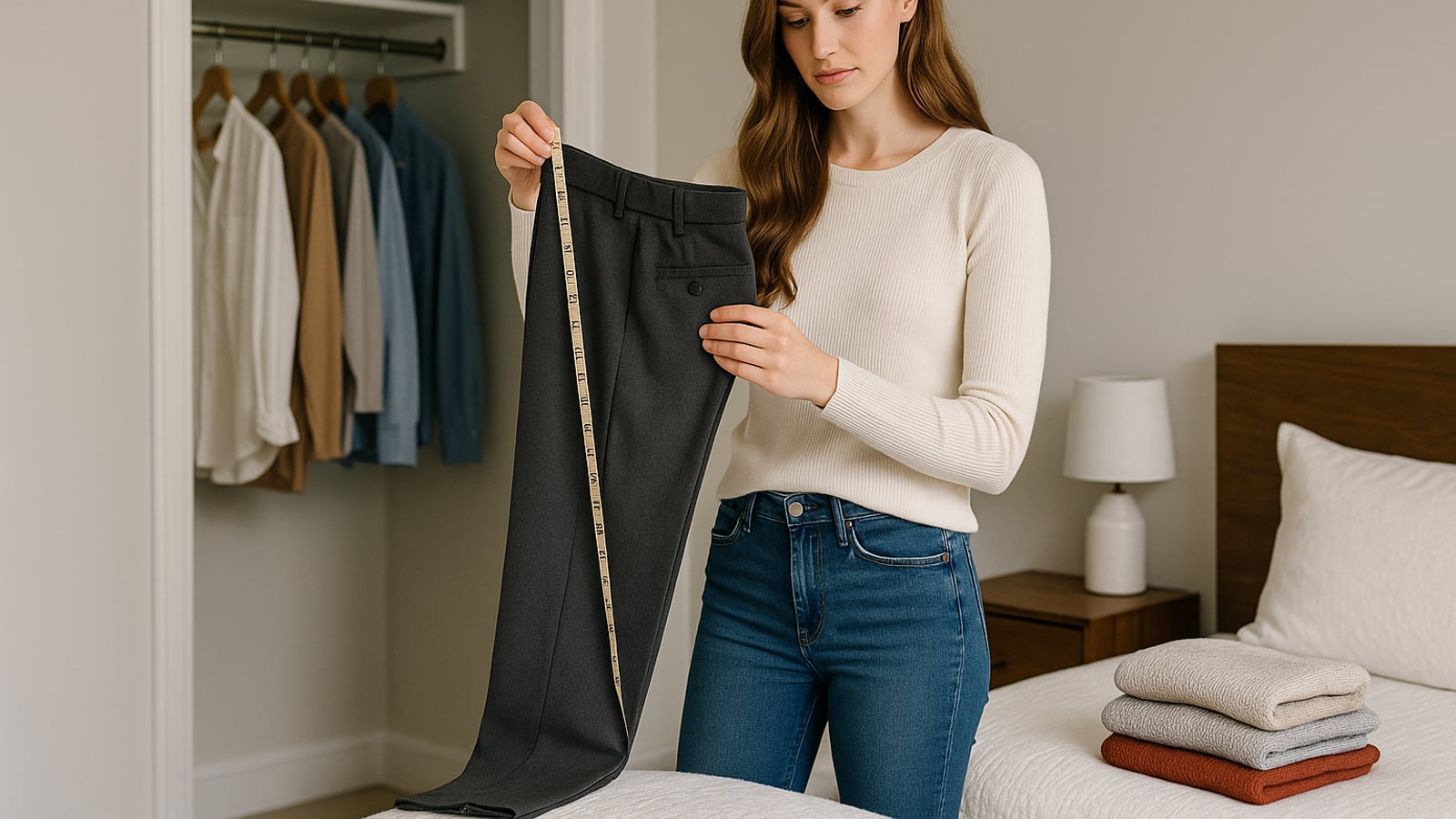
Go to the thrift store with a soft tape measure in your coat pocket. Not to check yourself. To check the garment against a pair of pants you already own and love. Measure your good pants at the waist and the inseam before you leave the house, write the numbers on your hand, and buy to those numbers. Sizing on a rack of six different decades and eleven different brands means nothing at all.
Then inspect it like you're buying a used truck. Armpits, for shadowing and thin spots. Seams, pulled open at the stress points. Zipper, all the way up and down twice. Hem, for the old crease line if it's been let down before. And smell it. Smoke never leaves.
The $30 you kept back
Three alterations do almost all the work.
Hemming pants to your actual leg length. This is the single biggest difference between clothes that look cheap and clothes that don't, and it's the cheapest thing on the menu.
Taking in a waistband. Pants that fit your hips almost never fit your waist, and every woman I know has bought a size up and cinched it with a belt into a paper bag. Two darts, and the pants look made for you.
Shortening sleeves on a jacket. A blazer sleeve that ends at your knuckles reads as borrowed. Ending it at your wrist bone reads as yours.
Call two shops in your area and ask for prices before you commit. They vary wildly by city, and the strip-mall place next to the dry cleaner is usually half what the boutique charges for identical work. Bring the shoes you'll wear with the pants. Every time you don't, you'll be back.
What kills clothes is the dryer
Heat is the enemy. It shrinks, it sets stains, and that fuzz in the lint trap is your sweater leaving in installments.
Wash cold. Hang or lay flat everything knit. Turn dark denim inside out and wash it rarely. Buy a sweater comb for a few dollars and take the pills off a knit instead of replacing it. Learn to sew a button and close a seam by hand, which takes one afternoon on YouTube and saves a garment a month.
And put things away when they're clean. A stain you find in October, set in since June, isn't coming out.
Where this doesn't work
If you're on a farm, in nursing, in a trade, or home with toddlers who use you as a napkin, a fourteen-piece capsule is fantasy for six days out of seven. Build the capsule for the days you leave the house looking like yourself, and keep a separate, cheap, replaceable rotation for the work. Don't wear the good pants to muck stalls because they were the only clean thing. That's how the good pants become the only pants.
The other honest caveat: a capsule built around two neutrals gets boring, and boring is a real cost. Budget one piece a season that's purely because you like it. A red coat. A scarf with actual color in it. Knowing you did it on purpose is the difference between a wardrobe and a uniform.
Now go turn the hangers around. You'll hate what it tells you for about three days.
Nina Castellan
BRO for Her
Runs the women-facing desk. Same standard, same tools, written for a different reader — not a softer one.

Watch
Worth an hour of your evening
More from BRO for Her.
From channels we rate. Plays on YouTube.
Read next