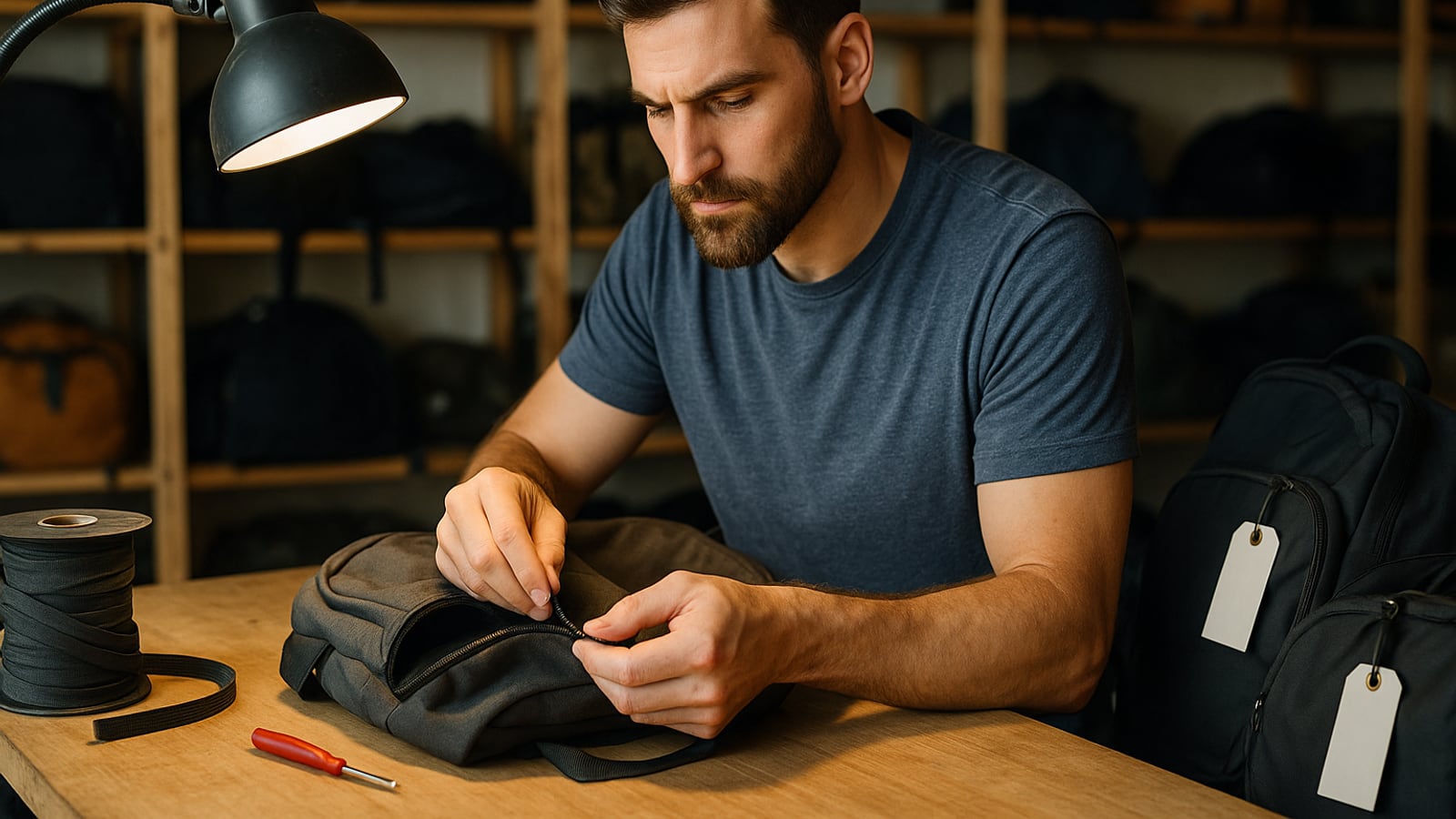
Pick up any bag you're thinking of buying and look at the slider on the main zip. If it doesn't say YKK, or a name you recognize as an actual zip manufacturer, put it down. That one check eliminates most of the bags that will fail on you inside three years, and it takes four seconds.
The zip is the moving part. Everything else on a bag just sits there. A main compartment zip on a daily bag gets opened and closed maybe six times a day, which is somewhere north of twenty thousand cycles in a decade, all of it under load, often with a coat sleeve in the way. Fabric doesn't get twenty thousand chances to fail. The zip does.
What to look for on the zip itself
You want a coil zip, not moulded plastic teeth, for anything that curves round a corner. Coil flexes and often recovers if you force it. Moulded teeth bend and stay bent.
Size matters more than most people realize. A #8 or #10 coil on a main compartment is built for abuse. A #5 is a pocket zip that somebody put on a main compartment to save money and weight, and on a heavy bag it'll start splitting behind the slider within a couple of years. The number is usually stamped on the underside of the slider. Turn it over and read it.
Look at where the zip ends. A good bag has the zip tape tucked into a bound seam with a fabric garage at each end. A cheap bag runs the tape straight to the edge and hits it with a bartack, which is the point where water gets in and where the tape frays first.
The good news: a worn slider on a decent zip is a twenty-minute fix at a shoe repair or a bag repair shop, because the tape is fine and only the slider has gone soft. That repair costs pocket money. On a no-name zip the tape and the teeth are the problem, and then you're replacing the whole thing, which means unpicking the binding, and most shops will quote you more than the bag is worth.
The failure nobody warns you about
Turn a ten-year-old nylon bag inside out and you'll sometimes find gray dust and sticky flakes all over your kit. That's the polyurethane coating on the inside of the fabric breaking down. It's a chemical process, it's accelerated by heat and damp, and it happens whether you use the bag or leave it in a loft.
It's the single most common way a bag that has been treated well still dies at year eight. Storing a bag damp in a garage is the fastest route there. Hanging it somewhere dry and ventilated is the fix, and it costs nothing.
Silicone-impregnated and TPU-coated fabrics don't do this in the same way. Waxed canvas doesn't either, though it has its own habits. If you're buying nylon and you want ten years, ask what the coating is, and store it properly.
Fabric weight is mostly marketing
1000D Cordura will outlast you. It also weighs a lot, it's stiff, and on a bag you carry every day that stiffness means the panels never soften and the shoulder strap never sits right.
500D is the honest sweet spot for a daily carry. Ballistic nylon at 1050D is superb for abrasion and poor for tear strength once it's been punctured. Waxed canvas ages beautifully, gets a patina you'll actually like, needs re-waxing roughly once a year if it lives outdoors, and is heavy when it's wet.
Denier tells you the thickness of the yarn. It tells you nothing about the weave density, the coating, or whether the panel is going to tear away from its stitching. A heavy fabric badly sewn fails sooner than a light fabric sewn well.
Where the stitching tells the truth
Find where the shoulder strap meets the body. That's the highest-load point on the whole bag and it's where cheap construction shows.
You want the webbing sewn through a reinforcement patch, not through a single layer of shell fabric. You want a box-X pattern or a pair of heavy bartacks, and you want the stitching to sit cleanly inside the edge of the webbing rather than wandering off it. Stitching that runs off the webbing edge means the machine operator was moving fast, and it means the load is carried by fewer threads than the design intended.
Run your hand inside along the main seams. Bound seams, wrapped in binding tape, last. Raw edges that have been overlocked and left will shed threads and eventually the seam allowance chews itself down to nothing.
Then look at the hardware. Metal G-hooks and metal strap adjusters are worth the weight. Good acetal buckles from a real hardware maker are fine. Unbranded plastic buckles go brittle, and they go brittle in January, in the cold, with your laptop inside.
What to skip
Skip the moulded organiser panel with fourteen elastic loops. You'll use two of them and the rest add weight and bulk and can't be removed.
Skip open-cell foam in the back panel and shoulder straps. It compresses into a pancake in about three years and the mesh over it pills into something unpleasant. Closed-cell foam stays.
Skip wheels unless you genuinely need them. A telescoping handle is the shortest-lived component on any piece of luggage, and when it jams you have a very heavy bag with an awkward lump in the back panel.
Skip white and cream interiors on anything that goes on a floor, and skip fully black interiors too, because you'll never find a charging cable again. A mid-gray lining is the practical answer.
When the cheap one is right
A $30 bag is the correct purchase when you don't yet know what you need. Buy the cheap one, use it for six months, and pay attention to what annoys you. Too deep. Not enough width for a laptop in a case. The strap slips off your shoulder in a waxed jacket. That information is worth more than a considered guess, and you'll spend the $150 much better afterwards.
Cheap is also right for a bag that lives in a locker at the gym and holds a towel, and for filthy jobs where you actively want not to care. I keep a supermarket holdall for taking rubbish to the tip and it owes me nothing.
What cheap costs isn't only the replacement. It's the timing. A strap anchor tears on an escalator and your laptop goes down twelve steps ahead of you, on a Tuesday, when you're already late. That's the real bill.
Two habits that add years
Run a candle along the zip teeth two or three times a year. Paraffin wax is the same principle as the zip lubricant sold in small tubes for six times the price. A waxed zip runs easier and you stop yanking it, and yanking is what kills sliders.
And when something tears, fix it that month. A two-inch tear in Cordura takes a cobbler ten minutes. A two-inch tear left for a year becomes a six-inch tear across a seam, and then the answer is a new bag.
The bags that hit ten years mostly aren't the expensive ones. They're the ones somebody bothered to look after in year three.
Wes Dunbar
Country & Skills
Grew up on an acreage and never quite left. Covers trucks, trades, land, and how to do the thing yourself.

Watch
Worth an hour of your evening
More from Gear.
From channels we rate. Plays on YouTube.