The watch you'll still be wearing in twenty years
Most watches get retired for reasons that have nothing to do with quality. Here is how to avoid buying one of those.
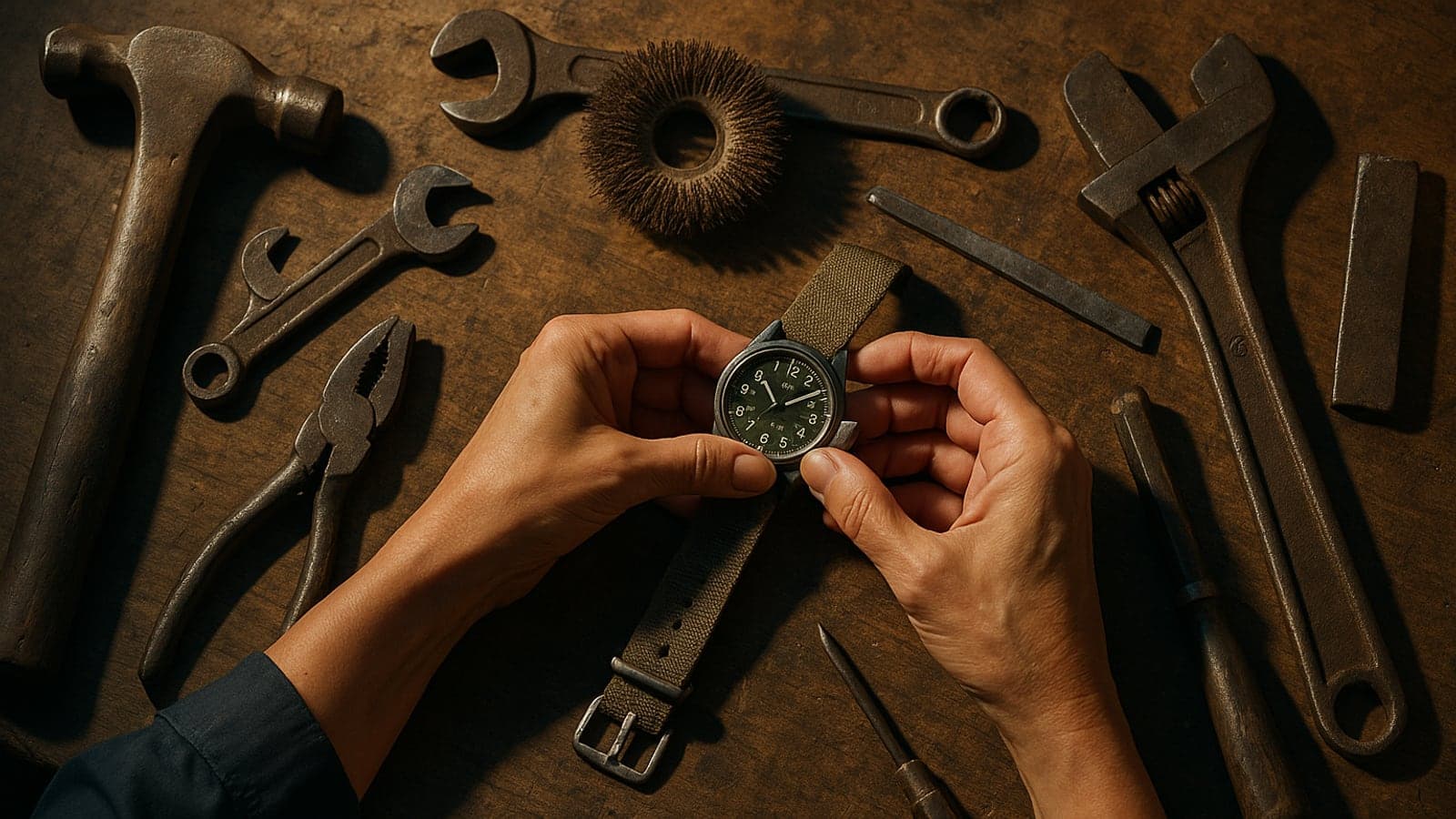
Buy a three-hand watch, 36 to 40mm across, with a dial you can read in a dim restaurant, standard lug width, and a case shape that was already old-fashioned when you bought it. That's most of the answer. Everything below is why, and where the money actually matters.
Because the watches people stop wearing usually don't break. They go in a drawer because the owner got tired of them, or the bracelet wore out and can't be replaced, or the thing sat 4mm too wide on the wrist and never stopped announcing itself. Durability is the easy part. Wanting to put it on for the next two decades is the hard part.
Size is the decision most people get wrong
Forget the case diameter for a second and look at lug-to-lug, the measurement from the tip of the top lugs to the tip of the bottom ones. That's what determines whether a watch sits on your wrist or hangs off it. A 40mm case with long, flat lugs can eat more real estate than a 42mm case with short curved ones.
Measure your wrist. If the lug-to-lug is longer than the flat top of your wrist, the lugs will lift and the watch will rock. That's the watch you take off at lunch.
Trends in case size move, and they move a lot. Big was the fashion, then small came back, and it'll swing again. The sizes that never look wrong are the middle: roughly 36 to 40mm for most wrists, with a case that's slim enough to slide under a cuff. Thickness matters more than width for daily comfort. Anything much over 12mm starts catching on sleeves and doorframes.
Quartz or mechanical, honestly
A quartz watch keeps better time, costs less, needs a battery every few years, and asks nothing of you. A mechanical watch drifts by seconds a day, costs considerably more for equivalent build, and needs servicing on a schedule.
Neither is the right answer for everyone. But understand what you're buying with mechanical: not accuracy, not reliability, and certainly not convenience. You're buying something that can be opened, cleaned, and put back together indefinitely by someone with the right tools. That's a real thing, and it's the whole argument for spending more.
The cost people forget is servicing. A full service on a mechanical watch runs into real money, and on an inexpensive automatic it can approach or exceed what you paid. That's not a scandal. It's labor. But it means a cheap automatic is, in practice, semi-disposable, while a cheap quartz is honestly disposable and priced accordingly.
If you want one watch for the next twenty years and you don't care about the machinery, buy good quartz and spend the savings on the case, crystal, and dial. Nobody at the dinner table can tell, and you'll never wind it.
Where the money should go
Sapphire crystal. This is the single best value upgrade on any watch. Mineral glass scratches, and a scratched crystal makes a good watch look tired faster than anything else. Acrylic scratches too, but it polishes out with a cloth and a little compound, which is why vintage-style watches get away with it. Mineral is the worst of both.
Case finishing. Run your finger along the edge of the lugs. Crisp transitions between brushed and polished surfaces, no soft mushy edges. This is where cost genuinely shows up, and it's what makes a watch look expensive at arm's length.
Dial legibility. Applied markers over printed ones. Hands long enough to actually reach the markers. Enough contrast that you can read it without turning your wrist toward a light. Date windows are fine if the print is crisp and the color matches the dial.
Water resistance of 100m or better. Not because you're diving. Because 30m means "don't wash your hands aggressively," and a watch you have to baby is a watch you leave at home.
Standard lug width. 18, 20, or 22mm. This matters more than it sounds. It means you can buy a strap anywhere, forever, in leather or canvas or rubber, and change the whole character of the watch for the price of lunch.
What quietly kills a watch
Proprietary parts. Integrated bracelets that can't be replaced when the end links wear. Fitted straps with a curved end that only one company ever made. Crowns and pushers that only one factory stocks.
Batteries in unusual formats. A quartz watch that needs a capacitor or a module nobody makes anymore is finished, no matter how nice the case is.
Complications you don't use. Chronographs are the main offender. Most people press the buttons twice in the first week and never again, and the pushers are the first thing to let water in. A moonphase is charming and will be misaligned for years at a time. A GMT hand is genuinely useful if you actually call people in other time zones, and clutter if you don't.
Plating. Gold-tone and PVD coatings wear at the high points, usually the bracelet edges and the caseback, and once they go patchy there's no fixing it cheaply. Solid steel, titanium, or actual gold ages. Plating just degrades.
When the cheap one is right
Often, and without apology.
If this is your first watch and you don't know yet whether you like a field dial or a dive bezel, buy inexpensive and find out. Spending a month wearing a cheap 38mm field watch will teach you more about what you want than a year of reading.
If you work with your hands, or around salt water, or on a jobsite, the cheap one is the correct one. Buy a beater quartz with a resin or steel case and treat it as consumable. Then keep something better for the rest of your life. Two watches solve this cleanly and cost less than one watch you're afraid to wear.
If you need something for a specific occasion, buy cheap. A thin dress watch gets worn four times a year. It doesn't need a sapphire caseback.
And if a cheap watch is what you can pay for right now, buy it and stop apologizing for it. A modest watch worn confidently reads better than a stretch purchase worn anxiously.
Buying used
Secondhand is where the value is, and it's also where you'll find the discontinued designs that never chased a trend. Two things to check. First, whether the model still has parts support, which you can usually learn by asking an independent watchmaker what they'd charge to service it. Second, whether the dial and hands are original. Redialed watches lose most of their value and are hard to spot in photographs.
Ask for pictures in daylight, on a wrist, with the caseback visible. Ask when it was last serviced. If the seller can't answer, assume never and price accordingly.
The test that matters
Put it on. Do something ordinary for ten minutes. Drive, wash your hands, type, reach into a pocket.
If you forget it's there, that's your watch. If you keep looking at it, that's a watch you're excited about, which is a different feeling and one that fades on a predictable schedule.
The watch you hand to your kid in twenty years won't be the one that turned heads in the store. It'll be the plain one with the scratched bracelet and the strap you replaced twice, and it'll be worth handing over precisely because it was never off your wrist.
Dean Shaw
Gear & Garage
Tests things until they break, then reports what broke first. Trucks, tools, watches, and the cheap version that costs more.

Read next