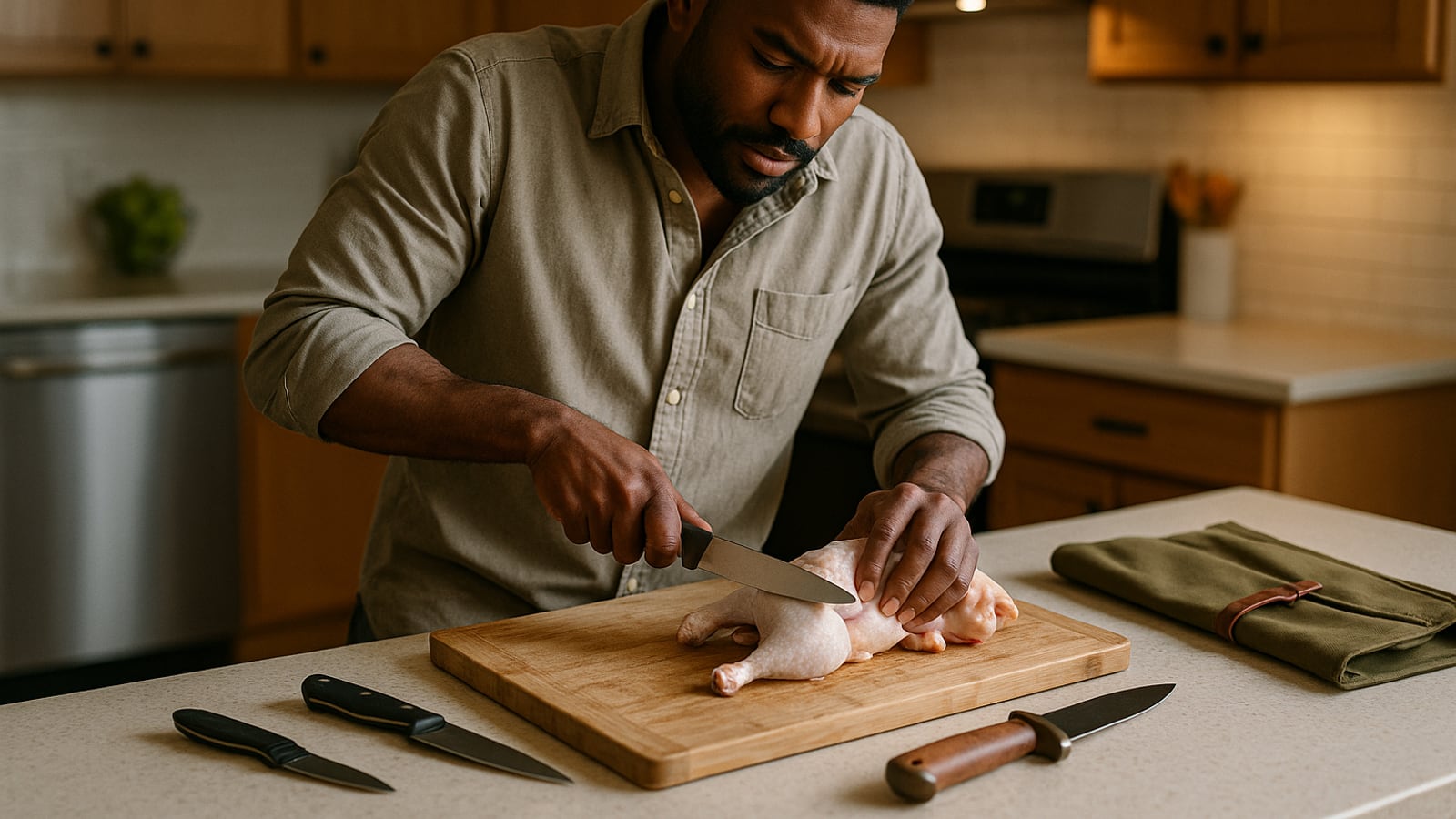
A Victorinox Fibrox 8-inch chef's knife. An Opinel No. 8. A Morakniv Companion. Street prices move, but the three together have sat comfortably under a hundred dollars for years, and none of them is a compromise you'll resent.
That's the whole answer. What follows is why, where each one fails, and the handful of places spending more genuinely buys you something.
The kitchen knife does ninety percent of the cutting in your life
Most men own six kitchen knives and use one. The one is a chef's knife, eight inches, and everything else in the block is decoration.
The Fibrox is the default recommendation in professional kitchens for an unglamorous reason. It's stamped rather than forged, which means it's light, and light matters when you're breaking down a case of onions. The handle is textured plastic that stays grippy with wet hands. It's soft enough steel that you can bring the edge back on a stone in two minutes, and cheap enough that you'll actually use it instead of babying it.
The annoying part: it looks like hospital equipment. The grind is fairly thick behind the edge, so it wedges in a dense butternut squash instead of gliding through. If you cook five nights a week and you've learned to sharpen, a Japanese gyuto in harder steel at around $150 will slice noticeably better and hold the edge three or four times longer. You'll also chip it on a chicken bone and feel sick about it.
Buy the cheap one first. Spend the money later, when you can tell me what specifically annoys you about the one you have.
Two more kitchen things, since they're not knives and they're where the real gains sit. A cheap plastic or end-grain wood board, never glass, never stone. And a paring knife, which is four dollars and does the jobs an eight-inch blade shouldn't.
The pocket knife you'll actually carry
An Opinel No. 8 weighs about as much as a pen. Beech handle, carbon or stainless blade, a twisting collar lock that Opinel calls the Virobloc. It's been made in roughly this shape since the 1890s and it costs less than a takeout lunch.
It opens boxes, cuts twine, takes the skin off an apple at a picnic table, and trims a loose thread off a jacket cuff without anybody deciding you're armed. That last part matters more than knife people admit. A slim wooden folder reads as a tool. A black tactical folder with a thumb stud and a pocket clip reads as something else to a lot of people, and you'll find yourself leaving it at home.
Where the Opinel fails: it's wood, and wood swells. Get it properly wet and the blade can jam shut for a day. The fix is to sand the slot slightly or to soak the pivot area in oil, but you shouldn't have to. The carbon version rusts if you cut a lemon and put it back in your pocket. The stainless version doesn't, and holds an edge slightly worse. Either is fine.
If you want a one-handed opening knife with a pocket clip, the honest budget answer is a folder in 8Cr13MoV steel from one of the big names, usually $30 to $45. That steel gets snobbed at constantly. It also sharpens on a stone in under five minutes, which the expensive powder steels don't.
Before you carry anything, look up your state and city law on blade length and locking mechanisms, and check again before you fly or cross a border. Rules vary more than you'd guess, and if you're genuinely unsure, ask a lawyer rather than a forum.
The fixed blade, for the jobs a folder shouldn't do
A Morakniv Companion costs about the same as two coffees and a tip. Around four inches of blade, a scandi grind, a rubberized handle, a plastic sheath that clips to a belt.
It's a Swedish woodworking knife, not a survival prop. That's exactly why it's good. It batons kindling, feathers a fire stick, guts a fish, cuts roofing felt, opens a hundred boxes on moving day without folding up on your fingers. There's no pivot to loosen and nothing to fail.
Get the carbon version if you'll maintain it and the stainless if you won't. Carbon takes a keener edge and develops a gray patina that actually helps protect it. It also flashes orange rust in about a week if you sheath it damp. I've done it. A wipe with a rag and a smear of mineral oil after use is the entire maintenance program.
The genuine trade-off is the sheath, which is thin plastic with a friction fit. It holds fine on a belt and rattles a bit. A leather sheath costs more than the knife.
Where you'd sensibly spend more: if you're processing a deer every season, a purpose-built skinner earns its keep. If you're out for days at a time and the knife is load-bearing safety equipment, a full-tang blade in better steel is worth the weight. For a man who camps a few weekends a year and keeps a knife in the truck, the Mora isn't a stepping stone. It's the destination.
What to skip
The block set. Fifteen knives, a steel, and a pair of shears for $90. You're paying for the block. The two you use will be the worst two knives in the set.
Pull-through carbide sharpeners. They scrape steel off in shavings and leave a ragged edge that feels sharp for a week. You'll take more metal off your knife in a year than a decade of stones would.
Anything called a survival knife with a hollow handle. The handle is hollow because the tang stops at the grip. That's the part that breaks.
Serrations on an everyday folder. They cut rope brilliantly and nothing else brilliantly, and you can't sharpen them at the kitchen table.
The dishwasher. Heat and detergent ruin handles and the blades knock against everything. Wash by hand, dry immediately.
Sharpening is the purchase that actually changes things
A dull knife is the one that cuts you, because you push harder and it skates. Every man who says he doesn't like knives is describing a dull knife.
Buy a combination waterstone, 1000 grit on one side and 6000 on the other, for around $30. Soak it, hold the blade at roughly the angle of two stacked quarters, and drag it edge-first like you're shaving a thin layer off the stone. Same number of strokes each side. Feel for the burr along the whole edge before you flip. Finish on the fine side, then strop on the back of a leather belt or a piece of cardboard.
Your first attempt will be worse than when you started. Your fourth will be better than any factory edge you've owned.
The honing rod in the block isn't a sharpener. It straightens an edge that's rolled over, which buys you time between real sharpenings. Use it every few cooks, ten light passes, and stop treating it like a magic wand.
Give it a Saturday morning and a knife you don't love. Once you can put an edge on steel, cheap knives stop being cheap.
Wes Dunbar
Country & Skills
Grew up on an acreage and never quite left. Covers trucks, trades, land, and how to do the thing yourself.

Watch
Worth an hour of your evening
More from Gear.
From channels we rate. Plays on YouTube.
Read next