How to pick between an automatic, a quartz and a smartwatch
Fit your wrist first, pick the movement for your week second, and let the brand be the last thing you worry about.
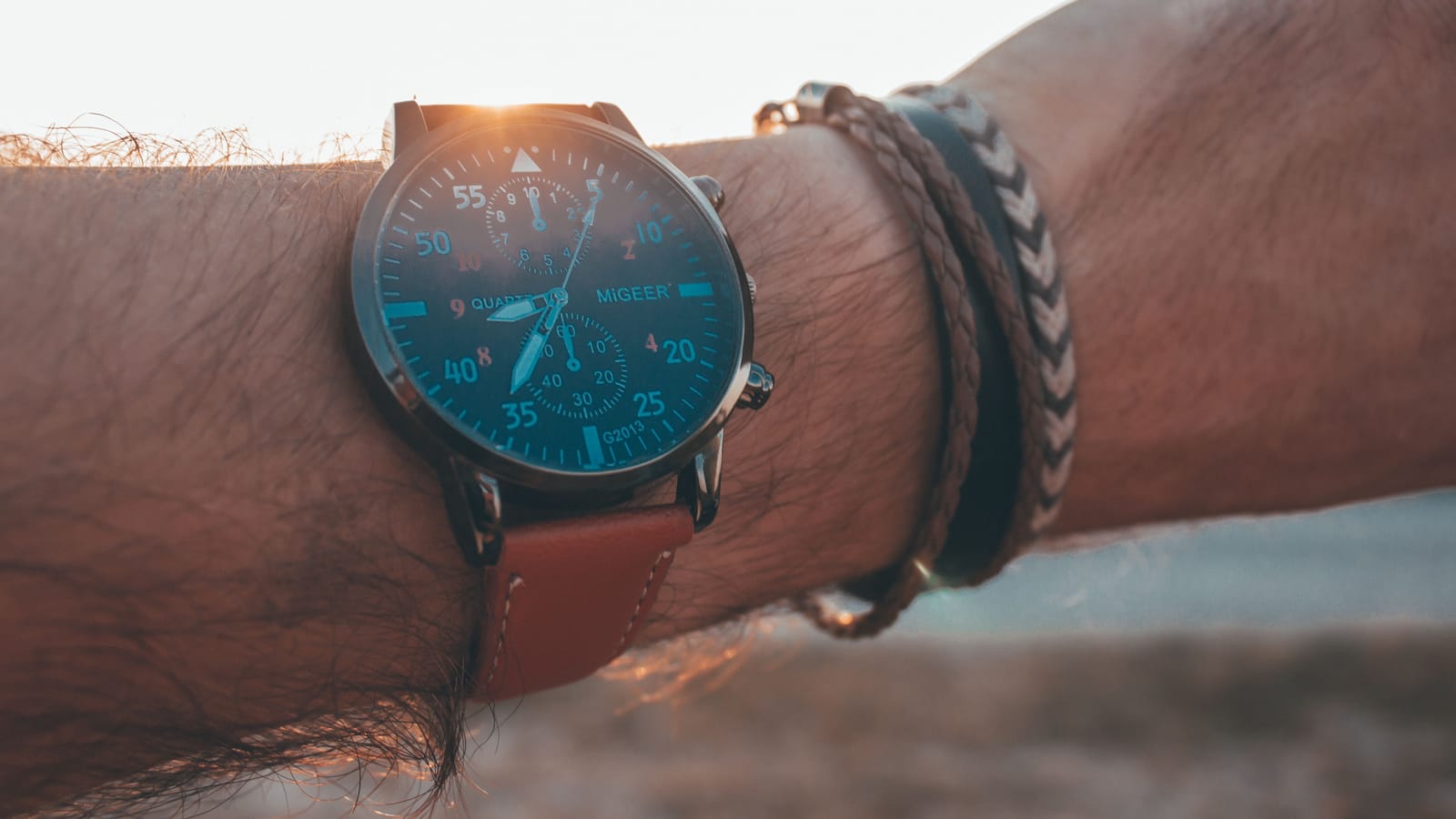
Before you argue about movements, measure the thing that actually decides whether a watch looks right on you: lug-to-lug. That's the distance from the tip of the top lug to the tip of the bottom lug, and it's the number nobody lists on the product page. If it's longer than the flat part of your wrist, the lugs hang off the sides and the watch looks borrowed. Case diameter gets all the attention. Lug-to-lug is what people see.
Wrap a strip of paper around your wrist and mark it, then hold it against a ruler. Around 6.5 inches, you're comfortable in a 36mm to 39mm case with lug-to-lug under about 46mm. Around 7.5 inches, you can carry 40mm to 42mm and 50mm of lug-to-lug without it looking like a gauge cluster. Bigger wrists can go further, but the ceiling is lower than the marketing suggests. A 44mm diver with 54mm lug-to-lug looks enormous on almost everybody.
Then check thickness. Under 12mm slides under a shirt cuff. At 14mm and up, you'll be tugging your sleeve over it all day, which is why a lot of expensive dive watches live at the bottom of a drawer.
The strap is the fabric, and it's the cheapest fix you own
A mediocre watch on the right strap beats a good watch on the wrong one. Most watches use a 20mm or 22mm spring bar, and swapping takes two minutes with a $10 spring bar tool. Buy the tool. The bent paperclip method ends with a scratch across your caseback.
Leather looks best and dies fastest. Sweat gets into the stitching, the lining stiffens, and by month eight it smells like a gym bag. Keep leather for the office and cool weather. For summer, heat, water or yard work, get a rubber strap or a nylon one. Rubber rinses clean under the tap. Nylon dries in an hour and costs about fifteen bucks.
Steel bracelets are the most versatile and the most commonly ruined, because people wear them two links too loose. Size it so you can slide one finger under the clasp and no more. A bracelet that slides down over your hand every time you reach for a coffee makes a nice watch look sloppy. Many bracelets have half-links or a micro-adjust in the clasp. Use them.
Quartz is the honest default and almost nobody admits it
A quartz movement keeps time to within roughly fifteen seconds a month. A good mechanical automatic keeps time to within maybe ten seconds a day, and that's on a well-regulated one. So the $40 watch is more accurate than the $4,000 watch, by a lot, forever. That's just how the physics works out.
Quartz is also thinner, tougher, and doesn't care if you ignore it for three weeks. Solar quartz goes further and kills the battery problem entirely. Citizen's Eco-Drive, Seiko's solar models and Casio's Tough Solar all charge off any light, including the lamp over your kitchen table. You set the time once and live your life.
The trade-off is real, though, and I won't pretend otherwise. A quartz second hand ticks once per second. It reads as a tool rather than a possession. And a standard battery quartz will die at an inconvenient moment, usually the morning of something that matters, and a battery swap at a shop runs twenty or thirty dollars because a good one includes a new gasket and a pressure test.
Buy quartz if you want a watch that works and you'd rather spend your thinking on something else. It's not a compromise. It's the correct answer for most men most of the time.
Automatic is a choice about the object, not the timekeeping
An automatic winds itself off the motion of your arm and stores maybe forty hours of power. Wear it Monday, skip Tuesday, and it's stopped by Wednesday morning. That's not a defect. It's what you signed up for.
The pleasure is genuine. The sweeping second hand, the weight, the fact that nothing in it needs a battery and it'll still run in fifty years if somebody takes care of it. A Seiko 5 costs a couple hundred dollars and gives you the whole experience. You don't need to spend four figures to own a mechanical watch, and anybody who tells you otherwise is selling something.
The annoying parts, since nobody mentions them in the ad copy. Service. A mechanical movement needs cleaning and fresh lubricant every several years, and on a Swiss watch that's a few hundred dollars, sometimes more than the watch is worth on an entry-level piece. Accuracy drift means you'll reset it most weeks. And the date. Never set the date while the hands are between roughly 9 PM and 3 AM, because the date mechanism is engaged and you can chip a tooth off it. Move the hands past noon first to confirm you're in AM or PM, then set the date, then set the time.
Watch winders are mostly a solution to a problem you don't have. Setting a watch takes fifteen seconds.
Smartwatches are tools, and tools belong where the work is
If you run, lift on a program, or want a heart rate trend you'll actually look at, a smartwatch earns its place. Garmin's fitness models go a week or more between charges. An Apple Watch is a better daily computer and needs the charger every night, which means it's on your nightstand and not on your wrist at 2 AM.
The cost isn't money. It's that your wrist becomes another place the phone can reach you. Sit at dinner with a watch that buzzes for every email and your kids learn exactly how much of you they're getting. If you wear one, turn off everything except calls and calendars. That single settings change is worth more than the watch.
And a smartwatch is wrong at a funeral, in a courtroom and across a table from someone who's deciding whether to hire you. A screen on your wrist says you might be somewhere else in four minutes.
What I'd actually buy
Two watches covers a whole life. A solar quartz on a bracelet for everything, and one other watch that matches what you do most. If you train seriously, the second one is the Garmin. If you like machines, the second one is a modest automatic on a leather strap.
Get the water resistance right while you're at it, because the numbers are misleading. 30m means rain and hand washing, nothing more. 50m survives a shower you didn't plan on. 100m is the honest minimum for swimming. 200m with a screw-down crown is more than you'll ever need unless you're diving with a tank, and always screw the crown back down after you set it.
Spend on fit and strap. Spend on the movement type that suits your week. Spend on brand last, because the logo on the dial is the only part of a watch that does no work at all.
One more thing worth weighing. Of everything you'll buy this year, a watch is on the short list of objects your son could still be wearing in 2065. A quartz can do that with a battery and a gasket. An automatic can do it with service. A smartwatch will be a drawer brick by the time he's in high school, and that's fine, as long as you know which one you're buying.
Dean Shaw
Gear & Garage
Reads the warranty, the parts list and the long-term owner reviews before anything else. Trucks, tools, watches, and the cheap version that costs more.

Watch
Watch how it's done
Picked for this article.
From channels we rate. Plays on YouTube.
Chrono24
WATCH MOVEMENTS explained in 3 minutes! | Manual, Automatic & Quartz Movements
Gentleman's Gazette
Watch Movements Explained - Mechanical vs. Automatic vs. Quartz Watches