Put your phone in the pocket before you buy the pants
Pocket depth and placement decide whether pants work for a living or just look the part. Here's a one-minute test and what a tailor can fix.
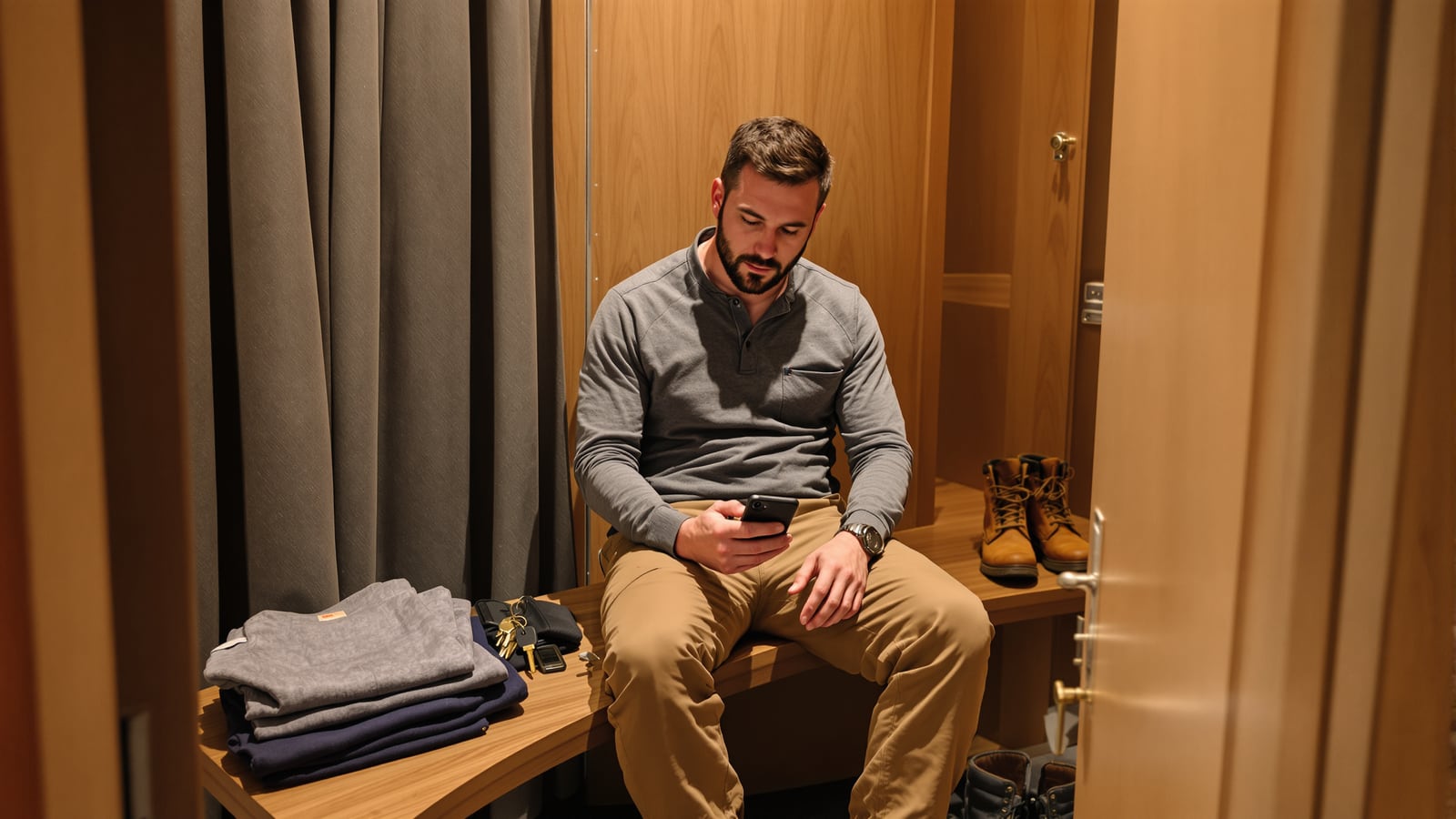
Quick answer: A good front pocket swallows your phone with an inch to spare, opens wide enough for your whole hand, and stays flat when you sit. If the pants fail any of those three, no brand name saves them.
You've done the truck-seat fish. You climb out, hear nothing hit the ground, and then realize the phone is somewhere between the seat and the console. That's not bad luck. That's a shallow pocket.
Pockets are the part of a pair of pants nobody photographs and everybody uses forty times a day. They're also where the cheap ones give themselves away. The fabric can look fine on the hanger. Then you put keys, a wallet and a phone in, and the pants start to behave like a costume.
The store test
Do it in the fitting room, with the pants on. Bring your actual phone.
- Drop the phone in. Push it all the way down. The top edge should sit at least an inch below the pocket opening. If the phone pokes out like a pack of cigarettes, it will fall out the first time you sit down.
- Sit. Pick a chair, or the bench. Watch what the phone does. Then stand up and see if it stayed.
- Put your hand in and make a fist. Your knuckles should clear the opening without a fight. If you have to flatten your hand and wiggle, the opening's too small.
- Add your keys. The pocket shouldn't bulge on the outside of your thigh. A little shape is normal. A visible lump means the pocket bag is too shallow or too narrow for what you carry.
Ninety seconds. It'll save you from pants you'll resent by Thursday.
Measure your phone at home first. Add an inch. That's the minimum depth you need, and it's a better number than anything on a size chart.
Depth is the whole game
Shallow pockets are the most common failure, and they're a cost decision. Pocket bags are the fabric pouches sewn inside the pants. Making them deeper takes more cloth, and cloth costs money. Fashion-forward slim pants tend to have the shallowest ones, because a deep bag in a narrow leg would show through.
Deep pockets do two things. They hold what you carry. And they let you move that stuff off your back pocket, which matters if you drive a lot or sit at a desk. A thick wallet in the seat pocket tilts your hips all day. Move it to the front, where the pocket's deep enough to hold it, and pants hang better too.
A pocketknife is the other test. If it rides at the top of the pocket and clips on the edge, the pocket's too shallow for it. A lot of men have given up on carrying a knife only because their pants wouldn't let them.
Opening and angle
Three common styles, and each has a catch.
Slant pockets. The opening cuts diagonally from the waistband toward the seam. They're easy to get a hand into and they stay put when you sit. Most chinos and work pants use them. On cheap pairs, the slant is so steep that the opening is wide but the bag underneath is tiny.
On-seam pockets. The opening runs along the side seam, so it almost disappears. They look clean on dress trousers and good chinos. Fine for a phone, awkward for a fist. If you tend to stand with your hands in your pockets, these will annoy you.
Jeans-style scoop pockets. Curved opening, with a small coin pocket tucked in the corner. The curve is what grips your hand, and it's why jeans feel natural to stand in. The coin pocket is the reason a lot of jeans lose depth. If a pair's front pocket is shallow, check whether the coin pocket is eating the room.
Where the pocket sits on your hip
Put your hands at your sides. Your fingertips should land at about the pocket opening or a little in front of it. If the pocket sits too far back, you reach behind you, and your elbow sticks out. If it sits too far forward, the opening drifts toward the front of your leg and gapes open when you walk.
Gaping is its own warning. If the pockets flare open while you stand still, the pants are too tight across your hips or seat. That's a fit problem, not a pocket problem, and the pockets are only reporting it. Read the checks that tell you a garment actually fits before you blame the stitching.
The cloth inside matters more than the cloth outside
Turn a pocket inside out in the store. It takes ten seconds.
Good pocketing is a tightly woven cotton or cotton blend with some body. You can feel the weave. It'll survive a few years of keys and loose change.
Bad pocketing is thin, silky and see-through. It'll wear a hole at the bottom corner, usually right where your keys live. And you'll find out when the keys are on the floor of a parking lot.
Work pants often have reinforced pocket corners or a bar tack, which is a small block of heavy stitching where the opening ends. It stops the seam from ripping when you shove your hand in. Check for it. Its absence on a pair that's supposed to be rugged tells you where the money didn't go.
Back pockets
They're a smaller job and an easier one to get wrong. A back pocket that's too small makes your seat look bigger. One that sits too high makes it look flat. Put them roughly centered on each cheek, with a hand's width of cloth between them.
Button-flap pockets are worth it if you carry a wallet there. Without the flap, a wallet can slide out when you lean over a truck bed. Fine if you keep your wallet in front. But if you don't have deep front pockets, you don't have that choice, and that's the point of this whole piece.
Cargo pockets: real or decoration
A real cargo pocket has a gusset, which is a fold of extra cloth along the sides so it expands when you load it. It closes with a flap and a snap or hook-and-loop. It's placed where your hand falls, a few inches above the knee.
A decorative one is a flat patch, sewn down, with a flap that doesn't open much. You'll know in two seconds. Try to put your phone in it. If the phone sticks out or won't go in, it's a toy.
Cargo pants earn their place on a job site, a fishing trip or a long travel day. For the rest of the week, a good pair of chinos with deep slant pockets does the same work with less to explain.
What a tailor can fix
Some of it, not all.
Fixable: Worn or thin pocketing can be replaced with sturdier cloth. A good alterations shop does this routinely, and it's often worth it on a pair you already love. A gapey pocket sometimes comes right if the tailor lets out the seat or hips slightly, which treats the cause and not the symptom.
Not fixable: A pocket that's too shallow can't easily be made deeper, because the pants don't have the extra fabric to hide it. A pocket that sits in the wrong place can't move. You buy those problems when you buy the pants.
Ask a tailor before you assume. Take the pants in and put your phone in the pocket in front of them. They'll tell you in one look.
What we'd buy, what we'd skip
Buy: Chinos or work pants with slant pockets, firm pocketing and a bar tack at the opening corners. Jeans where the front pocket takes your phone without the coin pocket crowding it. Dress trousers with on-seam pockets you'll mostly leave empty. Those should lie flat. See what smart casual actually means for where those fit.
Skip: Anything slim enough that the pockets are decorative. Pants where the phone sticks out an inch at rest. Cargo pockets you can't put a hand into.
Start the list for your closet with ten garments that get you through almost any week and run every one through the phone test.
A man's pants should carry his day for him. If they can't hold your phone, your keys and a knife, they were built for somebody who only stands next to a car.
Dean Shaw
Gear & Garage
Reads the warranty, the parts list and the long-term owner reviews before anything else. Trucks, tools, watches, and the cheap version that costs more.

Watch
Worth an hour of your evening
More from Style.
From channels we rate. Plays on YouTube.
Read next