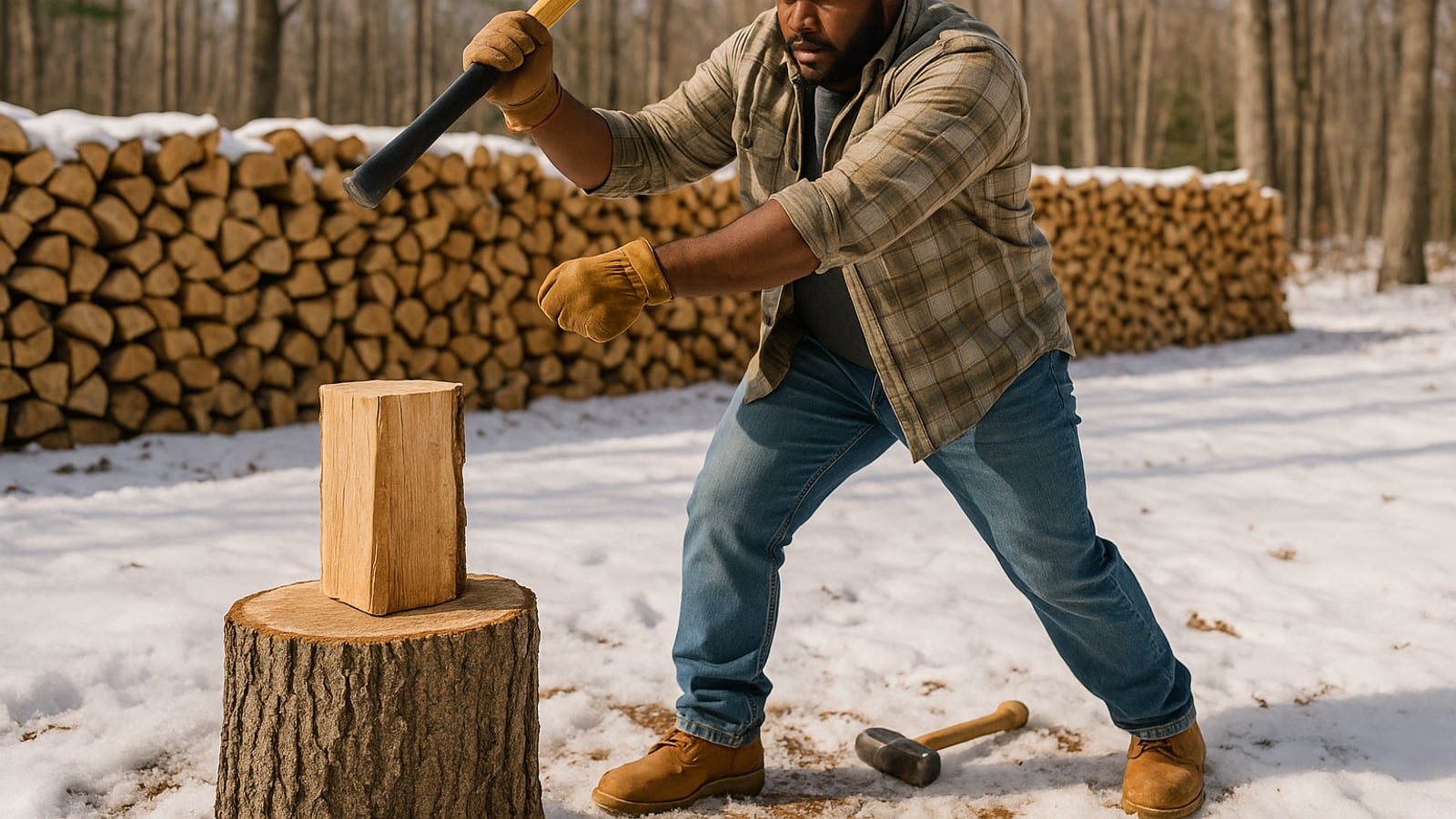
The block matters more than the axe. Find a wide, flat-topped round of something hard, set it on level ground, and get the top of it to about knee height. Twelve to sixteen inches tall is the range most people land on. Any shorter and a glancing blow carries through into your shin. Any taller and you're chopping downhill at a weird angle and losing half the energy of the swing.
That one adjustment fixes more bad splitting than any tool upgrade.
What you actually need
An eight-pound splitting maul will split nearly everything a homeowner burns. A lighter splitting axe, like the 36-inch Fiskars X27, moves faster and tires you out slower, which matters more than raw mass over three hours. If you can only have one and you're mostly working oak and hickory, take the maul. If it's ash, maple and pine, take the lighter axe.
Then: two steel splitting wedges, a small sledge, eye protection, boots with a hard toe, and gloves that fit. Loose gloves slip on the haft and that's how the head goes somewhere you didn't plan.
Never strike the back of an axe with a sledge. The poll on a splitting axe isn't hardened for it and it can spall. A maul's poll is designed to drive a wedge. Check yours before you assume.
Cut to length before you split anything
Measure the inside of your firebox and subtract three inches. For most stoves that gives you 16 inches, which is also the standard the whole firewood trade runs on. Cut every round the same length. A pile with 14s, 18s and 21s in it stacks badly, wobbles, and half of it won't fit the stove on a cold night when you don't want to be re-cutting anything.
Mark your chainsaw bar with a crayon at the right distance, or lay a cut stick along the log. Eyeballing drifts long by the end of the trunk. It always does.
Split green if you can. Freshly cut wood comes apart far easier than the same wood after a year in a pile, and it dries properly only once it's split. Winter helps too. Frozen rounds pop.
The swing
Stand with your feet a bit wider than your shoulders and far enough back that the head lands on the block, not past it. Grip with both hands near the end of the haft, then let your top hand slide down toward the bottom hand as the head comes down. That slide is the whole thing. It's what turns a chop into a drop with steering.
Let the weight do the work. Half-speed on the right spot beats a wild full-power swing every time, and a wild swing is how you bury the head in the block sideways or clip the dirt.
On anything over ten inches across, don't aim for the middle. Look at the end grain for the checks, the cracks radiating out from the heart, and put the edge into one. If there aren't any, work the outside: take slabs off the edge, going around the round like peeling an apple, until what's left is small enough to halve.
Never steady a piece with your hand and swing with the other. If a round won't stand up on its own, sit it inside an old tire laid flat on the block, or ring it with a bungee cord. Both keep the split pieces upright and standing so you're not bending over every ten seconds. Your back will notice by round forty.
Keep everyone out of a full circle around you, not just the front. Heads come loose. Glancing hits come back.
And stop before you're worn out. Almost every splitting injury happens in the last twenty minutes, when the swing has gotten sloppy and the person is telling themselves there are only six rounds left.
The ones that won't split
Elm. Sycamore. Sweetgum. The grain is interlocked, and you can hit a 20-inch elm round forty times and end up with a hairy, stubbornly whole 20-inch elm round. This isn't a technique problem.
Options, in order: cut them shorter, because a ten-inch length of elm will sometimes go when a sixteen won't. Or set them aside for a splitter. Or noodle them with the chainsaw, cutting lengthwise with the grain to slice the round into manageable chunks. It throws long stringy chips and eats a chain, but it works.
For knotty rounds and crotch pieces, drive a wedge into an existing check, then start a second wedge a few inches along the same line before the first is fully buried. Two wedges working the same crack open wood that one never will.
When to stop being stubborn and rent a splitter
If you're putting up more than three or four cords a year, hand splitting stops being exercise and starts being your entire October. A rented hydraulic splitter for a weekend, with a second person feeding it, will do in a day what takes two weeks of evenings.
The trade-off is honest: a splitter is slower per individual piece and it's noisy and it costs money. It also never gets tired, which is the part that wins after hour two. It has its own injury too, and it's fingers. One person on the lever, hands clear the moment the wedge moves, no reaching in to reposition a log under pressure.
Stacking so it dries
Get it off the ground. Pallets, a couple of 2x4s on cinder blocks, two straight poles laid parallel. Wood in direct contact with soil wicks moisture up and the bottom course will be punky inside of a year.
Pick a spot with sun and the prevailing wind on the long face of the stack. A single row dries much faster than a fat block of wood four rows deep, because air has to get through the middle.
The ends are what collapse. Cross-hatch them log-cabin style, alternating the direction every course, or brace against a post driven in. Keep the whole thing under about four feet high. Taller stacks lean, and a stack that leans eventually goes over, usually in the dark.
Cover the top only. A foot or so of overhang, weighted down, tarp or old roofing metal. Wrapping the sides traps moisture against the wood and undoes the entire point. Bark side up on the top course, so it sheds.
Know what a cord is
A cord is 128 cubic feet stacked: four feet by four feet by eight feet. A "face cord" or "rick" is four by eight by however long the pieces are, so at 16 inches it's a third of a cord. When you're buying, ask which one they mean and ask what length. That's where most firewood arguments start.
Seasoning: ash and pine can be ready in one summer. Oak wants two years. You're aiming for under 20 percent moisture, and if you check with a meter, split a piece open and test the fresh face. The outside of a round always reads dry and always lies. Without a meter, look for cracked ends, loose bark, and a sharp clack instead of a dull thud when you knock two pieces together.
Keep a week's worth on a rack by the door, not heaped against the siding where it holds water and brings insects to the house.
Stack this year's wood beside last year's and always burn from the older pile. Two stacks is the whole system. Once you're a year ahead, you'll never think about firewood during a cold snap again.
Wes Dunbar
Country & Skills
Grew up on an acreage and never quite left. Covers trucks, trades, land, and how to do the thing yourself.

Watch
Worth an hour of your evening
More from Skills.
From channels we rate. Plays on YouTube.
Read next