If the top third of a radiator is cold and the bottom is hot, that's air. Ten minutes and a radiator key fixes it. If the bottom is cold and the top is hot, that isn't air and bleeding it will do nothing at all. Knowing which one you're looking at saves you an afternoon.
Put your palm flat on the panel, low down, then slide it up. The transition tells you everything.
The kit
A radiator key. It's a small stamped bit of metal with a square socket, costs a couple of pounds at any hardware shop, and you will lose it, so buy two and put one in the boiler cupboard. Some modern valves take a flat-blade screwdriver instead. Look at the bleed point in the top corner before you go shopping.
An old towel on the floor. A small jug or a mug in your other hand. A cloth.
The water that comes out is black. Not tea-coloured. Black, oily, and full of magnetite, which is rust in suspension. It will stain a cream carpet permanently and it will mark grout. Treat it like sump oil and you'll be about right.
Turn the heating off and wait
Don't do this with the system running hot. Two reasons. The water in there's hot enough to scald badly, and a running pump keeps air moving around instead of letting it collect at the high points.
Switch the heating off at the programmer, then give it twenty to thirty minutes. The radiators should be warm to the touch, not hot. Air rises and gathers in the top corner while it sits.
While you're waiting, find your boiler and work out which system you've got. A combi or a sealed system has a pressure gauge on the front and a filling loop, usually a braided silver hose with a valve at each end underneath. An older open-vented system has a small header tank in the loft and no gauge. You need to know, because bleeding lets water out, and on a sealed system you have to put it back.
If you have a gas boiler and something about it's already wrong — error code, smell of gas, water weeping from a pipe — stop. That's a Gas Safe registered engineer's job, not yours.
Work in order
Start on the ground floor, at the radiator furthest from the boiler. Work through that floor, then go upstairs and do the same. Finish at the radiator closest to the boiler on the top floor.
The logic is simple enough. Air travels upward and outward through the pipework, so you're pushing it ahead of you rather than chasing it back and forth. If you do the upstairs bathroom first and the downstairs hall last, you'll often find yourself doing the bathroom again.
Do every radiator, even the ones that feel fine. It takes thirty seconds each and it's the only way to know.
The bleed itself
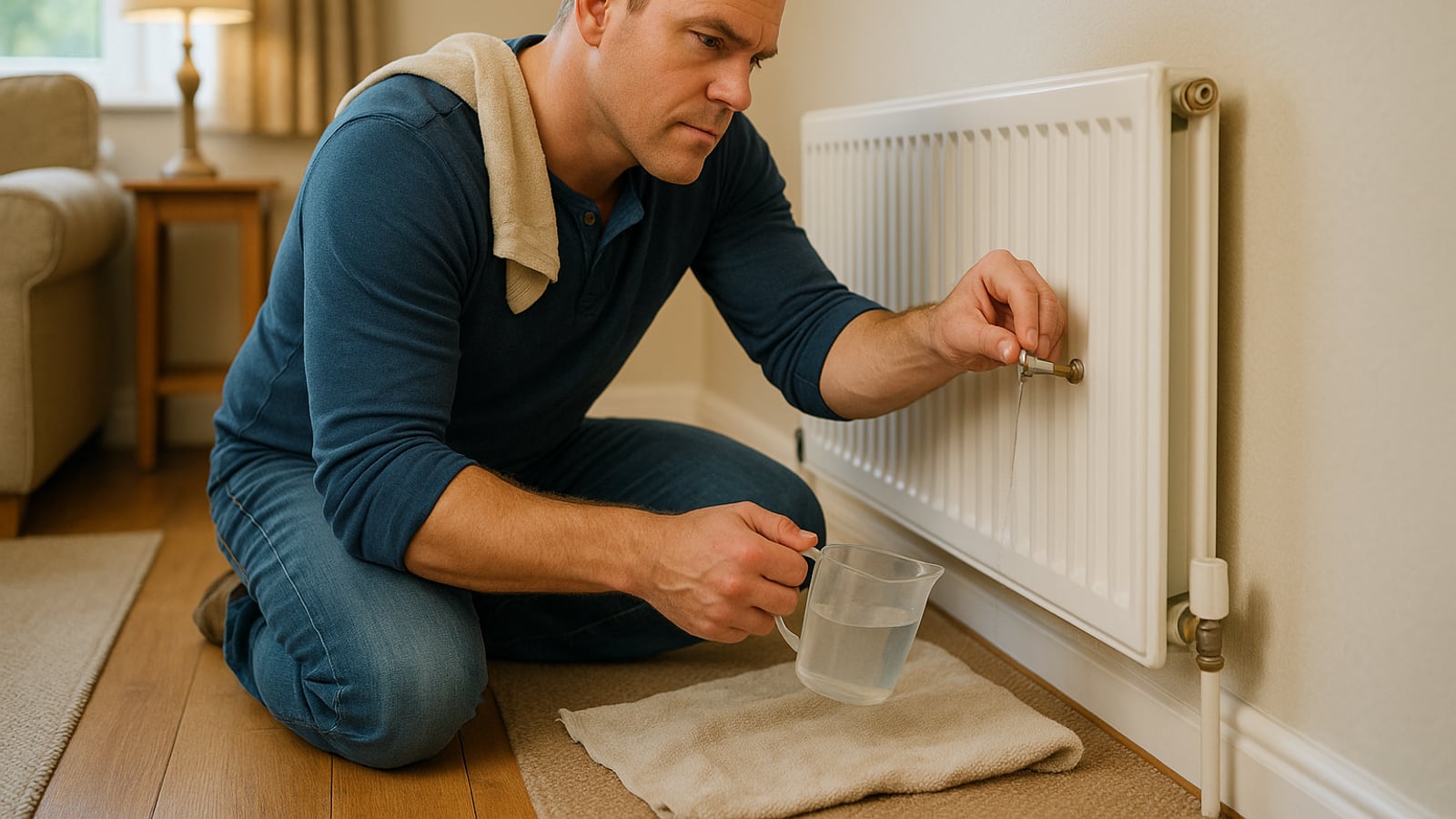
Towel down. Jug held under the valve, tilted so the lip is almost touching the brass.
Push the key on and turn it anticlockwise, a quarter turn. No more. You'll hear a hiss. That's the air.
Hold it there. The hiss will thin out, then spit, then turn into a steady dribble of water. The moment it's water rather than spray, close it. Quarter turn clockwise, firm, not gorilla-tight. Brass is soft and the square nipple will round off if you lean on it.
Wipe the valve and the skirting behind it.
Two things go wrong at this stage. The first is opening the valve too far — a full turn or two can unscrew the spindle completely, at which point you have a hot open hole in your radiator and about four seconds to get your thumb over it. Quarter turn, every time.
The second is closing it while it's still hissing because you're nervous about the water. If air is still coming out, air is still in there. Wait for the dribble.
Check the pressure before you walk away
On a sealed system, every radiator you bleed drops the pressure a little. Go and look at the gauge on the boiler.
Cold, it wants to sit somewhere around 1 to 1.5 bar. Most gauges have a green band printed on them. If the needle has fallen below about 0.8 bar the boiler may lock out and refuse to fire, usually with a low-pressure fault code.
To top it up, open both valves on the filling loop slowly. You'll hear water rushing. Watch the needle, not the hose. Close both valves as soon as you hit 1.2 or so, because it climbs further when the system heats up, and if it goes past about 3 bar the pressure relief valve will dump water out of a pipe on the outside wall.
Then fire the heating back up and leave it an hour before you judge anything.
Cold at the bottom is a different problem
This is the one people waste time on. A radiator that's hot across the top and cold along the bottom edge, often with the cold area shaped like a low hill, is full of sludge. Magnetite has settled out of the water and built up along the floor of the panel, and no amount of bleeding will shift it.
Fixing it means either a chemical clean and flush of the system, or taking that radiator off the wall, carrying it outside and running a hose through it. The hose method works and costs nothing but a wet morning. It's also heavy, messy, and you need to cap both valves properly before you lift it, so think honestly about whether you want to.
If you do have it flushed, ask about a magnetic filter on the return pipe and inhibitor in the water. That's what stops it coming back.
The radiator that's stone cold all over
Everything else in the house is hot and one is dead. Nine times out of ten it's the thermostatic valve, and the pin inside has seized.
Unscrew the plastic head — it usually comes off by hand or with a gentle turn of a spanner on the collar. Underneath is a small metal pin. Press it. It should spring back. If it's stuck down flush, grip it with pliers and work it up and down a few times, or tap the side of the valve body with the handle of a screwdriver. It'll usually free off with an audible click and the radiator will be warm within ten minutes.
Put the head back on and turn it fully open and fully closed a couple of times over the next week.
When to stop doing it yourself
Bleeding the same radiator every few weeks is a symptom, not a chore. Air keeps arriving because something is letting it in — a small leak somewhere drawing air on the suction side, a failing automatic air vent, or corrosion generating hydrogen inside the system. Repeated bleeding just manages it while the pipework gets worse.
One bleed in autumn is normal. Four bleeds by Christmas means you need a heating engineer.
Put the spare key back in the cupboard. You'll want it in October.
Wes Dunbar
Country & Skills
Grew up on an acreage and never quite left. Covers trucks, trades, land, and how to do the thing yourself.

Watch
Worth an hour of your evening
More from Skills.
From channels we rate. Plays on YouTube.
Read next