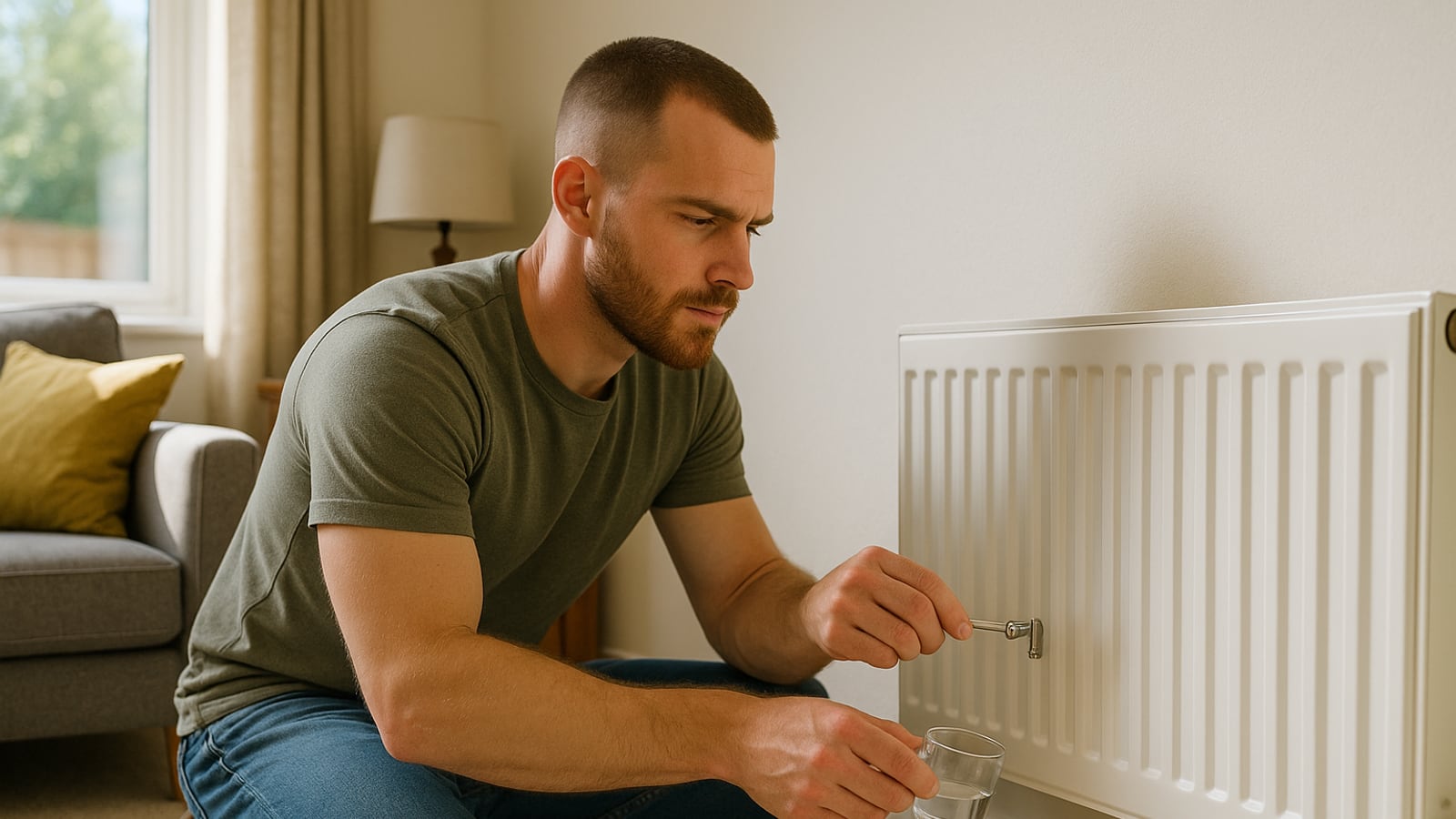
Put your hand flat on the radiator that's annoying you. If the bottom is hot and the top is cold, you've got air trapped in it and you can fix that yourself before lunch. If the top is hot and the bottom is cold, stop. That's sludge sitting in the base of the panel, bleeding won't touch it, and you'll need a proper flush.
That one check saves most people an hour of pointless fiddling.
A radiator key costs under two pounds in any hardware shop. Buy two, because you will lose one. Some newer radiators take a flathead screwdriver instead, and a few take a 5mm spanner, so look at the bleed valve before you go shopping. It's the little square or slotted nipple at the top corner of the panel, usually on the end facing the wall.
What you need on the floor next to you
An old towel, a small cup or a yoghurt pot, the key, and a screwdriver. That's the lot.
The towel goes under the valve and stays there for the whole job. The cup catches the water when it comes, and it will come, and it's the color of strong tea. It stains carpet and it stains skirting. People skip the towel because the hiss of air sounds harmless, then the air runs out without warning and a thin jet of black water goes horizontally across the room.
Turn the heating off first, then wait
Switch the heating off at the thermostat or the programmer. Then leave it. Twenty minutes minimum, an hour if you've been running it hard all evening.
Two reasons. First, the water in that pipework can be near 70°C and you're about to open a hole in the system at head height while kneeling under it. Second, while the pump is running it pushes air around the circuit, so you'll bleed one radiator and the air will simply relocate to another. With the pump off, the air rises and sits in the top of the panels where you can get at it.
Check the radiator is properly cool with the back of your hand, not your palm.
Work in the right order
Start downstairs, at the radiator furthest from the boiler. Work back towards the boiler. Then go upstairs and do exactly the same thing, furthest first.
Air travels up. If you start with the upstairs bathroom because that's the one that's cold, you'll bleed it, then bleed the lounge, and half the air from downstairs will find its way back up to the bathroom. Doing the whole house in order means you only go round once.
The actual bleed
Slide the key onto the valve square. It only goes on one way and it should feel snug. Turn it anticlockwise and stop after a quarter turn.
You want a hiss. Not a gush.
A quarter turn is enough for air to escape and not enough for water to fire out. Hold the cup under the valve with your other hand. When the hissing stops and you get a steady dribble of water with no spitting, that's it. Close the valve clockwise, firm but not heaved on. You're tightening a small brass thread into a brass body, and if you crank it you'll either round the square or crack the seat.
Wipe the valve dry with the towel and move on. A radiator that's been full of air can take thirty seconds. A big double panel in a cold hallway can take two minutes.
Now check the boiler pressure, because you just lost some
This is the step everyone forgets, and it's the one that leaves you with no heating at all the next morning.
Every cup of water you let out came from a sealed system. If you've done eight radiators, the pressure gauge on the front of your boiler will have dropped. Look at it now. Most sealed systems want somewhere around 1 to 1.5 bar when cold. The gauge usually has a green band or two red marks showing the range for your boiler.
If it's sitting below the bottom mark, you top it up with the filling loop. That's the braided silver hose under the boiler with a valve at each end, or on some models an internal key or lever. Open both ends slowly, watch the needle climb, and close them the moment you're in range. It moves faster than you expect. Overfill it and the pressure relief valve will dump water out of a pipe on your outside wall, and you'll be drying a patch of render in February.
If you've got an older open-vented system with a small tank in the loft, there's no filling loop and no gauge. It refills itself. Check the ball valve in that tank isn't stuck, and that's your lot.
If the gauge drops again within a week, you have a leak somewhere. Get a heating engineer in. Anything behind the boiler casing on a gas appliance is Gas Safe territory and it isn't a gray area.
When it doesn't go to plan
Nothing comes out at all. The bleed hole is blocked with old paint or gunk. Close the valve, then reopen it and clear the hole with a pin or a thin nail. Stand to the side.
The key spins and nothing happens. The square is rounded, usually because someone before you attacked it with pliers. A bleed valve can be replaced, but it means draining the radiator down, so that's a job for a decent afternoon or a plumber.
One radiator stays stone cold everywhere. Check the thermostatic valve at the bottom. Take the white plastic head off and look at the metal pin underneath. If it's stuck down, tap it gently with the handle of a screwdriver and pull it up with pliers. Seized TRV pins after a summer of no heating are one of the most common causes of a dead radiator in October.
You're bleeding the same radiator every month. Air shouldn't keep appearing in a sealed system. Something's drawing it in, or the water's corroding the steel and producing gas. Call someone.
While you're there
If your radiators have been rubbish for a couple of winters, the water in them is probably full of iron oxide. A magnetic filter on the return pipe catches it, and a dose of corrosion inhibitor stops it forming. Both are fitted by an engineer in an hour or so, and they'll do more for your heating bill than bleeding ever will.
The last thing. Take the spare key, put it in a sandwich bag, and tape it to the side of the boiler cupboard wall. Next November, that's the difference between an eight-minute job and a cold bedroom for a fortnight.
Wes Dunbar
Country & Skills
Grew up on an acreage and never quite left. Covers trucks, trades, land, and how to do the thing yourself.

Watch
Worth an hour of your evening
More from Skills.
From channels we rate. Plays on YouTube.
Read next