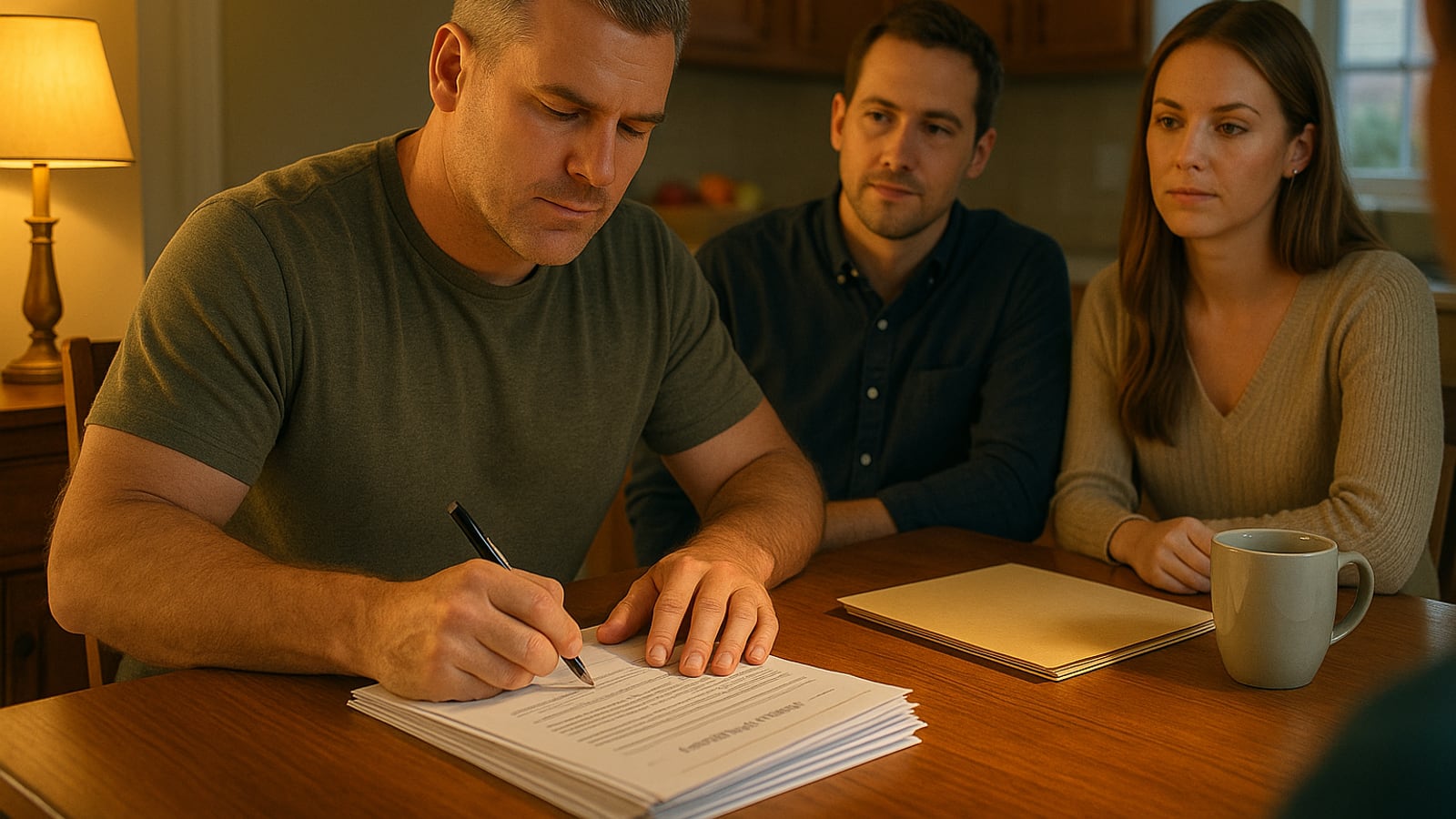
Name a guardian for your children. If you take one thing from this and act on it this week, make it that, because if you die without naming someone, a judge who never met your family decides instead, working from a court file and whoever turns up to ask.
Everything else in a will is logistics. That part isn't.
The document itself is less intimidating than people expect. In most states you need to be a legal adult, of sound mind, and you need two adult witnesses who aren't named as beneficiaries. Sign it in front of them, have them sign in front of you, and in most places you'll also want a notary for what's called a self-proving affidavit, which saves your executor from tracking down those witnesses years later to confirm they watched you sign. Rules vary by state. Check yours, or ask an estate attorney to check it for you.
The form that beats your will
Your will doesn't control your 401(k). It doesn't control your IRA, your life insurance payout, or any account with a payable-on-death designation on it. Those go to whoever is named on the beneficiary form held by the plan administrator, and that name overrides whatever your will says.
This is where things go badly wrong, and it's almost always the same story. Someone fills out a beneficiary form at twenty-three on their first day at a job, names a parent or a college girlfriend, gets married, has kids, writes a careful will at forty, and dies at fifty-two with the original form still on file. The insurance company pays the name on the form. The family finds out in the worst week of their lives.
So before you touch a will at all, go pull every beneficiary designation you have. Employer retirement plan. Any old 401(k) from a job you left. IRAs. Life insurance through work and any policy you bought yourself. HSA. Brokerage accounts with transfer-on-death instructions. Update the ones that are wrong, and name a contingent beneficiary on each, because if your primary dies first and there's no backup, the money can land in probate anyway.
One wrinkle worth knowing: for most employer plans governed by federal law, your spouse is the default beneficiary unless they've signed a waiver. That surprises people who assumed they could simply write a different name in the box.
Who's in charge, and did you ask them
Your executor is the person who gathers the assets, pays the debts, deals with the court, and hands out what's left. It's a job. It takes months, sometimes longer, and it lands on them while they're grieving.
Pick someone organized over someone senior. Your oldest brother isn't automatically the right choice, and neither is the friend who's good in a crisis but has never filed anything on time in his life. Name an alternate. Then call both of them and ask, out loud, before you put their names in the document. Being told at a funeral that you've been volunteered is a rotten surprise.
Same goes for guardians. Ask. Ask both halves of the couple separately if you can, because one of them may be quietly appalled and going along with it. Talk about what you'd want: schooling, faith, where the kids would live, whether they'd stay near their cousins. You can put a non-binding letter of wishes alongside the will explaining all of that. A judge isn't required to follow it, but they read it, and so does the guardian.
What a will won't do
It won't keep your family out of probate. A will is instructions for probate, not a way around it. If avoiding probate matters to you, that's a revocable living trust conversation, and a trust only works if you actually retitle assets into it. Half-funded trusts are one of the most common expensive mistakes in this whole area.
Most people with a house, a couple of accounts and young kids don't need one. Blended family, a business, property in more than one state, a child with a disability who receives benefits, or an estate large enough to bump into estate tax thresholds, and you should be paying an attorney rather than reading articles.
That's the honest trade-off with the online will services. For a straightforward situation, a well-made template signed correctly is enormously better than nothing, and nothing is what most people have. For anything with moving parts, the few hundred dollars you save drafting it yourself can cost your family many times that in litigation. A special-needs child inheriting outright can lose benefits. A second marriage without careful drafting can accidentally disinherit children from the first. Templates don't know any of that about you.
The signing is where people fail
Unsigned drafts are the single saddest thing that shows up in estate files. Someone did the hard thinking, printed it, meant to sort out the witnesses on Saturday, and never did.
Block twenty minutes. Two witnesses who get nothing under the will, plus a notary. Many banks and shipping stores have a notary on staff; call first and ask if they'll also serve as one of the witnesses, because some won't.
Don't sign multiple originals. Don't write on it afterwards. If you want to change something, you do a formal amendment, called a codicil, or you redo the whole thing. A crossed-out line in blue pen and an arrow in the margin is an invitation for someone to contest it.
Store it somewhere findable. A fireproof document box at home works. A safe deposit box can work but check first with your bank and attorney how it's accessed after death, because in some situations getting into it requires exactly the court order your executor is trying to obtain using the will inside it.
The other three documents, which you'll probably use first
A will only matters once you're dead. These matter while you're alive, and statistically you're more likely to need them.
- Durable power of attorney. Someone who can pay your mortgage and talk to your bank if you're unconscious for six weeks. Without it, your wife may need a court to get that authority.
- Health care proxy or medical power of attorney. Who decides treatment when you can't speak.
- Living will or advance directive. What you want done, and not done, at the end. Write it down so nobody has to guess and then carry the guess around for years.
If you have a faith tradition with a clear view on end-of-life care, say so in writing, and tell your pastor or priest as well as your family.
The list that makes all of it usable
Separately from the legal documents, write a plain letter of instruction. No lawyer needed. Where the will is. Account numbers and institutions. The mortgage servicer. The life insurance policy number. Who does your taxes. The safe combination. Whether there's a burial plot. What you want sung.
Digital access belongs here too. Most password managers have an emergency access feature that grants a trusted person entry after a waiting period. Set it up. Many states now have laws letting you authorize a fiduciary to reach your online accounts, but the platforms still make it painful, and one working password saves weeks.
Update the whole set after a marriage, a divorce, a birth, a death, a move to another state, or a big change in what you own. Otherwise read it through every three years or so. Put a reminder in your calendar for a date you'll actually see.
Then tell one person where it lives. A will nobody can find is just paper with your signature on it.
Ray Okonkwo
Money & Business
Former commercial banker turned small-business owner. Covers salary, credit, margins and the arithmetic nobody does before signing.

Watch
Worth an hour of your evening
More from Be a Man.
From channels we rate. Plays on YouTube.
Read next