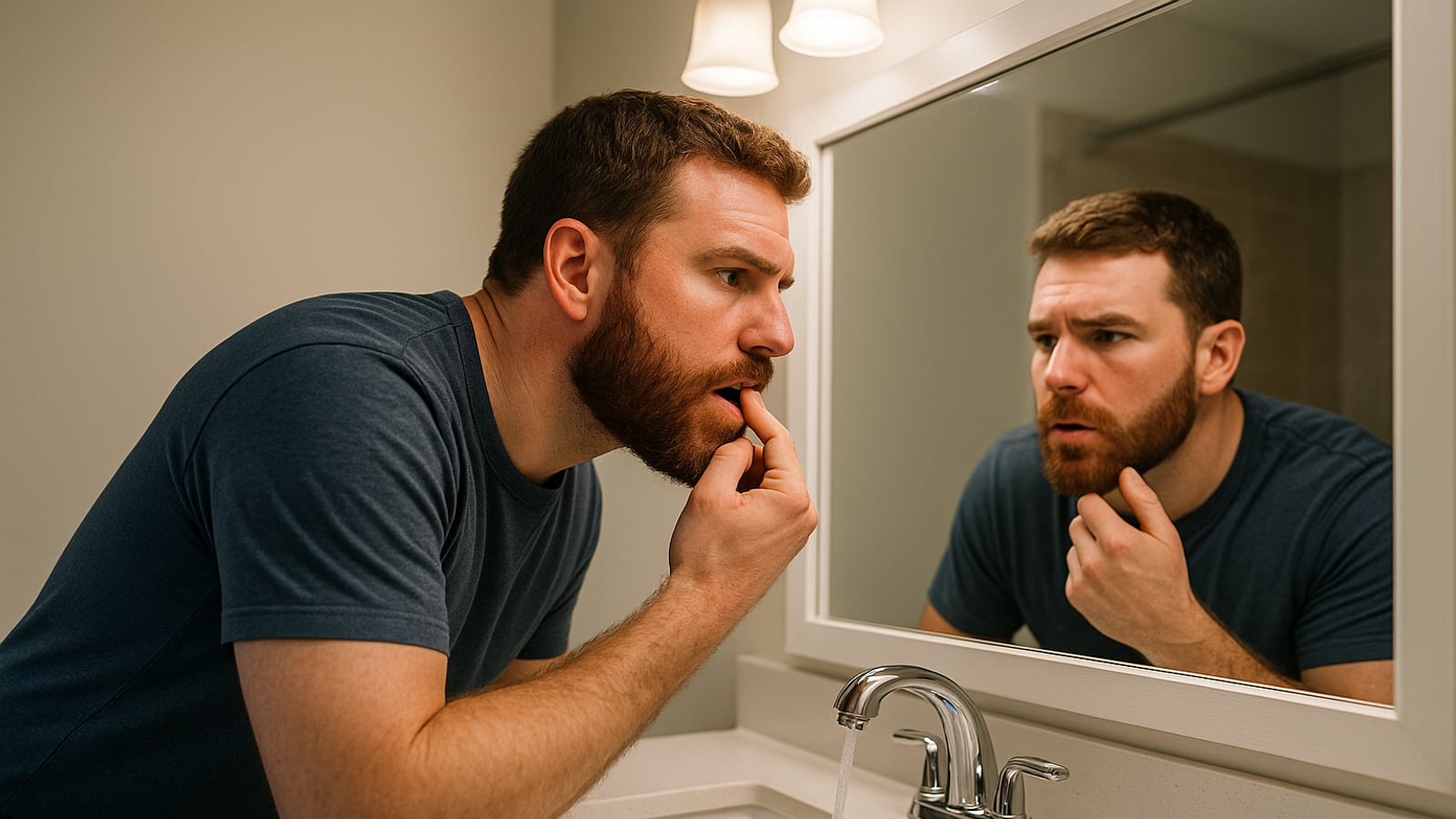
Healthy gums don't bleed when you brush them. That's the entire test, and you can run it tonight.
Skin doesn't bleed when you wash your arm. Gums are the same deal. If the foam comes out pink, something under there's inflamed, and the standard male response is to brush that spot more gently for the next eighteen months until it stops bleeding. It stopped because you stopped touching it. That's not healing.
Most guys find out the hard way, in a chair, when a hygienist reads numbers off a probe and the numbers keep being fours and fives.
What the probe is actually measuring
At a real cleaning, someone runs a thin marked instrument into the space between your tooth and the gum and calls out a depth in millimeters, six spots per tooth. That's the periodontal chart. Somewhere between 1 and 3 millimeters is healthy. Four starts the conversation. Five, six and up means the gum has pulled away and you've got a pocket that a toothbrush can't reach, because a toothbrush bristle isn't three millimeters long and doesn't turn corners.
They're also noting bleeding on probing. A pocket that doesn't bleed is stable. A pocket that bleeds is active.
Ask for the numbers out loud. Ask what they were last time. If you have nothing else from this piece, take that: "What were my pocket depths, and how many sites bled?" It turns a vague "you should floss more" into a scoreboard you can move.
Gingivitis, the early version, is reversible. You can turn it around in a couple of weeks with nothing but a brush and something between your teeth. Periodontitis, the version where bone has started to go, is manageable but not reversible. Bone doesn't grow back because you finally got serious. That's the line worth staying on the right side of.
The part that isn't about your mouth
A chronically inflamed gum pocket is an open wound with a permanent bacterial population living in it. Add up all the pockets in a bad mouth and the wound surface isn't small.
Researchers have spent decades connecting gum disease to the rest of the body, and the honest summary is this: the association with cardiovascular disease is consistent and the causation is still argued about. The diabetes link is the strongest one. It runs both directions. High blood sugar makes gum infection worse, and gum infection makes blood sugar harder to control. Treating the gums has been shown to improve glycemic markers. If you're managing type 2 or sitting in the prediabetes range, your dentist is part of that team whether anybody told you or not.
There's ongoing work on rheumatoid arthritis, pregnancy outcomes and cognitive decline. Interesting, not settled. Don't let anyone sell you a mouthwash on the strength of an Alzheimer's headline.
What you can say without overreaching: your body doesn't run a separate inflammation budget for your mouth. And smoking or vaping makes all of it worse while hiding the warning sign, because nicotine constricts the small vessels in the gum. Smokers often don't bleed. They just lose bone quietly. Same story with pouches parked in the same spot in the lip every day. Dentists can usually tell you which side a guy keeps his, because the gum there has receded off the root.
The routine that survives a job and a four-year-old
Optimal is a ten-minute nightly ritual with three tools and a timer. Nobody with a commute and a kids' bedtime does that for a year. So here's what actually holds.
Two minutes, twice a day, soft bristles. Hard bristles don't clean better. They scrub the gum off the root. Angle the bristles at about 45 degrees so they're pointed into the gum line, not flat against the tooth face. The gum line is where all of this starts and it's the part everybody skips.
Get an electric brush if you'll use it. The main thing it buys you is the timer and the fact that it doesn't let you scrub like you're cleaning grout. Good ones run from around thirty dollars up to stupid money, and the cheap end of a reputable brand is fine. The expensive one you leave uncharged does nothing.
Clean between your teeth once a day, and be a realist about the tool. String floss has a weaker evidence base than dentists imply, mostly because almost nobody uses it correctly. If you've got any space between your teeth, interdental brushes, the little bottlebrush ones on a handle, tend to do more and take less patience. A hygienist can tell you which size fits your gaps. Water flossers work well for people with bridges, implants or braces. Floss picks are the worst of the options and infinitely better than the nothing you're currently doing.
Night brush beats morning brush. Saliva flow drops while you sleep, so whatever's on your teeth at 11 p.m. gets eight uninterrupted hours. If you only get one good clean in, make it the last thing you do.
Spit, don't rinse. Rinsing your mouth with water right after brushing washes the fluoride straight out. Spit and walk away.
Keep a pack of interdental brushes in the truck console and another in your gym bag. Between-teeth cleaning done badly in a parking lot counts. Between-teeth cleaning planned perfectly for tomorrow doesn't.
Training habits that quietly wreck your gums and teeth
Sipping a carb drink across a two-hour ride bathes your teeth in sugar and acid for two hours. Same with gels, chews and dried fruit, which pack into the grooves and sit. Rinse with plain water when you're done, and wait thirty minutes before brushing if you've had anything acidic, because enamel is temporarily softened and brushing right away scours it.
Hard efforts mean mouth breathing, and mouth breathing dries everything out. Saliva is your actual defense system. Dry mouth from breathing, medications or a CPAP mask all push the same direction. Water, not more sports drink.
And if you wake up with sore jaw muscles or your dentist points out flat wear facets on your molars, you're clenching. Grinding doesn't cause gum disease, but it accelerates the damage when bone support is already thin. A night guard is a cheap insurance policy.
When it stops being a housekeeping issue
Call a dentist, not next quarter:
- Gums that bleed every single time, for more than two weeks of good brushing
- A tooth that feels loose, or bites differently than it used to
- Gums pulling back so a tooth looks longer, especially one tooth in particular
- Persistent bad taste or a bad smell you can't brush away
- A swelling, a bump on the gum, or pain with facial swelling and fever, which is same-day
Cleanings every six months is the default. If you've got pockets, three or four months is common, and skipping them to save a couple hundred dollars is how people end up pricing implants. Deep cleaning, scaling and root planing, is done with the area numbed and it's not the ordeal guys imagine.
None of this is a diagnosis. A dentist with a probe and a set of X-rays gives you that, and if the numbers are ugly, a periodontist is the specialist to ask for.
Two weeks of honest brushing and one pass between the teeth every night. Then look at the sink.
Cal Brennan
Fitness
Strength coach. Trains fathers, tradesmen and desk workers, which means programmes that survive a bad week.

Watch
Worth an hour of your evening
More from Fitness.
From channels we rate. Plays on YouTube.
Read next