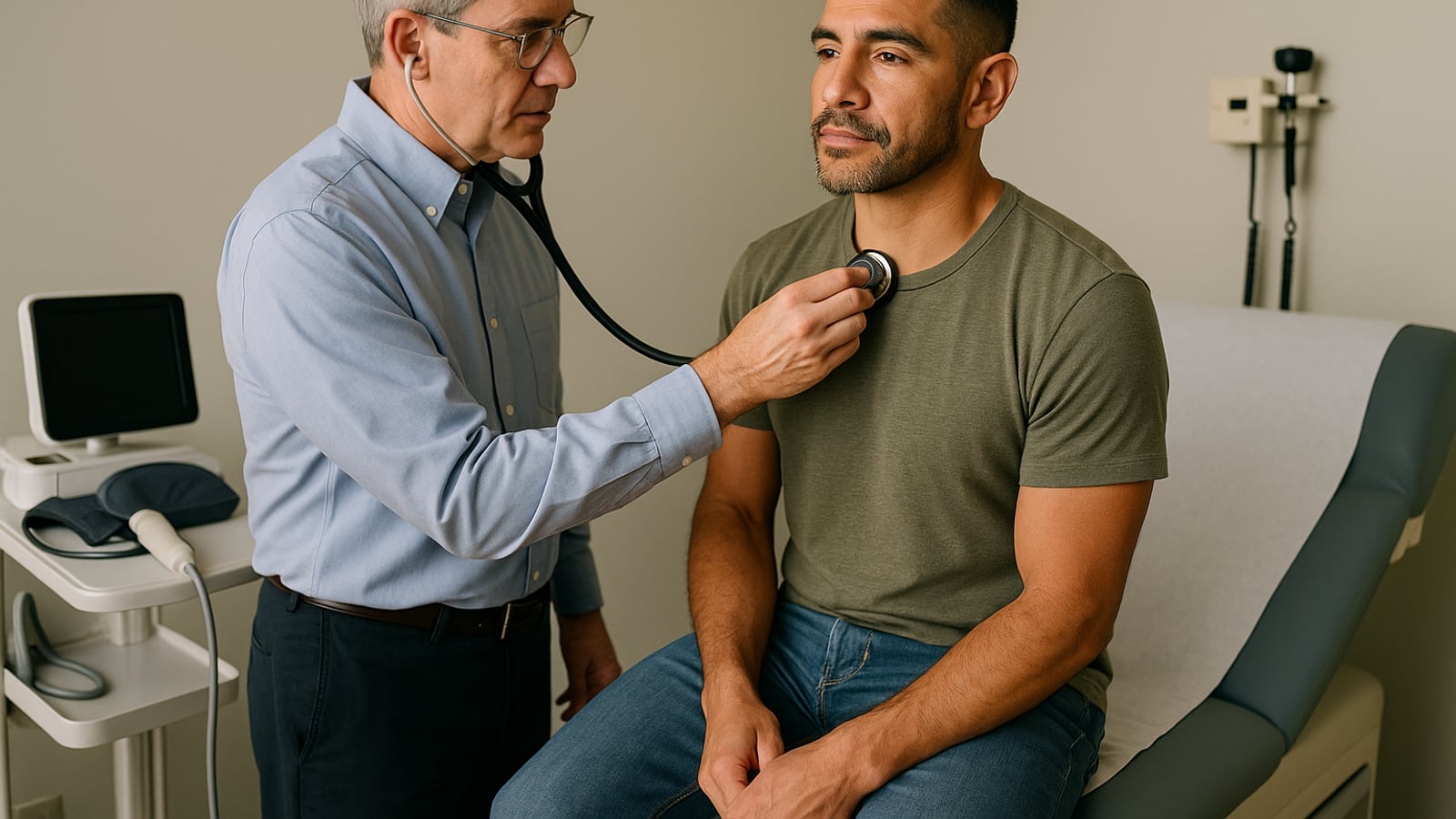
If your doctor pressed a stethoscope against the side of your neck and then went quiet for a second longer than usual, he was listening for a bruit. It's a whooshing sound made by blood squeezing past a narrowed spot in the carotid artery. Sometimes it means nothing. Sometimes it buys you a 20-minute ultrasound and a conversation you weren't planning to have on a Tuesday.
That's one of two stroke conversations. The other one starts with your pulse, not your neck, and it ends with a word most guys flinch at: anticoagulant. Eliquis, Xarelto, warfarin. A pill you take for the rest of your life so a clot doesn't ride up into your brain.
They're different problems with different fixes, and they get blended together at the exam table until nobody knows which one they're deciding about. Sort that first.
Rhythm problem or plumbing problem
Atrial fibrillation is a rhythm problem. The top of the heart quivers instead of squeezing, blood pools in a little pocket called the left atrial appendage, and pooled blood clots. That clot doesn't stay put. AF is one of the biggest single drivers of stroke risk in adults, and guideline groups like the American Heart Association treat it that way. The fix is a drug that makes clots harder to form.
Carotid stenosis is a plumbing problem. Plaque builds up in the artery running up the side of your neck, narrows the channel, and bits of debris can break loose. The fix is some combination of aggressive medical treatment and, in certain cases, a surgeon.
Same outcome if you ignore either one. Completely different decision tree.
You can have both, and plenty of men in their sixties do. But when you walk out of the office, you should be able to say out loud which one you're being treated for. If you can't, call back and ask. Nurses answer that question all day.
The AF question is a score, not a coin flip
Doctors don't guess on this. There's a scoring tool called CHA₂DS₂-VASc that adds points for age, high blood pressure, diabetes, heart failure, prior stroke and vascular disease. For men, a score of 2 or more usually tips toward long-term anticoagulation. Ask for your number. Write it down.
Two things men get wrong here.
The first is aspirin. For a long time, aspirin was the compromise offered to guys who didn't want a real blood thinner. For stroke prevention in atrial fibrillation, it isn't the answer, and current guidelines stopped pretending it was. If your AF earns anticoagulation, aspirin isn't a lighter version of the same thing. It's a different, weaker drug with its own bleeding risk.
The second is thinking of AF as an episode. You felt the flutter, it stopped, you feel fine now. The clot risk doesn't track how you feel. Guys with AF they can't sense at all still stroke.
Warfarin versus the newer ones
Warfarin is the old one, and it's cheap. The cost is the maintenance. You get INR blood draws, usually targeting a range of 2 to 3, and the dose gets nudged around based on the result. Vitamin K matters, which means a big bowl of spinach or a week of kale can move your numbers. So can an antibiotic. So can beer.
The newer drugs, apixaban and rivaroxaban among them, need no routine INR checks and don't care much what you eat. They cost more, and how much more depends entirely on your plan. Ask the pharmacist to run the cash price and check whether the manufacturer has a copay program, because the difference between what two counters quote you can be absurd.
Both classes have reversal options if you end up bleeding badly or need emergency surgery. Warfarin has vitamin K and factor concentrates. The newer ones have specific reversal agents that most hospitals stock. Ask which one covers your drug and whether your local hospital carries it. Then put the drug name in your phone's medical ID, because you won't be the one talking if it matters.
Kidney function drives the dose on the newer drugs. If yours changes, the dose may need to change. That's a lab, not a guess.
Carotids, and the word that changes everything
The word is symptomatic. If you've had a stroke or a TIA on the same side as the narrowing, you're in a different category, and the threshold for opening the artery drops. Guidelines generally consider a procedure for symptomatic narrowing at 50 percent or more, and the timing matters. Weeks, not months.
Asymptomatic narrowing found by chance is the murkier one. Roughly, surgeons start thinking about it around 70 percent, but medical treatment has improved so much that a lot of asymptomatic plaque now gets managed with drugs and blood pressure control instead of a knife. High-dose statin, blood pressure under control, antiplatelet, no cigarettes.
The right question isn't "should we operate." It's "what's my annual stroke risk with medication alone, and what's the risk of the procedure itself in this hospital, with this surgeon." Those are two numbers. A good vascular surgeon will give them to you.
Training when your blood doesn't clot the way it used to
Nothing about a blood thinner says stop lifting. Squats, presses, rows, carries, walking hills with a pack, all still yours. Cardiovascular fitness and strength are part of the treatment, not a hobby you're getting away with.
What changes is head impact and falls. A bump that would've given you a headache can become a bleed you don't feel for hours. So:
- Drop the sparring. Boxing, hard rolling, anything where your skull gets rattled. This is the concession nobody wants to make, and it's the one that matters most.
- Helmet on the bike and the ladder job. Every time, including the short ride.
- Rethink the singles at maximum effort. Not because the weight hurts you, because blacking out on a heavy squat and hitting the rack does.
- Electric razor, softer toothbrush. Small, boring, works.
- Direct pressure for a full 15 minutes on a cut, timed, without peeking. Most job-site bleeds stop. The ones that don't need stitches, not a bandana.
Skip the NSAIDs. Ibuprofen and naproxen stacked on top of an anticoagulant raise stroke-patient odds of a gut bleed, and most guys take them like candy after a long Saturday. Ask your pharmacist what's fine for your knee instead. That conversation costs you four minutes at the counter.
And don't stop your blood thinner before a dental cleaning or a colonoscopy because somebody at the front desk told you to. That call belongs to the doctor who prescribed it.
The part no pill covers
Blood pressure under 130/80 does more for your brain than anything else on this page. LDL down, as low as your doctor wants it. Nicotine gone, all forms. Alcohol honestly reported, not the number you tell the intake form. Sleep apnea treated, because untreated apnea keeps AF coming back after every attempt to fix the rhythm.
Then learn BE-FAST and teach it to your wife and your kids. Balance, Eyes, Face droop, Arm weakness, Speech trouble, Time. If any of it shows up and clears by lunch, that's a TIA, and it's the warning shot, not the all-clear. Same-day emergency room. Not Monday.
Everything here's general education, and your situation belongs to your doctor and your pharmacist, not an article. Bring them the questions.
Most men think stroke prevention is one heroic decision. It's a pill you swallow in four seconds and a blood pressure cuff you actually use, repeated for twenty years, so you're still the guy who can carry the cooler from the truck to the bleachers.
Cal Brennan
Fitness
Strength coach. Trains fathers, tradesmen and desk workers, which means programmes that survive a bad week.

Watch
Worth an hour of your evening
More from Fitness.
From channels we rate. Plays on YouTube.
Read next