The 3 p.m. wall isn't a coffee problem. Neither is falling asleep on the couch at 8:40 with a kid still awake upstairs, or waking up at 6 with a dry mouth and a headache and the distinct feeling that the night did nothing for you. If your collar size is over 17 inches, your wife has elbowed you in the ribs more than once this year, and you're tired in a way that sleeping in on Saturday never fixes, you may not be lazy or old. You may not be breathing properly for chunks of the night.
Sleep apnea is mechanical. The soft tissue at the back of your throat relaxes when you sleep, the airway narrows or closes, and oxygen drops until your brain panics you into a partial wake-up to reopen it. You gasp, you shift, you go back under. You don't remember any of it. That cycle can run five times an hour or fifty. Every one of those micro-arousals pulls you out of the deep sleep where your body actually does its repair work.
Which is why this belongs in a training section. You can run the smartest two-day barbell plan ever written and it won't do much if the recovery half of the equation is broken every night for eight hours.
The signs, and the ones people miss
The classic picture is a heavyset man in his fifties who snores like a chainsaw. Real life is messier. Watch for:
- Loud, habitual snoring, especially snoring that stops, goes silent for a beat, then restarts with a gasp or snort. That pause is the tell. Ask whoever sleeps next to you.
- Waking up unrefreshed, no matter how long you were in bed.
- Morning headaches and a dry, sandpaper mouth.
- Nodding off during the boring parts of the day. Meetings. Church. A red light. That last one is the one that should scare you into a phone call.
- Waking two or three times a night to use the bathroom. Interrupted breathing messes with the hormones that regulate that.
- High blood pressure that won't come down, especially if it's already on medication.
- Irritability and a shorter fuse than you used to have. Chronic sleep fragmentation makes people mean. Your family notices before you do.
Women get missed constantly, because apnea in women often shows up as fatigue, insomnia, anxiety or morning headaches rather than the cartoon snoring, and it gets written off as stress or hormones. If that's your wife, she deserves the test too.
You don't have to be overweight, either. Thin people with narrow airways, recessed jaws or large tonsils get it. Weight makes it more likely. It isn't the only cause.
Two free screeners you can do tonight
Neither one diagnoses anything. Both are used by actual sleep clinics to decide who needs a test, and either one gives you something concrete to hand your doctor instead of "I've been kind of tired."
STOP-BANG. Eight yes-or-no questions. Snoring loudly, Tiredness during the day, anyone Observed you stopping breathing, high blood Pressure, BMI over 35, Age over 50, Neck circumference over about 17 inches for men or 16 for women, and male sex. Three or more yesses puts you at intermediate risk. Five or more puts you at high risk for moderate-to-severe apnea.
The Epworth Sleepiness Scale. Eight everyday situations, scored 0 to 3 on how likely you're to doze off. Sitting and reading. Watching TV. As a passenger in a car for an hour. Lying down to rest in the afternoon. A total above 10 means you're abnormally sleepy during the day, whatever the cause.
Do both. Write down the numbers. Ten minutes, total.
How the actual test works
Two routes, and your doctor picks based on what else is going on with you.
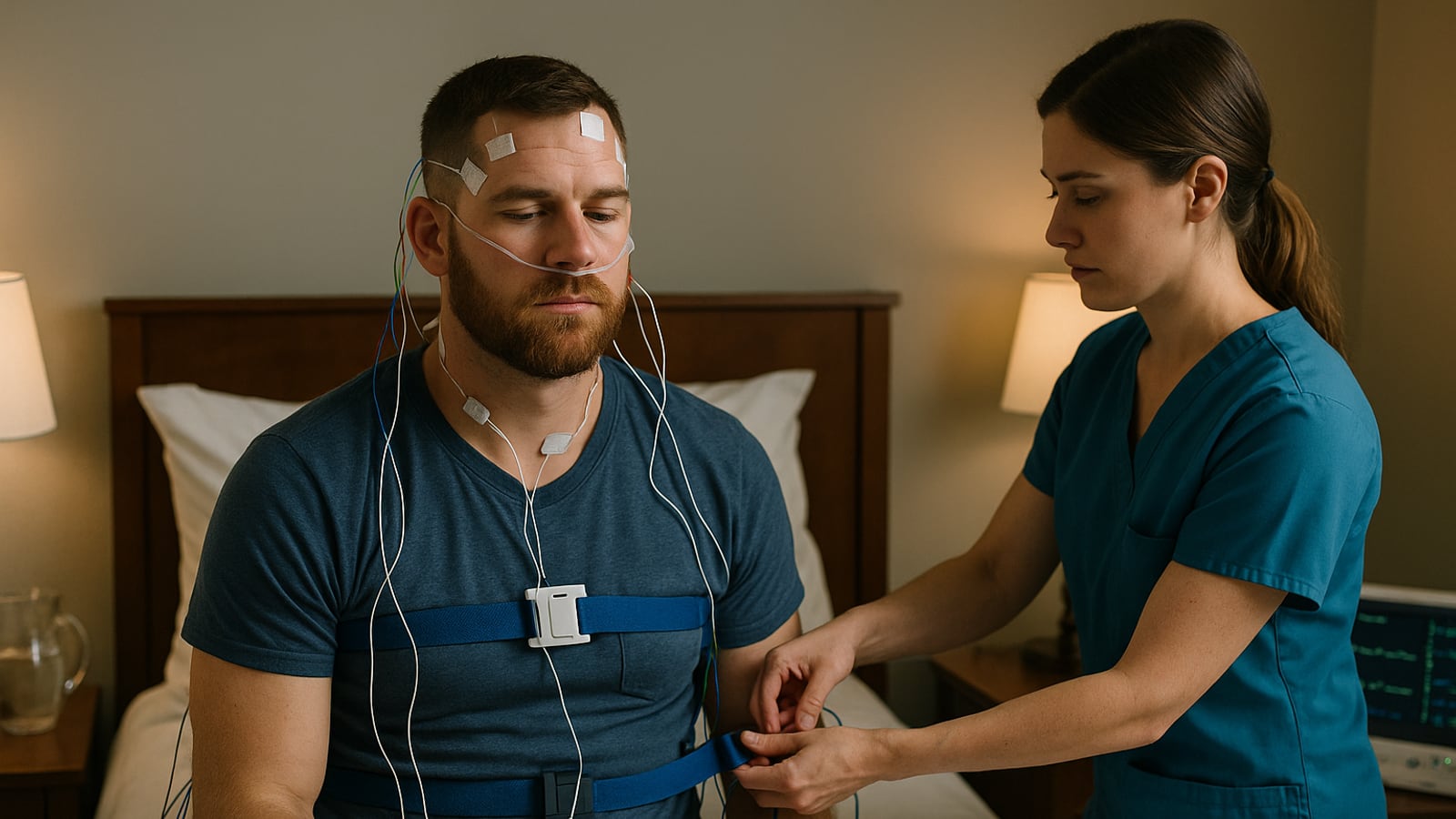
A home sleep apnea test is the common starting point now. They hand you a kit, you sleep in your own bed with a finger probe, a nasal cannula and a chest belt, and you return it in the morning. One or two nights. It's cheaper, faster, and you sleep more normally than you would wired up in a lab.
An in-lab polysomnography study is the full version. You sleep at a facility with EEG leads, leg sensors, the works. They measure sleep stages, not just breathing. You'll get sent this route if you have heart failure, significant lung disease, a suspected movement disorder, or if the home test came back clean but your symptoms didn't.
The annoying part nobody warns you about: home tests can underestimate. They generally can't tell whether you were actually asleep, so if you lay awake for two hours, that time gets averaged in and dilutes your score. A negative home test in someone with textbook symptoms is a reason to push for the lab study, not a reason to give up.
The number that comes back is the AHI, apnea-hypopnea index, which is events per hour. Roughly: 5 to 15 mild, 15 to 30 moderate, above 30 severe. Severe means your airway is closing more than once every two minutes, all night, for years.
What treatment actually looks like
CPAP is the standard for moderate and severe. A small pump, a hose, a mask, gentle constant pressure that holds the airway open. It works. It's also the thing everybody quits.
Be honest about the first two weeks. They're bad. The mask feels ridiculous, the air feels like a leaf blower, you'll wake up at 2 a.m. and rip it off. What fixes it's mask fit, not willpower. Nasal pillows versus a full face mask is a real decision, and most people who gave up on CPAP gave up on the wrong mask. Use the humidifier. Use the ramp setting so the pressure starts low. Wear it while you watch TV for a week before you try sleeping in it.
For mild to moderate cases, or for people who genuinely can't tolerate CPAP, ask a sleep physician about a mandibular advancement device fitted by a dentist who does this specifically. It pulls the lower jaw forward a few millimeters and holds the airway open. Less effective than CPAP on paper, far more effective than a CPAP sitting in a closet.
Other levers exist. Side sleeping helps some people a lot, and there are positional trainers that buzz when you roll onto your back. Weight loss reduces severity for many. Alcohol in the evening relaxes the airway and makes everything worse, which is worth testing on yourself for two weeks. Surgery and implanted nerve stimulators are real options for specific anatomy, and that's a conversation with a specialist, not a blog.
None of this is medical advice, and I'm not your doctor. Take the two questionnaire scores to your primary care physician and ask for a referral to a sleep specialist. That's the whole ask.
The trade the second night
Give it a fair trial before you judge it. Most people don't feel transformed on night one, because a sleep debt years deep doesn't clear in eight hours. Ask for the compliance data after a month, look at the AHI the machine reports, and go back to the clinic if it's still above 5. That's a tuning problem, not a failure.
Somewhere in the second or third week, most people who stick with it have the same strange morning. The alarm goes off and they're already awake. Not groggy, not clawing for the snooze button. Just awake, at 5:40, thinking clearly for the first time in a decade.
You've been rebuilding yourself in a room where somebody keeps turning the lights off. Go find out if that's you.
Cal Brennan
Fitness
Strength coach. Trains fathers, tradesmen and desk workers, which means programmes that survive a bad week.
Watch
Worth an hour of your evening
More from Fitness.
From channels we rate. Plays on YouTube.
Read next