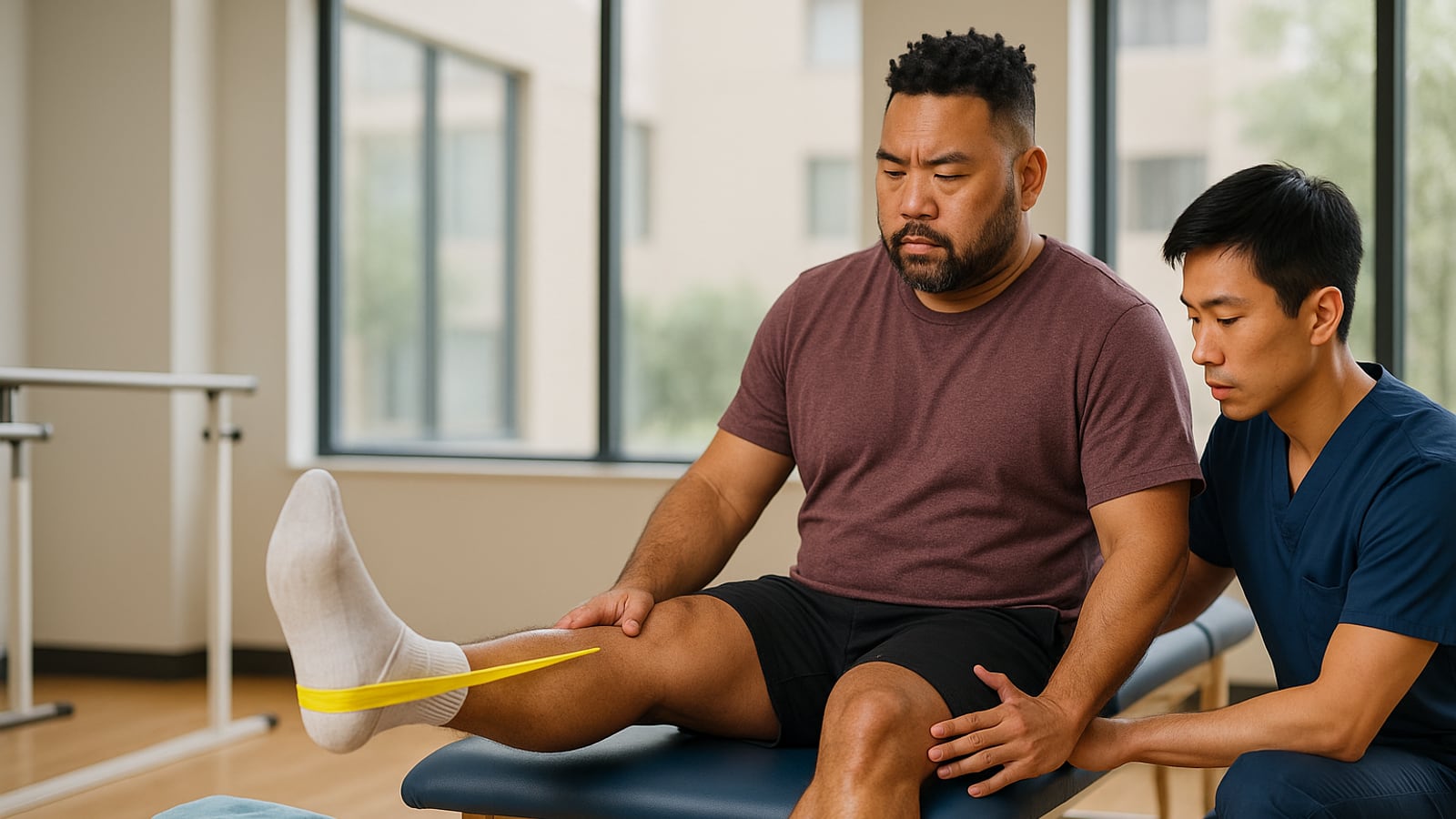
Stand up and straighten both legs. If the bad knee stops short of the good one and won't go the last ten or fifteen degrees, and the end of that range feels like a rubbery door wedge rather than pain, get an orthopedic appointment this week. That's a locked knee, and it's the one meniscus problem that genuinely doesn't wait.
Everything else on the meniscus menu has more runway than you've been led to believe. Which is good news, because you have a job, a school run, and roughly zero appetite for six weeks on crutches.
Two different injuries share one word
A traumatic tear has a moment attached to it. Planted foot, body rotated, something gave. The knee swelled over the next several hours and you remember the day. These happen to people in their teens, twenties and thirties, often alongside an ACL injury, and the torn tissue is usually otherwise healthy.
A degenerative tear has no moment, or an embarrassing one. You stood up from a crouch by the water heater. You got out of the truck funny. The meniscus has been thinning and fraying for a decade the way tire rubber does, and one day a frayed edge became a "tear" on a report.
Same word. Different disease, different treatment, different answer about surgery.
Worth knowing before you get an MRI: imaging studies of people with no knee pain at all find meniscal tears all over the place once you're past fifty. A tear on the report doesn't prove the tear is what hurts. This is why a good orthopedist wants a weight-bearing X-ray too. Cartilage loss and joint space narrowing on that X-ray change the whole conversation, and an MRI ordered on its own can quietly skip it.
What "locking" actually means
Patients say locking. Doctors mean something narrow by it.
True mechanical locking is a physical block. A displaced flap of meniscus, often a bucket-handle tear, has folded into the middle of the joint and the knee can't fully straighten because there's tissue in the way. You can't will it straight. It feels solid.
What most people call locking is catching. The knee grabs, twinges, then goes. Or it hurts too much to straighten and you stop. That's a pain response, not a block, and it doesn't carry the same urgency. A displaced bucket handle sitting in the joint chews up cartilage and loses repairability as the weeks pass. Catching does neither.
If you're not sure which one you have, have someone else gently straighten the leg while you relax it. If it goes, it isn't locked.
The scope that mostly doesn't earn its keep
For a middle-aged person with a degenerative tear and some arthritis, arthroscopic partial meniscectomy has been tested against physical therapy in randomized trials, and against sham surgery, where patients were taken to the operating room and given incisions and no trim. The scope didn't beat the alternatives at a year. Trials like METEOR and the Finnish FIDELITY study are the reason most guidelines now push structured exercise first for this exact patient.
The part that should relax you: in those trials, plenty of people assigned to therapy later crossed over to surgery, and they did fine. Waiting three months doesn't burn the bridge.
Now the concession, because the honest version isn't "surgery is a scam." Some people with a degenerative tear, a clean-ish X-ray, and genuine mechanical catching get real, lasting relief from a trim. Surgeons see those patients. The problem is that the scope got sold as the opening move for everyone with a tear on a report, and for most of those knees it's an expensive way to lose two weeks.
The tears that do earn an operation
A locked knee. Covered above. Days and weeks matter for whether a bucket handle can be repaired rather than removed.
A root tear. The meniscus is anchored front and back like a hammock. Tear the posterior anchor and the whole meniscus slides out of the joint, so mechanically you've lost it entirely, even though it looks intact. Classic story is a person in their forties or fifties who squatted down, felt a pop, and has disproportionate pain and swelling for something so ordinary. Ask the question by name: is this a root tear, and is there extrusion? These are often repairable and the window isn't infinite.
A young athlete with a peripheral tear. Out at the edge, where blood supply is decent, a longitudinal tear can heal if it's stitched. Especially worth doing during an ACL reconstruction, since you're already in there.
A knee that got a real rehab effort and stayed bad. Twelve honest weeks, not three sporadic ones.
Trim versus repair, and why you must ask
These are two completely different lives.
A trim gets you walking that day and back to normal work in a couple of weeks. The cost is deferred. You leave with less meniscus than you came in with, and less meniscus means more load on the cartilage for the next thirty years.
A repair keeps the tissue. It also costs you a brace, limited weight bearing, no deep knee bend for months, and a return to real activity somewhere in the four-to-six month range. For a guy with two kids and a physical job, that's a genuine hardship, and it's the right call anyway more often than people expect.
Ask your surgeon which one is planned, what would make them switch mid-operation, and what recovery looks like for each. Ask it before you're in the gown.
Twelve weeks of unglamorous leg work
This is the part that actually works for degenerative tears, and it's also what you want going into surgery if you end up having it. Quadriceps strength is the whole ballgame.
- Pick a pain-free depth and load it. Box squat to a height that doesn't bother you tomorrow. Leg press in a partial range. Add depth every two weeks, not every session.
- Isometrics for pain. Wall sit or a Spanish squat with a strap, five rounds of 45 seconds, most days. You can do these in the hallway while the pasta boils.
- Slow step-downs off a four-inch step, three seconds down, five to eight reps a side. Add height later.
- Hamstrings and calves, single leg. The knee doesn't work alone.
- Ten easy minutes on a bike before and after. Motion is medicine for a grumpy joint.
- Park the pivoting sports and deep loaded squats for now. Walk all you want.
Three sessions of 25 minutes you'll actually do beats five you'll skip by week two. Sustainable wins here every time.
Your soreness rule: discomfort during the work is acceptable if it's settled by the next morning. Visible swelling the day after means you did too much, and swelling shuts down the quad, which is the muscle you're trying to build. Back off one notch and continue.
One more lever nobody enjoys hearing about. Load through the knee going up and down stairs runs at several times body weight, so every pound off your frame does multiplied work at that joint. It's not the fun answer. It's the cheapest one.
None of this is a diagnosis for your knee specifically. Take the locking question and the root tear question to an orthopedic surgeon or sports medicine doc, and get a physical therapist who'll give you a program rather than a hot pack.
And if you rehab for three months and end up scheduling the operation anyway, you didn't waste the spring. You go under with a stronger leg, and strong legs come back faster. That's the version where you can't really lose.
Cal Brennan
Fitness
Strength coach. Trains fathers, tradesmen and desk workers, which means programmes that survive a bad week.

Watch
Worth an hour of your evening
More from Fitness.
From channels we rate. Plays on YouTube.
Read next