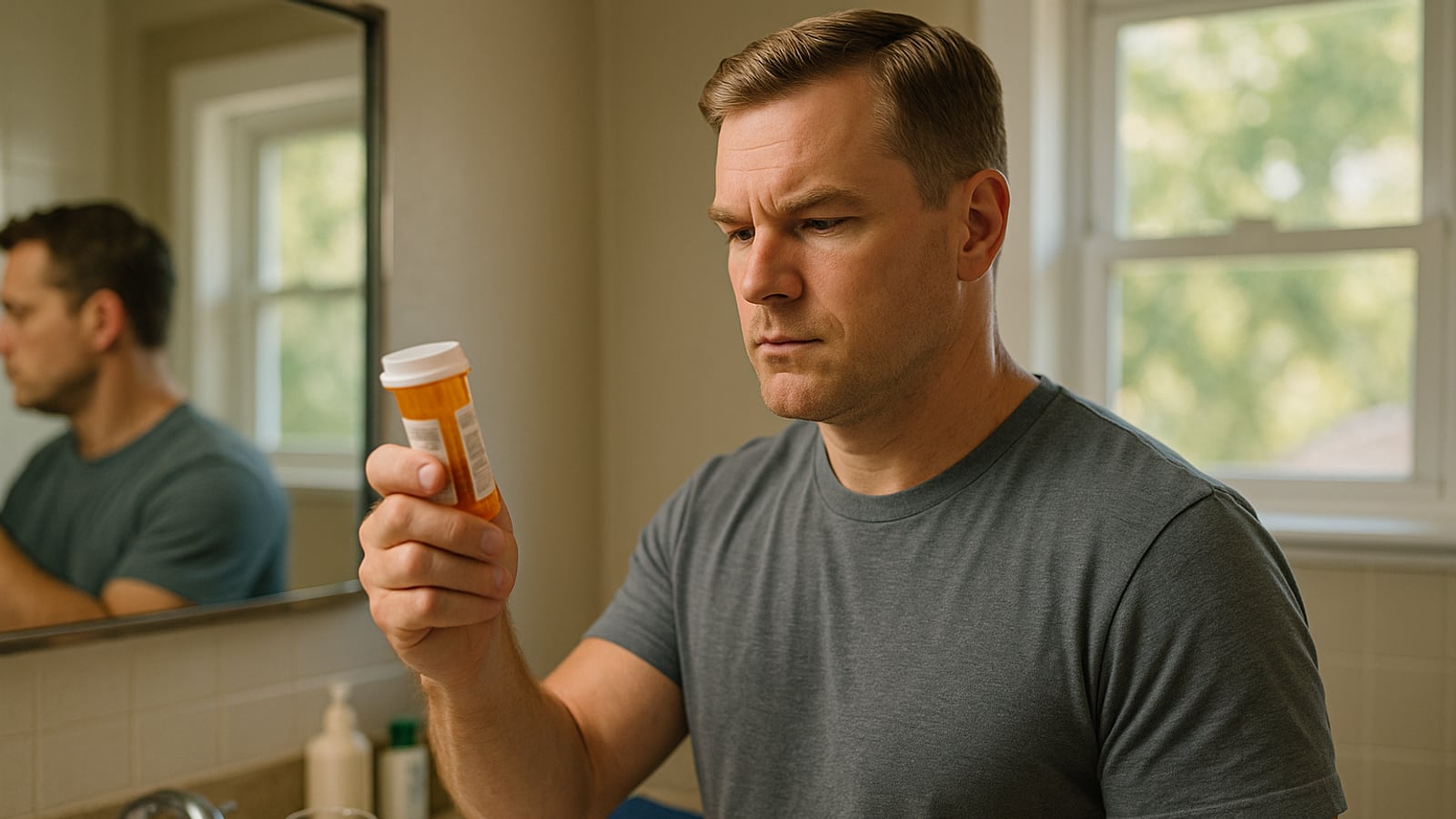
You're 44. You lift twice a week because that's what fits between the job and the kids. Your annual physical comes back with an LDL of 168, your dad had a stent at 58, and the doctor says the words "low dose atorvastatin, 20 milligrams, take it at night." You leave with a prescription and about nine unanswered questions, most of which start with "but I train."
So let's go through what that pill is doing, what it isn't doing, and which of the complaints you've heard at the gym hold up.
None of this is medical advice. You have a doctor and a pharmacist, and the pharmacist in particular is free, underused, and usually standing right there.
One enzyme, one job
Your liver builds cholesterol. Not most of it from your breakfast, from scratch, on an assembly line. One of the key workers on that line is an enzyme with the unlovely name HMG-CoA reductase. A statin sits on that enzyme and slows it down.
Here's the part people miss. Slowing production isn't the main event. When the liver makes less cholesterol internally, it puts out more LDL receptors on its surface to grab cholesterol from your bloodstream instead. Those receptors are little vacuum nozzles. That's why your blood LDL drops.
How far it drops depends on the drug and the dose. Cardiology guidelines split them into moderate intensity, which is expected to cut LDL somewhere in the 30 to 49 percent range, and high intensity, meaning a 50 percent cut or better. Atorvastatin (Lipitor) at 40 or 80 milligrams and rosuvastatin (Crestor) at 20 or 40 sit in the high-intensity tier. Pravastatin and lower-dose simvastatin are gentler.
There's a second effect that doesn't show up on your lab sheet. Statins appear to calm inflammation in the artery wall and make existing plaque more stable, which matters because heart attacks are usually a plaque cap tearing open, not a pipe slowly clogging shut. A stable plaque is a plaque that stays put.
What it doesn't do
It doesn't scrub your arteries clean. High-dose statins can produce some plaque regression, but "some" is the honest word. Mostly you're stabilizing what's there and stopping new deposits.
It doesn't do much for triglycerides, and it barely moves HDL. If your triglycerides are 300, the statin isn't the answer to that number.
It does nothing for lipoprotein(a). Lp(a) is genetic, it's an independent risk factor, and most people have never had it measured. Ask for it once. You only need the one test in your life, and if it comes back high it changes how aggressive you and your doctor want to be about everything else.
It doesn't cancel your diet. It doesn't cancel your training. And it doesn't make the conversation about seed oils, red meat or eggs go away. A statin lowers one risk factor. Your blood pressure, your waist, your sleep and whether you smoke are still yours to handle.
It also isn't a guarantee. Plenty of people on statins still have cardiac events. The drug shifts the odds. That's all any of this does.
The muscle thing
Here's the complaint you've actually heard: my legs ached, my lifts went backward, I quit the statin and felt fine in three weeks.
Take it seriously. Muscle aching is far and away the most reported side effect, it drives most of the people who stop taking these drugs, and nobody should be told their pain is imaginary.
But the evidence is genuinely strange, and you should know about it before you make a decision. In blinded trials, where nobody knows whether they're swallowing the drug or a sugar pill, muscle symptoms show up at nearly the same rate in both groups. The most interesting version of this was the SAMSON trial, published in the New England Journal of Medicine in 2020. Patients who had previously quit statins because of side effects took, in rotation, the statin, an identical placebo, and nothing at all, a month at a time, rating their symptoms daily. The overwhelming majority of the symptom burden they recorded on statin months showed up in the placebo months too. Not in the empty months. In the placebo months.
What that suggests is that the aching is real, and the pill is real, and the link between them is weaker than almost everyone assumes. Middle-aged men who lift have sore legs. That's the job.
It doesn't mean true statin-associated muscle injury never happens. It does. Rhabdomyolysis, the serious version, is rare but it's an emergency: severe weakness, badly swollen muscle, dark cola-colored urine. That's an ER visit, not a Monday morning phone call.
The rest of the list
New-onset diabetes. Small but real. Statins slightly raise the chance of crossing the line into type 2 diabetes, mostly in people already parked at the edge of it with a rising A1c and a thickening waist. Worth knowing. Also worth noting that resistance training and losing fifteen pounds push in the opposite direction with more force.
Liver enzymes. Mild elevations happen and usually settle. Routine repeat liver panels aren't standard anymore the way they were twenty years ago.
Memory and fog. Enough people reported it that the FDA added a note about it years ago. Large studies haven't found a link to dementia, and the effects reported are described as reversible. If you feel foggy, say so, don't just stop.
Interactions. This is the one people actually ignore. Grapefruit is a genuine problem with simvastatin and lovastatin, less so with atorvastatin, and a non-issue with rosuvastatin and pravastatin. Some antibiotics, antifungals, amiodarone and gemfibrozil raise statin levels in your blood, which is exactly when muscle trouble becomes more likely. Every new prescription, ask the pharmacist to check it against the statin. Takes ninety seconds.
If you lift, say so before the blood draw
Creatine kinase is the enzyme they measure when they're looking for muscle damage. A heavy squat session will raise it. A brand new eccentric-heavy program will send it up considerably, and it can stay elevated for days.
If nobody knows you lift, an elevated CK looks like a drug reaction and you get pulled off a medication you may need. Tell them what you did that week. If you can, don't schedule the blood draw for the morning after your hardest session.
Same goes for timing the dose. Simvastatin and lovastatin have short half-lives and genuinely work better at night. Atorvastatin and rosuvastatin hang around long enough that you can take them whenever you'll actually remember, which for most men with kids means with breakfast, not at 11 p.m. when you're asleep on the couch.
What to ask, out loud
Ask for ApoB alongside the standard panel. It counts the actual number of dangerous particles instead of the cholesterol riding inside them, and for guys with big waistlines and high triglycerides it's the more honest number.
Ask about a coronary calcium scan if you're on the fence. It's a quick CT that tells you whether there's calcified plaque in your arteries right now. A zero can buy you real reassurance. A high score ends the debate.
And if you try a statin and feel terrible, say so instead of quietly stopping. There are lower doses, different molecules, every-other-day rosuvastatin, ezetimibe, bempedoic acid, and injectables for the people who need them. Stopping without telling anyone is the only option on that list with no upside.
The pill and the barbell aren't competitors. Only one of them needs you to show up.
Cal Brennan
Fitness
Strength coach. Trains fathers, tradesmen and desk workers, which means programmes that survive a bad week.

Watch
Worth an hour of your evening
More from Fitness.
From channels we rate. Plays on YouTube.
Read next