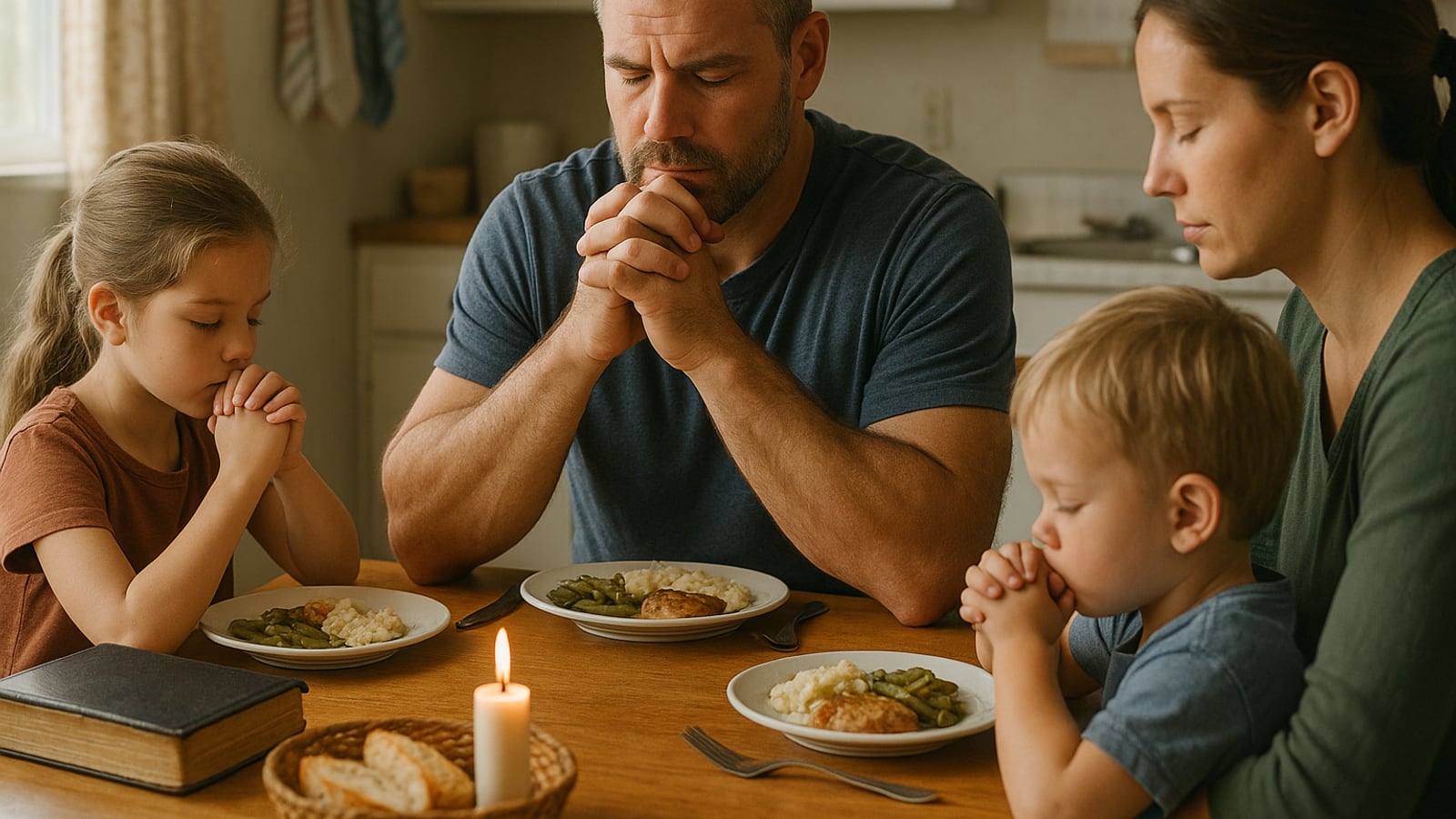
Pray out loud at dinner tonight. Twenty seconds. Thank God for the food, name one thing that went well, name one person who's struggling, say amen.
That's it. If you do nothing else in this article, do that, and do it every night for a year.
Most men who want to lead their families spiritually get stuck because they picture the wrong job. They imagine a lectern, a teaching plan, a father with answers. Then they look at their own faith — patchy, inconsistent, full of questions they haven't resolved — and decide they're unqualified. So they wait. And the waiting turns into ten years of nothing.
You're not being asked to teach seminary. You're being asked to set a household rhythm and stay inside it.
The difference between leading and lecturing
Lecturing is an event. You feel convicted on a Sunday, you sit everyone down, you deliver fifteen minutes on the state of their souls, and everyone nods and escapes. Nothing changes. The next event is eight months away.
Leading is a rhythm. It's short, it's repeated, and on any given day it looks like almost nothing.
Deuteronomy 6 is the clearest instruction on this in the whole Bible, and it's striking how ordinary it's: "You shall teach them diligently to your children, and shall talk of them when you sit in your house, and when you walk by the way, and when you lie down, and when you rise." Sitting. Walking. Going to bed. Getting up. Not a classroom. The commute, the kitchen, the ten minutes before lights out.
Kids don't remember your talks. They remember what happened every day without fail.
Four habits that carry most of the weight
Grace before meals. Short. Same structure every time so the youngest can learn it. Rotate who prays once the kids can string a sentence together. Don't correct their theology mid-prayer.
A blessing at bedtime. Hand on the head, name the child, say something over them. The Aaronic blessing works and has for about three thousand years: "The Lord bless you and keep you; the Lord make his face to shine upon you and be gracious to you." Thirty seconds. A child who has been blessed by name every night for a decade knows something about God that no lesson delivers.
Read something aloud. One chapter, or half a chapter. A children's Bible storybook while they're small, the actual text as they get older. If you miss three nights, pick up where you left off without an apology or a speech about how you're going to be better.
Church on Sunday, as a settled fact. Not a negotiation you relitigate each week. The logistics are the real battle, so fight there: clothes out Saturday night, bags by the door, leave fifteen minutes earlier than you think you need to. Most families who drift out of church drift out over transport and tempers, not theology.
Your wife isn't your congregation
Some men read one book, get fired up, and come home with a new regime their wife never agreed to. That's not leadership. That's a reorganization announcement.
Ask her first. What's working in the evenings? What's already impossible? She probably knows which child is anxious about death, which one has questions she's been fielding alone, and which night of the week is a wall of homework and exhaustion.
Then take a job off her. The bedtime routine is usually the one. If she's been running it for six years alone and you take two nights a week, that's a spiritual contribution and a marital one at the same time.
And pray with her. Out loud, together, even if it's awkward for the first month. Lots of couples who pray in front of their children have never once prayed with just each other. Start with sixty seconds after the kids are down.
Don't use Scripture as a discipline tool
This is where good intentions curdle. A child hits his sister and you reach for a verse about kindness. It feels efficient. What it teaches him is that the Bible is a stick.
Discipline on the behavior. Use Scripture for the thing Scripture is for, which is telling him who God is and what God has done. Keep the two conversations separate as far as you can.
Paul's line to fathers in Ephesians is the warning label: "do not provoke your children to anger, but bring them up in the discipline and instruction of the Lord." Both halves are in there. Instruction that provokes is a failure even when the content is true.
Answer questions honestly, including the hard ones
At some point a child will ask you why a good God let something happen. Or whether their grandmother is in heaven. Or why anyone believes this at all.
Three things to have ready.
Say "I don't know" when you don't know. It costs you nothing and buys you enormous credibility later.
Say "let's find out" and then actually find out. Ask your pastor. Read something. Come back to the child within the week with what you learned.
Never punish the question. A kid who gets shut down at nine won't come back at nineteen, and nineteen is when it matters.
When they push back
Teenagers test whether the faith is yours or just the house rules. Expect it. The goal in those years isn't to win the argument, it's to keep the relationship open enough that they're still talking to you at twenty-five.
Keep the household rhythms running. They can disagree with you at the table and still be at the table. Don't make every conversation about their soul, or they'll stop having conversations with you. Ask about their friends, their music, their work. Be a father they actually like.
And let them see you go to church on the mornings you don't feel like it. That's a sermon you can't preach.
Repent out loud
The single most formative thing you'll ever do spiritually in your home is apologize properly to your own children.
Name the thing. "I shouted at you this morning and there was no excuse for it. I was tired and I took it out on you. I'm sorry. Will you forgive me?" No "but you were." No softening.
They already know you're not perfect — they live with you. What they don't know yet is what a man does with his failures. Watching you take one to God and to them teaches grace in a way nothing else can, and it quietly dismantles the idea that faith is for people who have it together.
Measure this in decades
Six weeks of consistency will feel like nothing. You'll wonder if any of it lands. It mostly won't show up on a timescale you can see.
Then one night you'll be washing up and you'll hear your seven-year-old praying for her cousin, in your words, with your cadence. Years after that you'll hear the same six-word grace you've mumbled over spaghetti a thousand times, said badly and sincerely over a table in a house you don't live in, by a grown child with a kid of their own.
One generation commends the works of God to another. Usually by accident, and almost always in the kitchen.
Cal Brennan
Fitness
Strength coach. Trains fathers, tradesmen and desk workers, which means programmes that survive a bad week.

Watch
Worth an hour of your evening
More from Christian Bro.
From channels we rate. Plays on YouTube.
Read next