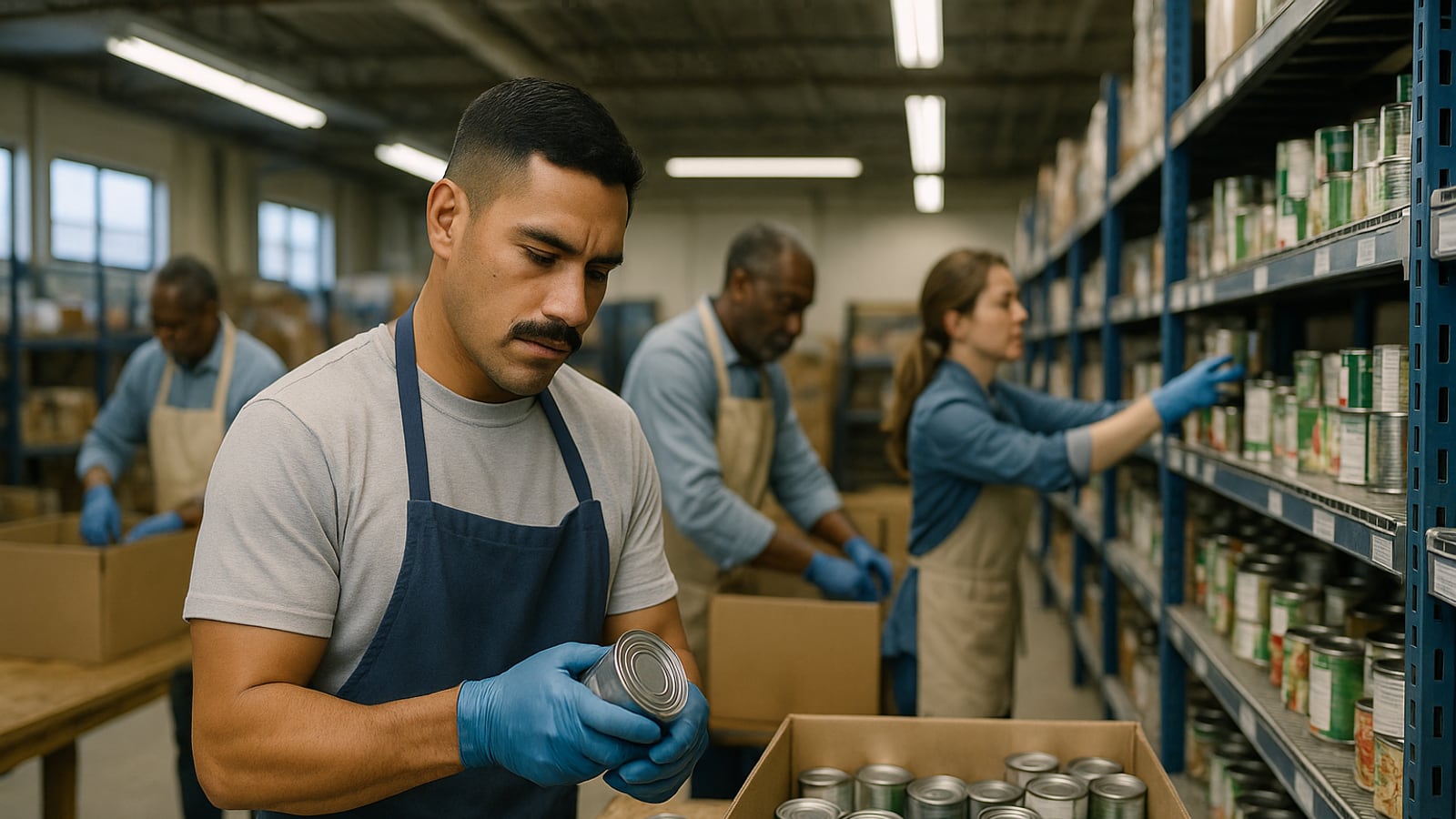
The first thing they'll hand you is a box cutter and a rule about dates. At most food banks the rule is that "best by" is a suggestion and "use by" isn't, that dented cans are fine unless the dent is on a seam, and that anything bulging goes in the trash without a debate. You'll sort maybe 900 pounds of donated canned goods in a three-hour shift, and about a tenth of it will be somebody's expired pantry cleanout that you have to throw away.
That's the job. It's not moving. It's not cinematic. It's enormously worth doing, and the gap between a volunteer who's useful and one who's a burden on the staff comes down to about six things nobody tells you in the orientation email.
Get on the schedule in one phone call
Skip the contact form. Call the number.
Two places to find one: dial 211, which is the United Way's community referral line and works across most of the U.S. and Canada, or use the Feeding America food bank locator to find the regional warehouse that supplies every small pantry in your county. Churches are the other front door. A lot of neighborhood pantries run out of a fellowship hall on Thursday nights with four retirees and no website at all, and those are the ones that will actually notice whether you came.
When you call, ask three things. Which shift is hardest to fill. Whether there's a minimum age, because most warehouses set it at 12 or 14 and shelters often go higher. And whether they need you for one Saturday or every other Tuesday, because the honest answer is almost always Tuesday.
Then put it in your phone as a repeating event with a reminder the night before. Not a reminder an hour before. The night before is when you decide.
Take the shift nobody wants
Everybody wants to serve on Thanksgiving. Some pantries have to turn people away that week and then run short-handed for the next eleven months.
February is the hole. So is the second week of January, when the holiday food drives are gone and the heating bills came due. If you want to be the volunteer who matters, tell them you're available the last week of the month, when SNAP benefits have run out and the line gets long.
Early morning is the other underfilled slot. Warehouse trucks get loaded before 8 a.m. and shelter breakfast starts around 5:30. A shift that inconveniences you is a shift somebody genuinely needs covered.
Dress for a concrete floor and a walk-in cooler
Closed-toe shoes, and they will check. Steel toe if you own them, because pallet jacks don't care about your sneakers.
Layers, because you'll spend part of the morning in a 38-degree cooler and the rest of it sweating next to a loading dock. Skip the cologne and the scented lotion entirely if you're anywhere near food prep. Leave the good watch at home. Bring your own water bottle, because the break room cups run out by nine.
If you have a bad back, say so at check-in instead of proving it at noon. There's always a seated job. Somebody has to bag rice into two-pound portions, and that person is as necessary as the guy on the forklift.
At a shelter, the rules exist for a reason
A food bank warehouse is logistics. A shelter is people, and the etiquette is different.
Use first names and let people offer theirs. Don't ask how somebody ended up here. If they want you to know, they'll tell you, usually around the third time you work the same shift. Serve the portion the kitchen tells you to serve, even when you want to give more, because the count at the end of the line is somebody's dinner too.
Don't give rides. Don't hand out your cell number. Don't give cash at the door. Every one of those rules was written after something went badly, and the staff aren't being cold when they enforce them. They're protecting a guest who's six days into sobriety and a volunteer who doesn't know what they're walking into.
And don't preach at a man holding an empty tray. Feed him first. If he asks you why you're there, tell him the truth, plainly, and then pass the rolls. Faith that shows up at 5:30 in the morning with a hairnet on makes its own argument.
What actually goes wrong
You'll get bored. Sorting donated cans is repetitive in a way that surprises people who imagined the work as dramatic.
You'll get frustrated with the waste. Someone donates a case of expired baby formula and you have to throw all of it away, and it will bother you more than it bothers the staff, who threw away a case last week and will throw away another next week.
You'll meet a volunteer who's been there nineteen years and has opinions about how the pallets get stacked. Defer to that person. They're right.
And here's the trade-off worth naming honestly: if pure efficiency is your goal, writing a check beats showing up. Regional food banks buy by the pallet through distributor relationships you don't have, so your dollar stretches further in their hands than in your grocery cart. If you can only do one, and the pantry is short on food rather than hands, ask them which they need and believe the answer.
But labor isn't the only thing you're giving. The pantry that has ten reliable volunteers can plan a distribution schedule. The one with sixty holiday drop-ins and no Tuesday crew can't.
How to still be there in June
Three things keep people going, and none of them is inspiration.
Same shift, same day, same people. Novelty burns out in about seven weeks. Routine doesn't.
Bring somebody. A brother-in-law, a neighbor, your 14-year-old. Two people who've told each other they're going will both go, even on the morning when neither one wants to. Teenagers, incidentally, are very good at this work once you stop hovering. Give a kid the job of breaking down cardboard or restocking the pasta shelf and let him do it badly the first three times.
Learn one job well enough to teach it. The day you're the person showing a newcomer how to check seams on a dented can is the day you stop being a guest and start being staff that doesn't get paid.
The part you won't see
You won't get closure. The family you boxed groceries for in March will be back in September, and you won't know if anything you did mattered.
What you'll get instead is smaller and stranger. A woman who starts saving you the good coffee. A guy in a Carhartt jacket who asks about your daughter's knee surgery because you mentioned it four weeks ago. A pantry manager who calls you at seven on a Saturday because the truck came early and she knew you'd answer.
That's what service pays. Not results you can measure. A place where they notice when you're not there.
Go get on somebody's Tuesday list.
Josh Halloran
Christian Bro
Leads a mid-week mens group and has done for eleven years. Writes about faith as a practice rather than a position.

Watch
Worth an hour of your evening
More from Community.
From channels we rate. Plays on YouTube.
Read next