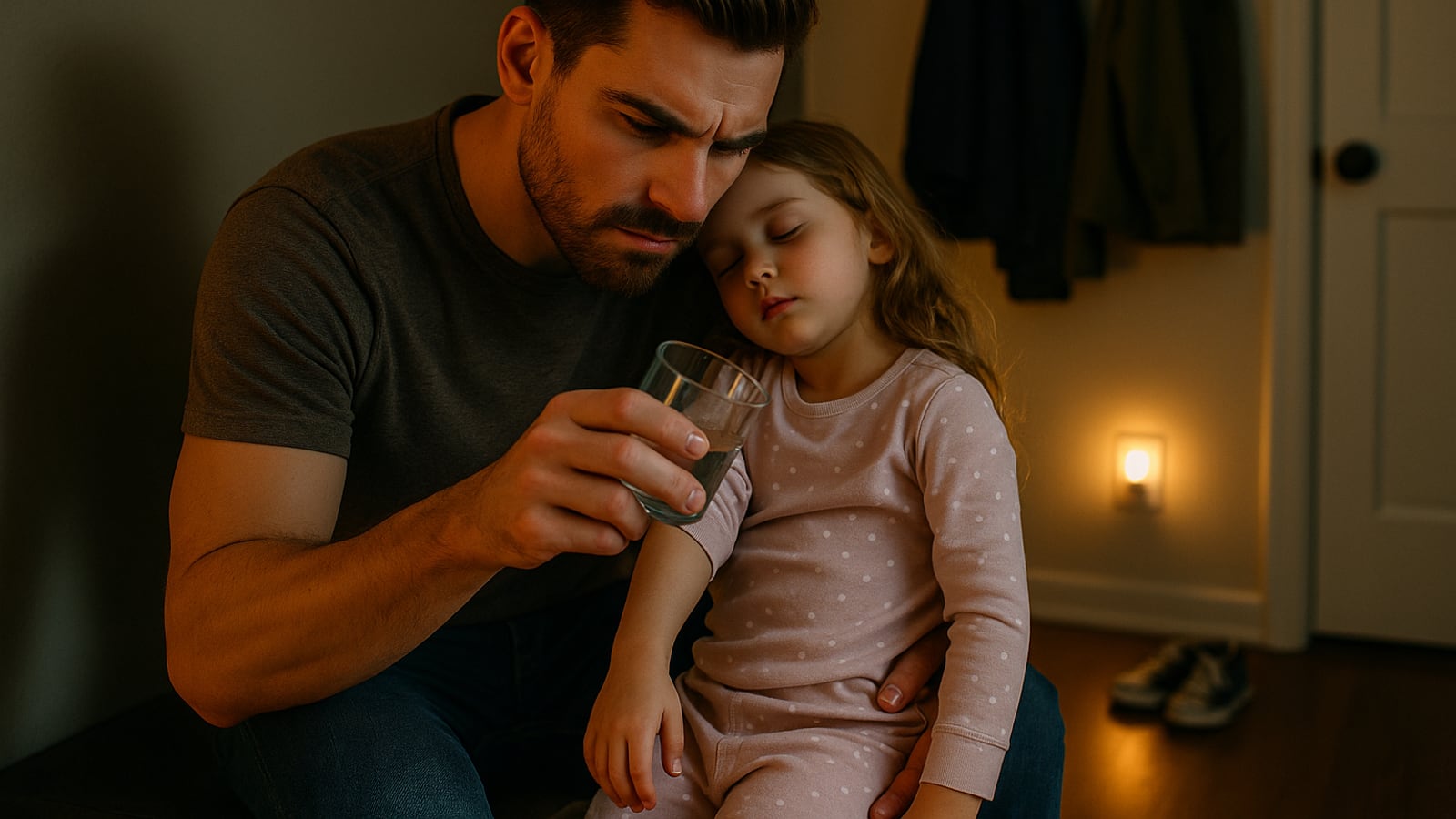
Get a clear drinking glass. Not the plastic one with ridges from the ball game, not a mug. A smooth, clear tumbler. Press the side of it firmly against the rash, hard enough to squash the skin pale under the glass, and look through the glass at the spots.
If the spots go white and then color back in when you lift the glass, that's a blanching rash. Most rashes blanch. Viral rashes, hives, heat rash, the mystery blotches your four-year-old gets from nothing in particular.
If the spots stay there, still red or purple, still visible through the pressed glass, that's a non-blanching rash. That's blood under the skin, not inflammation in it. Small pinprick versions are called petechiae, bigger bruise-like patches are purpura, and either one on a sick child with a fever is an emergency room visit tonight. Not the morning. Tonight.
That's the whole test. It takes thirty seconds and you should know it cold, because the night you need it, you'll be standing in a hallway at 11:40 with a warm kid on your hip and no ability to think straight.
Why the glass matters and where it lies to you
The reason every parent gets taught this one is meningococcal disease, which can cause bleeding into the skin and moves faster than almost anything else that comes through your front door. A child can go from "off" to critically ill inside a day.
But the glass test has a flaw, and the flaw kills people who trust it too much. It's a rule-in, not a rule-out. A non-blanching rash means go. A blanching rash means nothing at all if the rest of the child looks wrong. In meningococcal illness the rash is often a late sign. Some of the sickest kids have no rash yet. You don't stand there pressing a glass on a normal chest, feeling reassured, while your son gets worse behind you.
The second flaw is practical. On darker skin, spots are harder to see, and glancing at a chest under a yellow hallway light isn't a real look. Use a bright phone flashlight, and check the paler places: palms, soles, inside the lower eyelid, the roof of the mouth, the belly.
Third flaw. Kids get little red dots on the face and upper chest from hard vomiting or a violent coughing fit, and those don't blanch either. They're broken capillaries from pressure. A well, happy, fever-free kid with a few dots above the nipple line after throwing up all evening is a different situation than a hot, floppy kid with spots on the legs. Still worth a call to your doctor. Not the same panic.
The child tells you more than the skin does
Old pediatric wisdom, and it holds: treat the kid, not the rash. What you're watching is behavior.
The things that should get you moving, rash or not:
- Won't wake up properly, or wakes and drifts straight back out. Drowsiness that isn't normal tiredness.
- Cold hands and feet with a hot body. Mottled, marbled-looking skin. That's circulation shutting down to the edges.
- Breathing fast, or grunting, or you can see the skin sucking in between the ribs.
- Stiff neck, hates the light, terrible headache.
- Severe leg pain or refusing to walk on legs that were fine this morning.
- No wet diaper in eight hours, or a much older kid with no urine all day.
- In a baby: a bulging soft spot, a high, strange cry, refusing feeds, floppiness.
Any of those with a fever is a tonight problem. Two of them together and you don't debate it.
A fever in a baby under three months is its own category. Any temperature at or above 100.4°F rectally in a newborn gets a call immediately, rash or no rash, day or night. Their immune systems don't give you the usual warnings.
Four rashes that don't wait for morning
Hives with any swelling or breathing change. Welts everywhere is uncomfortable. Welts plus swollen lips or tongue, a hoarse or croupy voice, throat tightness, repeated vomiting, or a child who goes pale and limp is anaphylaxis. If you carry an epinephrine auto-injector, that's what it's for, and you use it early and then call 911. Nobody has ever regretted using it a few minutes too soon.
Blisters with fever, especially around the mouth, eyes or the private areas. Peeling skin, raw lips, eyes gluing shut. Severe drug and immune reactions look like this, and they're managed in a hospital.
Red skin that's spreading while you watch it. Draw the edge with a ballpoint pen and write the time next to it. If the redness has crossed your line in an hour, or the skin is hot, tight and hurting far more than it looks like it should, that's an ER trip.
Any purple. Bruise-colored patches on a child who hasn't taken a hit have a short list of causes and none of them are handled with a bath and an early bedtime.
The rashes that look terrifying and aren't
Most rashes are viruses being viruses. Roseola gives a toddler three days of high fever, the fever breaks, and then a pink rash blooms all over the trunk right when the kid is finally acting fine. Fifth disease slaps both cheeks bright red like a sunburn and then makes a lacy pattern on the arms. Hand, foot and mouth puts sores in the mouth and small blisters on the palms and soles, and the worst part is that they won't eat or drink for two days.
Chickenpox still exists, eczema flares in the winter, heat rash shows up under the collar of a costume, and contact rash traces the exact shape of whatever touched the skin. Every one of those is a phone call in the morning.
Keep the receipts
Photograph the rash with something in the frame for scale. A quarter works. Photograph it again two hours later from the same distance. A doctor looking at "it was way bigger before" is guessing. A doctor looking at two photos ninety minutes apart is diagnosing.
Write down the temperature and the time you took it, what medicine you gave and when. When the fever is high and you're both exhausted, you will absolutely forget whether the acetaminophen was at 9:15 or 10:30, and that matters.
You'll feel foolish sometimes
You'll drive in at midnight and a resident will tell you it's a virus and you'll drive home at 3 a.m. feeling like a rookie. Take that trade every time. The cost of being wrong in one direction is a lost night and a copay. The cost of being wrong in the other direction isn't something you recover from.
And none of this replaces your pediatrician. It's the thirty seconds before you call one, and the vocabulary to describe what you're looking at when you do. Say "non-blanching" on the phone and watch how fast the conversation changes.
Buy a plain glass tumbler. Put it in the cabinet where the kid's medicine is. Tell your wife where it lives.
Cal Brennan
Fitness
Strength coach. Trains fathers, tradesmen and desk workers, which means programmes that survive a bad week.

Watch
Worth an hour of your evening
More from Dads.
From channels we rate. Plays on YouTube.
Read next