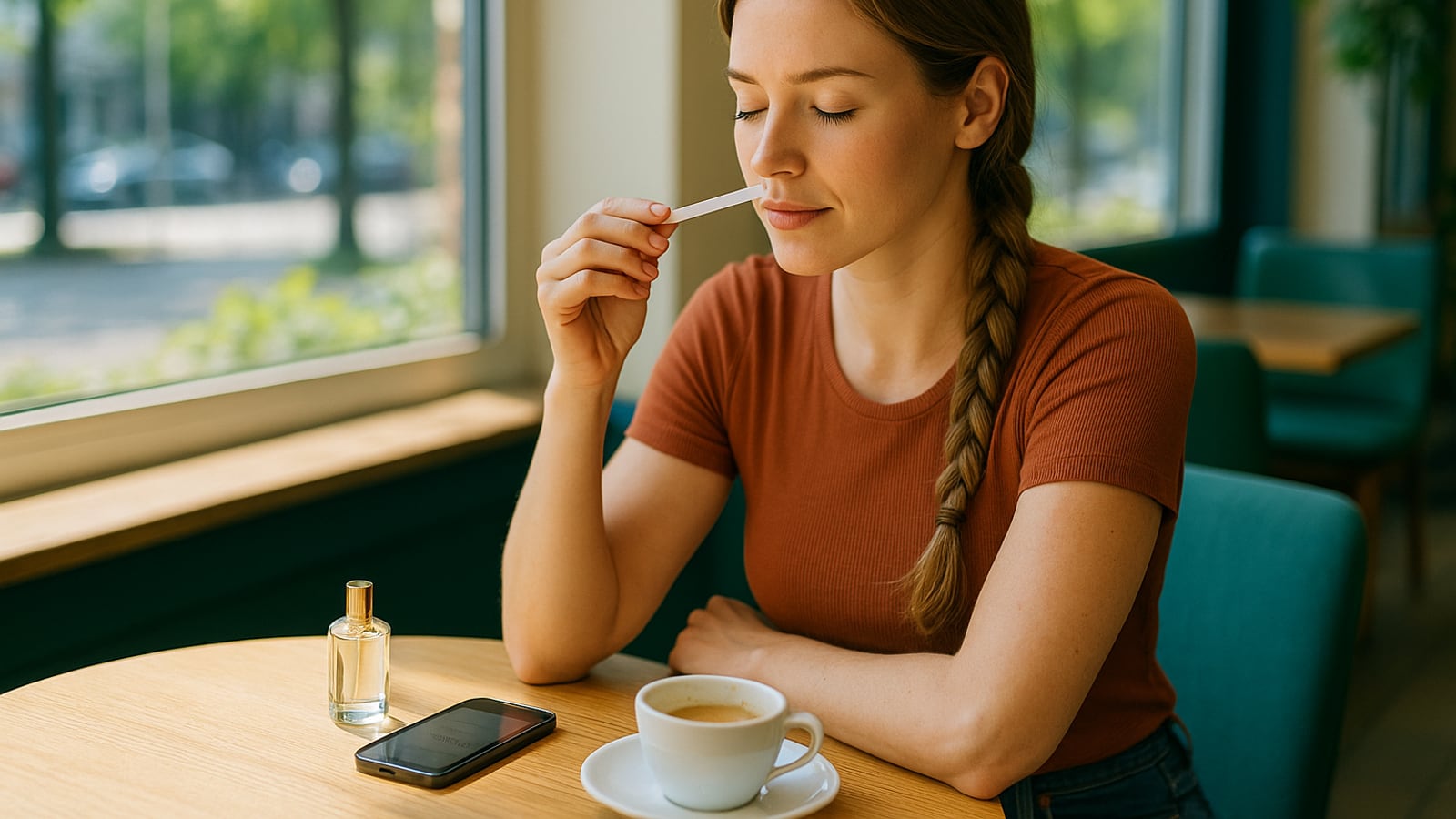
There's a bottle on your dresser you've worn twice. It cost more than your last pair of boots, it smelled incredible on the little paper strip, and on you by lunchtime it went sour and powdery and you haven't touched it since.
That's not your fault and it isn't bad luck. It's the way fragrance gets sold. You walked into a bright store, smelled eight things in ten minutes, your nose gave up somewhere around number four, and you bought the one the woman at the counter said was her favorite. Nobody tests a mattress by lying on it for eleven seconds. Same principle.
Finding a scent you'll actually reach for every morning takes about three weeks and costs less than one bottle if you do it in the right order.
Learn what the label is telling you
The words on the front aren't marketing fluff. They're a concentration spec.
- Eau de cologne is the weakest, and it'll be gone in an hour or two.
- Eau de toilette sits lower on the scale. Bright, lighter, usually three or four hours before it fades to almost nothing.
- Eau de parfum is the sweet spot for most everyday wear. Stronger concentration, five to eight hours, and it develops properly on skin instead of flashing off.
- Parfum or extrait is the densest and the most expensive per milliliter. Two dabs, not five sprays. It sits close to the skin and stays all day.
Same name on the bottle doesn't mean the same scent. The eau de toilette and the eau de parfum of a single fragrance are often built differently, with the EDT pushing citrus and the EDP pushing the warm base. If you loved the tester and hated the bottle, check which one you smelled.
For daily wear, buy the eau de parfum unless you work shoulder to shoulder with people in a small room. Then go EDT and enjoy reapplying at two o'clock.
Wait four hours before you decide anything
Every fragrance has three acts. The top notes are what hits in the first fifteen minutes, and they're almost always the prettiest part, because that's the part engineered to sell. Citrus, green things, something sparkling. Then the heart opens up over the next hour or two. Then the base settles in and stays for the rest of the day. Woods, musk, vanilla, resins, whatever's holding the thing together.
The store sells you the top. You live with the base.
So spray one fragrance on your forearm, walk out, and don't smell it again for four hours. Smell it in your own kitchen, on your own skin, after you've made dinner. That's the version you're buying. If it's still good at hour four, it's a candidate. If it's turned into something plasticky and sweet, you just saved a hundred and forty dollars.
One per day. Two absolute maximum, one on each arm, and don't spray the inside of your elbow and your wrist and call it a fair test. Your nose fatigues faster than you think. The coffee beans they hand you at the counter do very little. Smelling a patch of your own clean skin does more.
Buy samples first, and be ruthless about families
Fragrance splits into a handful of broad families, and the fastest thing you can do is figure out which two you like and stop smelling the other three.
Fresh and citrus is bergamot, lemon, neroli, that clean sharp lift. Wears beautifully in July, disappears by 11 a.m. Florals run from soapy and clean to enormous and heady, depending on whether you're in rose and iris territory or tuberose and jasmine territory. Woods are cedar, vetiver, sandalwood, dry and quiet and very hard to get wrong at work. Ambers lean vanilla, tonka bean, benzoin, warm and sweet and much better in January than August. Chypres and greens are the dry, mossy, slightly bitter ones that read as expensive and grown-up and have gone out of fashion, which is exactly why wearing one makes you smell like nobody else in the room.
Nobody likes all five. Pick your two.
Then buy samples. Decant sellers do 2ml and 5ml sprays for the price of a sandwich, most fragrance houses will sell you a sample set, and the counter at any department store will make you a vial if you ask politely. Twenty-five dollars in samples is a month of real wear across real days. That's a better test than any review, because the question isn't whether it's a good fragrance. It's whether you like it on a Tuesday when you're late.
Spray less than you think, in the right places
Two or three sprays. Collarbone, the back of the neck under your hair, one on the forearm. Done.
Don't rub your wrists together. It crushes the top notes and speeds up the whole thing by warming and grinding it into your skin. Spray, then leave it alone.
Fragrance holds better on hydrated skin. If your skin runs dry, an unscented lotion first will buy you an extra hour or two, and that's the single biggest reason two people get wildly different longevity from the same bottle. Skin chemistry gets blamed for a lot of things that are really just dryness.
Hair and fabric hold scent far longer than skin does, but the alcohol is drying on hair and it can mark silk. If you want it in your hair, mist the brush, not your head.
The arm's-length rule
Someone should notice your fragrance when they hug you. Not when they sit down across a conference table from you.
That's not timidity, it's competence. Hospitals, dental offices, a lot of schools and plenty of small open-plan workplaces have real restrictions, and some people genuinely get migraines from heavy aldehydes or big musks. If a coworker tells you yours sets off a headache, believe her the first time and switch to the lighter thing. It costs you nothing and it's the kind of courtesy people remember.
Ambers and ouds project hard. Woods and clean musks sit close. If your job puts you inside three feet of other humans all day, buy accordingly.
Two bottles, not seven
The honest answer to "how many do I need" is one signature and one for cold weather.
Heat amplifies fragrance. A warm amber that's perfect on a gray February morning becomes overwhelming in a hot car in August, and a crisp citrus that's gorgeous in summer reads thin and cheap in the winter. Two bottles covers the whole year. Anything past that's a collection, which is a fine hobby, but it's not what you asked for.
Store it like it's food, and buy a backup if you love it
Perfume dies from heat and light. The bathroom windowsill is the worst place in your house for it, and the steam from the shower doesn't help. A drawer or a closet shelf will keep a bottle good for years. Citrus-heavy things turn first and go sharp and vinegary. Ambers and woods age more gracefully, sometimes better than new.
And the thing nobody warns you about: houses reformulate. Ingredient restrictions change, suppliers change, and the bottle you buy in five years may not smell like the one you're wearing now. If you find the one, buy a second bottle while it's still the version you fell for.
Start with the small size. If it's still the first thing your hand goes to twelve months from now, go buy the big one.
Nina Castellan
BRO for Her
Runs the women-facing desk. Same standard, same tools, written for a different reader — not a softer one.

Watch
Worth an hour of your evening
More from BRO for Her.
From channels we rate. Plays on YouTube.
Read next