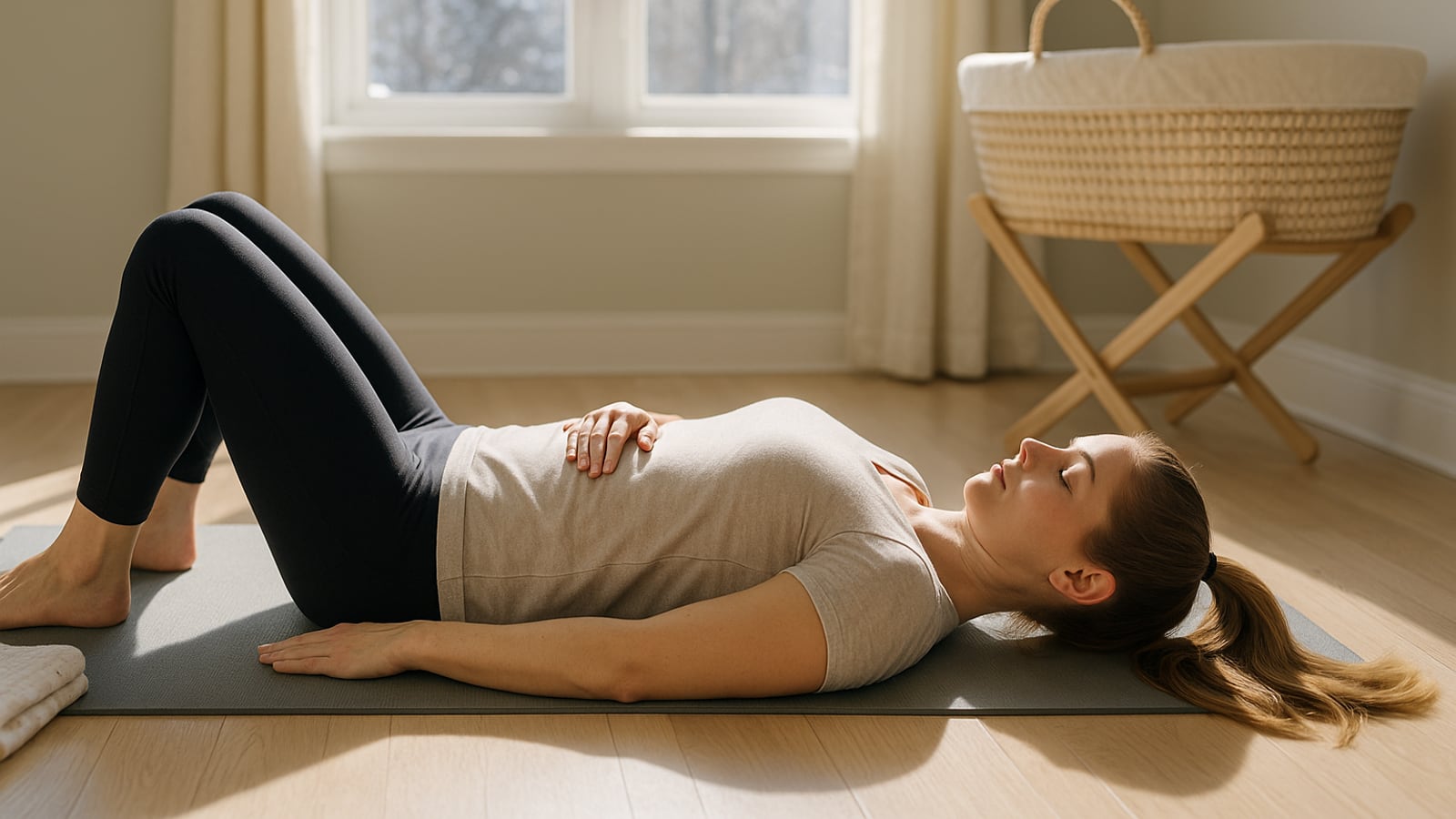
Put the crunches down. Not forever, and not because they're dangerous in some vague wellness-blog way, but because they're the last thing your midsection needs right now and they'll happily hide the problem you're trying to fix. A sit-up can be performed beautifully by a core that isn't managing pressure at all. You'll just push everything out and down, feel the burn, and wonder in three months why you still leak when you sneeze.
Start with breathing. Five minutes, twice a day. I know how that sounds.
What actually happened to your middle
Think of your torso as a soda can. The diaphragm is the lid, the pelvic floor is the base, the deep abdominals and low back wrap the sides. Pressure inside that can has to go somewhere every time you lift, cough, laugh, or stand up holding a car seat.
Pregnancy stretched the front of the can and the base of it. The linea alba, the connective tissue running down the middle of your abs, thinned and widened to make room. That's diastasis recti, and it isn't an injury. It's what's supposed to happen. The question isn't whether you have a gap at six weeks. Most women do. The question is whether that tissue can generate tension under load.
Lie on your back, knees bent, and lift your head an inch off the floor. Press two fingers into the midline just above the belly button. You're not measuring width. You're feeling for whether the tissue springs back against your fingers or lets them sink like a hammock. Tension is the win. A two-finger gap with good tension beats a one-finger gap with none.
While you're there, watch the shape of your belly when you sit up or when you get out of bed. If a ridge pops up down the center, or the lower belly balloons forward, that's pressure escaping the front door. Change the movement, don't push through it.
The things that mean you call a pelvic floor PT, not the internet
Leaking with a sneeze, a jump, or a run. A dragging or heavy feeling in the pelvis, especially by evening. Pain during intimacy. A bulge you can feel. Back or hip pain that showed up after delivery and stayed.
None of that's the price of admission for having children, and none of it gets better by waiting. Pelvic floor physical therapy is a real specialty with real credentials, and a good therapist will do an internal assessment, tell you whether you're weak or gripping too tight, and hand you a plan. Ask your OB or midwife for a referral. Many states let you self-refer.
Do this whether you delivered vaginally or by C-section. A cesarean is major abdominal surgery. The pelvic floor still carried nine months of load, and you now have a scar that can tether the tissue underneath it.
Weeks one through six, when it feels like nothing
You're doing three things.
Breathe into the sides and back of your ribs. Hand on your lower ribs, inhale wide, let the pelvic floor soften and drop. Exhale slowly and feel the floor lift and the lower belly draw in without you squeezing your glutes or holding your breath. Ten slow breaths, twice a day.
Exhale on effort. Every single time you stand up with the baby, get off the couch, lift the car seat. Blow out on the hard part. It's the cheapest pressure management there's and it becomes automatic in about a week.
Walk. Start at ten minutes. Add five every few days. If you finish a walk feeling heavy in the pelvis, you went too far. Back off and try again in three days.
That's it. No planks, no running, no "just a little" HIIT because you feel fine. Feeling fine isn't the same as being healed, and the tissue doesn't send a bill until later.
Weeks six to twelve, building the connection
Now you load the system gently and in positions where you can see what's happening.
- Dead bugs. On your back, knees over hips, arms up. Exhale, lower one leg and the opposite arm, stop before the low back arches. 8 per side, 3 sets.
- Glute bridges. Feet flat, drive through the heels, exhale up. 12 reps, 3 sets. Your glutes are half your core support and they've been asleep since the third trimester.
- Side plank from the knees. 20 seconds a side, build to 45.
- Suitcase carries. One dumbbell, 20 pounds if that's what's in the garage, walk 40 feet without leaning. Four trips.
- Bird dogs. Slow. 8 per side.
Carries are the best-kept secret of postpartum training. Your core has to resist being pulled sideways while you're upright and breathing normally, which is exactly the job it has all day with a kid on one hip.
If you had a C-section and you're cleared, start touching the scar around week eight. Fingertips, gentle, move the skin in small circles and side to side for two minutes. It'll feel strange and partly numb. That numbness can last a long time and it's normal. Silicone strips help the scar flatten. A PT can free up a stubborn one.
Twelve weeks and out, get genuinely strong
This is where most women stall, because the internet keeps selling them the same five rehab moves for two years. Rehab is the on-ramp. The road is strength training.
Goblet squats. Trap bar deadlifts. Split squats holding one dumbbell. Push-ups on a countertop, then a bench, then the floor. Overhead press, standing, which is a brutal core exercise disguised as a shoulder exercise. Two or three sessions a week, six to eight reps in the working sets, add a little weight when the last rep still looks clean.
Watch the midline on every set. Doming means the load is ahead of the tissue. Drop the weight, fix the exhale, keep going.
Returning to running, and why the date on the calendar is the wrong test
Clinicians who work in pelvic health use a function checklist rather than a number of weeks. Can you walk 30 minutes with no heaviness afterward? Single-leg calf raises, 20 a side? Hop on one leg 10 times with no leaking? Single-leg bridges, single-leg squat to a chair?
If you can't, running won't fix it. Running will make it louder. Give it four to six more weeks of strength work and test again.
What nobody puts on the twelve-week plan
You're rebuilding on four hours of broken sleep. Relaxin's still floating around if you're nursing, joints feel loose, and your appetite is either enormous or absent. Eat protein at breakfast, not just at dinner. Don't run an aggressive deficit while you're feeding a baby. If you want numbers for your own body, ask your doctor or a registered dietitian rather than a stranger with a ring light.
And the timeline is longer than the postpartum-fitness industry wants to admit. Six to twelve months to feel like your own body again is normal. Second and third babies rebuild differently, sometimes faster because you know what you're doing, sometimes slower because you're doing it with a toddler using your ribcage as a speed bump during dead bugs.
Some gaps never fully close. If the tension is there and you can lift, run, sneeze and carry a sleeping five-year-old up the stairs without symptoms, you're fixed, whatever the tape measure says. For a small number of women, the tissue doesn't recover enough and surgical repair is a reasonable conversation. Have it with a surgeon, not a comment section.
The goal was never a flat stomach in a mirror. It's picking both kids up at once, in a parking lot, in the rain, and not thinking about it.
Nina Castellan
BRO for Her
Runs the women-facing desk. Same standard, same tools, written for a different reader — not a softer one.

Watch
Worth an hour of your evening
More from BRO for Her.
From channels we rate. Plays on YouTube.
Read next