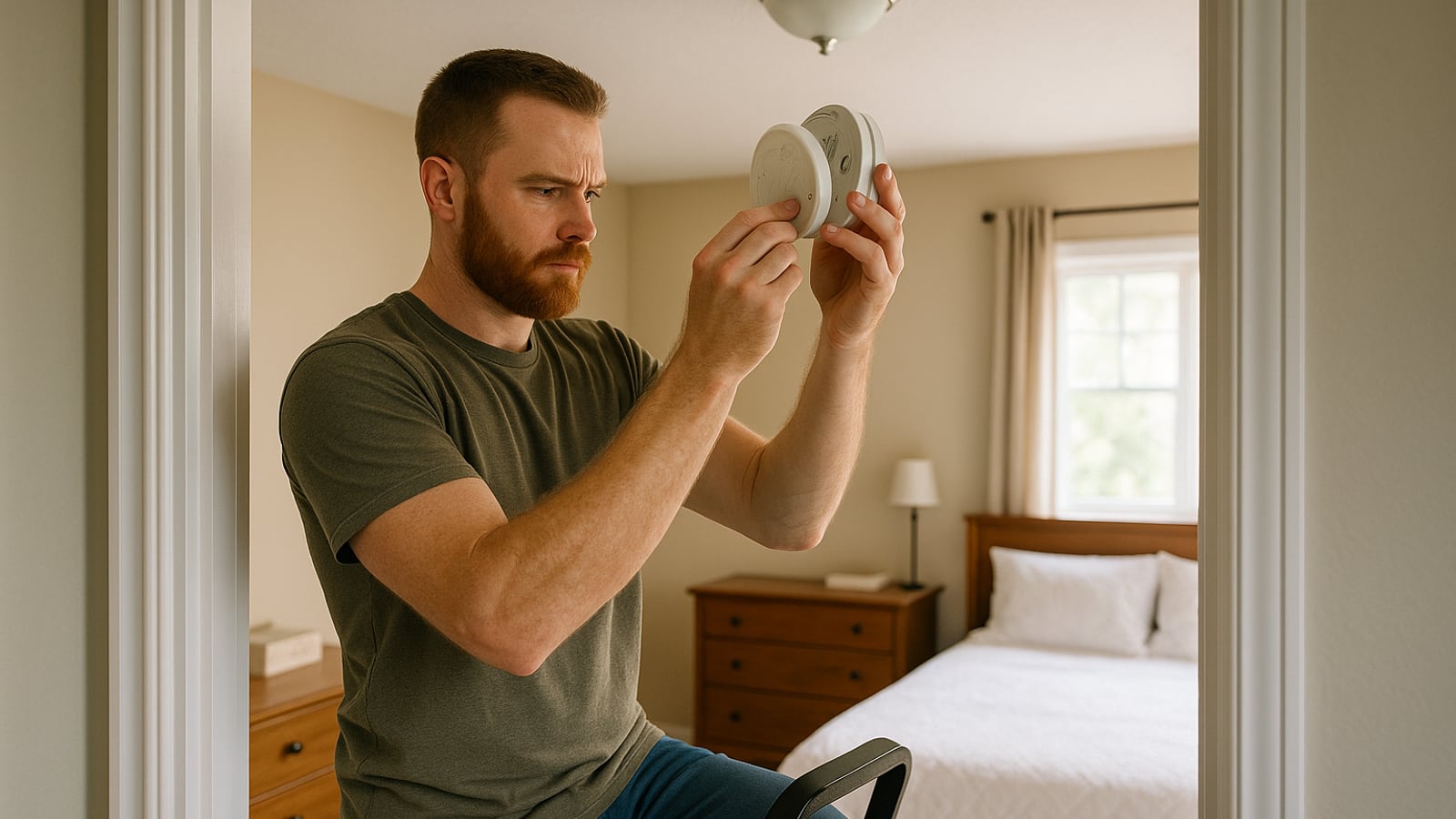
Go pull one down right now. Twist it off the base, flip it over, and find the date of manufacture stamped into the plastic. Not the date you bought it. Not the date you last changed the battery. The date it was made.
If that date is more than ten years old, the alarm on your ceiling is decoration. The sensing chamber has spent a decade breathing dust, cooking grease, and whatever drifts up from the dryer, and its ability to tell smoke from air has quietly degraded. It'll still chirp when you press the test button. That button only proves the horn and the battery work. It tells you nothing about the sensor.
Ten years, every smoke alarm, no exceptions. Carbon monoxide alarms go sooner, usually seven, sometimes five, and the manufacturer prints it on the unit. Write the replacement year on the side with a Sharpie when you install it so the next guy on the step stool doesn't have to squint.
Where the smoke alarms actually go
The rule is simpler than people think. Inside every bedroom. Outside every sleeping area, in the hallway. On every level of the house, including a finished or unfinished basement. A three-bedroom two-story with a basement needs six, minimum, and most houses built before 2000 have two.
Details that matter:
- Ceiling is better than wall. Smoke rises and spreads across the ceiling first. If you must go on a wall, keep the top of the alarm between 4 and 12 inches down from the ceiling.
- Stay 4 inches off the wall when it's on the ceiling. The corner where wall meets ceiling is dead air, and smoke takes its time getting there.
- Peaked or cathedral ceiling? Put it within 3 feet of the peak measured horizontally, but not jammed right into the apex. The very top few inches is another dead air pocket.
- Basement alarm goes at the bottom of the stairs, on the ceiling, not tucked behind the furnace.
For the basement in particular, mount it where smoke coming up from a laundry area or a workbench will hit it on its way to the stairwell. That's usually near the base of the steps, not the far corner.
The spots that'll make you hate the thing
Nuisance alarms are why alarms end up in a kitchen drawer with the battery out, and that's how people die in house fires. So place them to avoid the false trips.
Keep smoke alarms at least 10 feet from the stove. If your floor plan won't allow it, use a photoelectric alarm rather than ionization, because photoelectric sensors are far less twitchy about toast and bacon smoke. Same story for the bathroom door. Steam reads as smoke to a lot of sensors, so give a full bath 3 feet of clearance minimum.
Also avoid supply registers, ceiling fans, and the top of a drafty stairwell where air is moving fast. Moving air pushes smoke past the sensor instead of into it.
Don't put one in an unconditioned attic or an uninsulated garage either. Most alarms are rated for roughly 40 to 100 degrees, and a July attic in Texas will cook it.
Carbon monoxide is a different problem entirely
Smoke rises. Carbon monoxide doesn't really do anything dramatic. It's close enough to the weight of air that it mixes and distributes, which means all the arguing about high versus low mounting is mostly noise. Follow the height the manufacturer prints in the manual, because that's what the thing was tested at, and plenty of plug-in units are designed for outlet height on purpose.
Placement that matters:
- One on every level, including the basement.
- One outside each sleeping area, and ideally inside bedrooms where somebody sleeps with the door shut.
- Near, but not on top of, fuel-burning appliances. A CO alarm mounted 2 feet from the furnace or the water heater will nuisance-trip on normal startup spillage. Give it distance. Most manufacturers want something in the neighborhood of 15 feet from the appliance, and the manual will say.
- Attached garage? Put one in the room adjacent to it. Cold-start exhaust migrates through the common wall and under the door faster than you'd guess.
If your house is all-electric with no gas, no oil, no wood stove, no fireplace, and no attached garage, the CO risk drops way down. It doesn't hit zero. A generator running too close to the house during an outage has killed families in all-electric homes.
Buy the CO alarm with a digital display and a peak-level memory. When the fire department shows up, the number on that screen and the peak reading are worth more than any description you can give them.
Understand what the standard alarm does and doesn't do. UL-listed residential CO alarms are built to ignore low, sustained levels and sound off on dangerous ones, so they won't scream at 25 parts per million. That's deliberate, and it keeps the fire department from running 400 calls a week. But pregnant women, infants, the elderly, and people with heart trouble can feel effects well below the alarm threshold. If someone in your house fits that description, a low-level CO monitor sold as a supplement to a code-compliant alarm is worth the extra money. It's an addition, never a substitute.
Interconnect them, because the basement one is useless alone
An alarm in the basement that goes off at 2 a.m. won't wake you upstairs with the bedroom door closed. Interconnected alarms all sound together when one senses something, and in a real fire that difference is measured in the minutes you need to get four people down a staircase.
Newer homes have hardwired interconnected alarms already. Same-brand replacement units drop right onto the existing base with a plug harness, and the whole house takes maybe forty-five minutes. Mixing brands on a hardwired interconnect loop is a bad idea, so replace them all at once with one model.
Older homes can do this wirelessly now. A set of battery alarms that talk to each other over RF costs roughly $35 to $50 apiece, and they don't need a single wire pulled. Buy the whole set from one line, because the wireless protocols don't cross brands.
Get the 10-year sealed lithium versions. No battery drawer, no 3 a.m. chirp, no family member pulling a 9-volt to power a remote. The unit dies and the battery dies at the same time, by design, and you throw the whole thing out.
Decoding the chirp at 3 a.m.
One chirp every 30 to 60 seconds is low battery. Change it and go back to bed.
If it still chirps after a fresh battery, that's the end-of-life signal, and it'll keep going until you replace the unit. Some models use a distinct pattern, often five or seven chirps. The alarm is telling you it's expired, and it has no reverse gear.
Three loud beeps, pause, three loud beeps is smoke. Four beeps, pause, four beeps is carbon monoxide. Learn that difference tonight and teach it to your kids, because the response isn't the same.
When the CO alarm sounds, you don't investigate
Everybody in the house goes outside. Take a head count in the driveway. Call 911 from out there and tell them you have a CO alarm sounding. Don't open windows first, don't reset the alarm, don't go back in for the phone charger. Fresh air changes the readings, and the fire department wants the house the way the alarm found it.
Then, before anybody sleeps in that house again, a licensed HVAC technician inspects every fuel-burning appliance and the venting. Cracked heat exchanger, blocked flue, a bird's nest in the chimney cap, a backdrafting water heater. That's a combustion analyzer and a manometer job, not a YouTube job.
The alarms themselves you can absolutely do yourself. A drill, a step stool, two anchors, a Saturday morning. Call an electrician only if you're adding hardwired units where none exist, or if you open a base and find wiring that makes you uneasy.
And do your parents' house too. Nobody over seventy should be on a ladder at the top of the stairs, and there's a decent chance the alarm above their bedroom door was made during the Bush administration.
Wes Dunbar
Country & Skills
Grew up on an acreage and never quite left. Covers trucks, trades, land, and how to do the thing yourself.

Watch
Worth an hour of your evening
More from Home.
From channels we rate. Plays on YouTube.
Read next