Pick three places. Go back to each one on the same day, at the same time, for eight weeks. That's the method. Everything else in this piece is detail.
Most people who move somewhere new do the opposite. They treat it like a search: a different event every week, a new bar on Friday, a meetup group on Thursday, a festival on Saturday because somebody said it's the thing to do. Eight weeks later they've met sixty people and know none of them. Novelty feels like progress and produces almost nothing, because friendship isn't made of first meetings. It's made of the fourth one, where somebody remembers your name and asks how the drywall turned out.
So you want repetition. You want to be a face that shows up, reliably, in a place where the same other faces also show up.
What counts as a good place
Three features. It has a fixed schedule, it has a roster rather than a crowd, and it needs something from you.
A Tuesday-night league is better than a gym. A choir is better than a concert. A volunteer shift at the food pantry that runs the second and fourth Saturday is better than a one-off charity 5K. A church on Sunday morning, then the same small group on Wednesday, is about as strong as it gets, because it combines all three and nobody there thinks it's strange that you turned up alone.
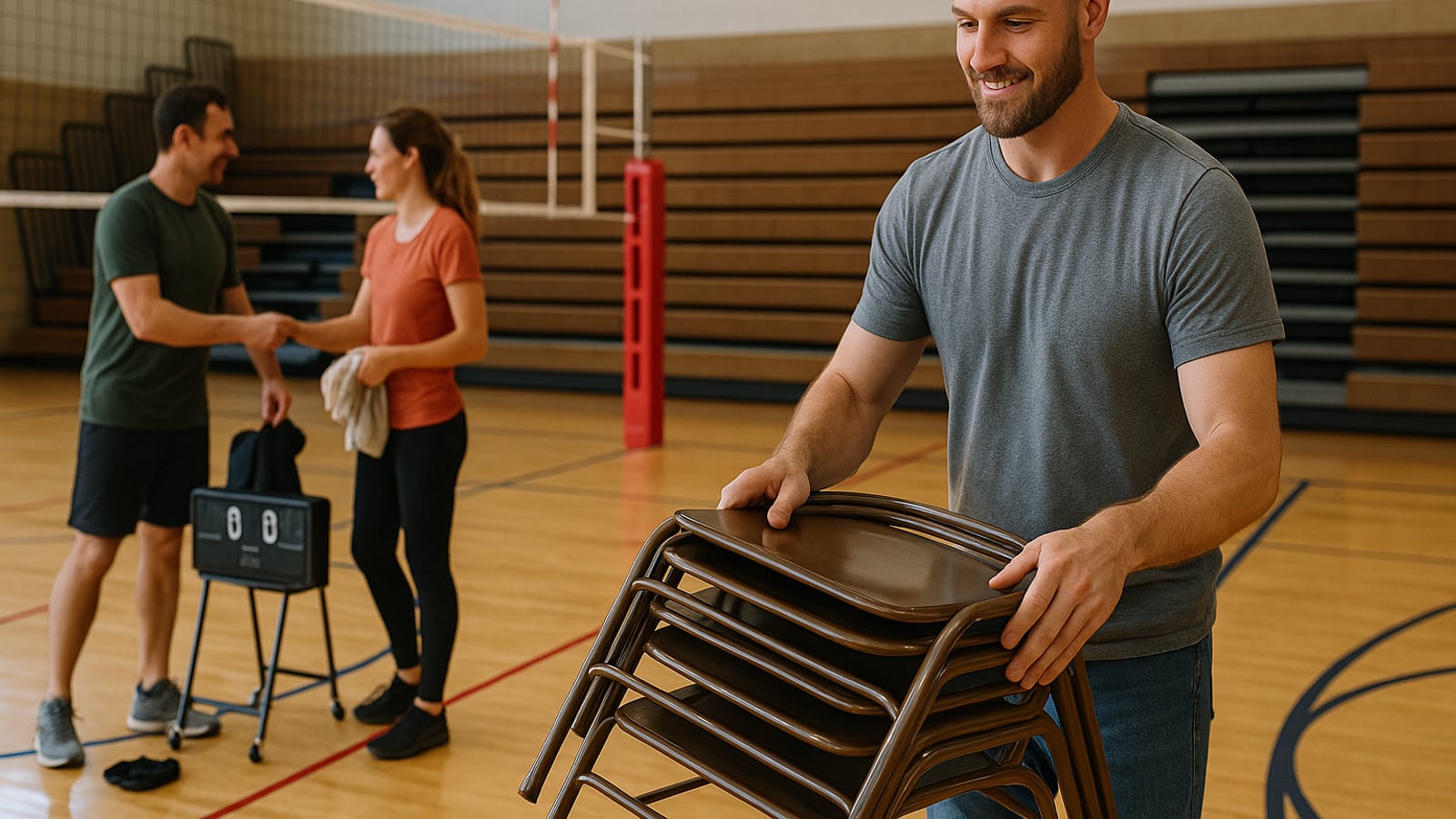
The "needs something from you" part is the one people skip. Being useful shortcuts about two months of social throat-clearing. If you can carry tables, run a scoreboard, drive the trailer or make coffee, you stop being the new guy and become the new guy who does the coffee. That's an identity. People can hang things on it.
Bars and coffee shops can work, but only if you get on a first-name basis with staff and go at the same hour. A Saturday 8am regular gets known. A random Friday 9pm drinker doesn't.
The first eight weeks are genuinely bad
Nobody tells you this part, so brace for it. Weeks one through six are lonely in a specific, low-grade way that doesn't look like grief but sits in your chest anyway. You'll eat a lot of meals standing at the counter. You'll get through a whole Saturday having spoken to one cashier. You'll start thinking there's something wrong with this town, or with you.
There isn't. You're just early.
The thing that wrecks this stage most often is driving back to your old town every weekend. It feels like a lifeline and it's actually a tourniquet on the wrong limb. Every weekend you're away is a weekend you're not at the Saturday shift, not at the Sunday service, not on the pitch. Three months in, your old friends have absorbed your absence and your new town still doesn't know you exist.
Give yourself a rule. One trip back in the first three months, and not on a weekend you'd otherwise be somewhere on your list.
Be the one who invites
At some point somebody will be friendly to you and then nothing will happen, because they're an adult with a job and children and a roof that needs work. Friendliness isn't an invitation. Somebody has to actually issue one, and it should be you, because you're the one who needs the friends.
Make it specific and small. "Come round Sunday at four, I'm doing chili, bring the kids" beats "we should hang out sometime" by a distance you can't measure. Name a day, name a time, set a bar low enough that saying yes costs nothing. Nobody has to tidy, nobody has to dress up, nobody's committing to a four-hour evening.
Expect a hit rate of about one in three. That's not rejection. People are busy, and half the no's come back as "can't this week, what about the next one?" if you ask again. Asking twice is normal. Asking a third time after two vague no's is the point to move on quietly and without resentment.
And when somebody invites you to something you don't fancy — a 6am bike ride, a church workday, a cousin's birthday at a bowling alley — go anyway for the first year. Say yes to everything you're free for. You can be selective once you have a circle. You can't be selective while building one.
When the town really is closed
Some places are. Small towns where the same six families have been intermarrying since the railroad came through, and every friendship group solidified in eleventh grade. You can do everything right there and still find the door only opens so far.
Two things work. First, find the other transplants. The nurse who moved for the hospital job, the couple who came for the school district, the family who arrived a year before you and still remember what it felt like. Newcomers are hungry for exactly what you're hungry for, and they don't have a childhood best friend occupying the slot. Second, go where the town's own structures put strangers together on equal terms: the volunteer fire service, the school board, coaching a youth team, the church that's actively growing rather than the one that's been the same eighty people since 1974.
Kids and dogs are accelerants. If you have either, use them shamelessly — the touchline and the dog park are two of the few places in adult life where talking to a stranger is expected. If you have neither, you'll need to work harder on the fixed-roster stuff, and that's a real disadvantage. It's not fatal. It's just slower.
The marriage part
If you moved for your job, your wife is very likely having a worse time than you're. You got handed a building full of colleagues and a reason to leave the house at eight. She may have got a house full of boxes and a town where she knows no one.
Don't let her become your only social life, and don't let yourself become hers. Both are easy and both curdle. Make sure each of you has one thing a week that belongs to you alone, and one thing you do together with other people in the room. Watch for the point where every conversation you have is about the move, the house, the town, the last place. That's the signal you both need more faces.
The honest timeline
Six months to have people to call. Eighteen months to two years before somewhere feels like home, before you have the friend who'll drive you to the airport at 5am without being asked. That's not slow. That's the actual speed of the thing, and knowing it stops you from quitting at month four, which is when most people quit.
The Tuesday league doesn't look like much on Tuesday. Then one week you can't make it, and three people text to ask where you were.
Cal Brennan
Fitness
Strength coach. Trains fathers, tradesmen and desk workers, which means programmes that survive a bad week.

Watch
Worth an hour of your evening
More from Life.
From channels we rate. Plays on YouTube.
Read next