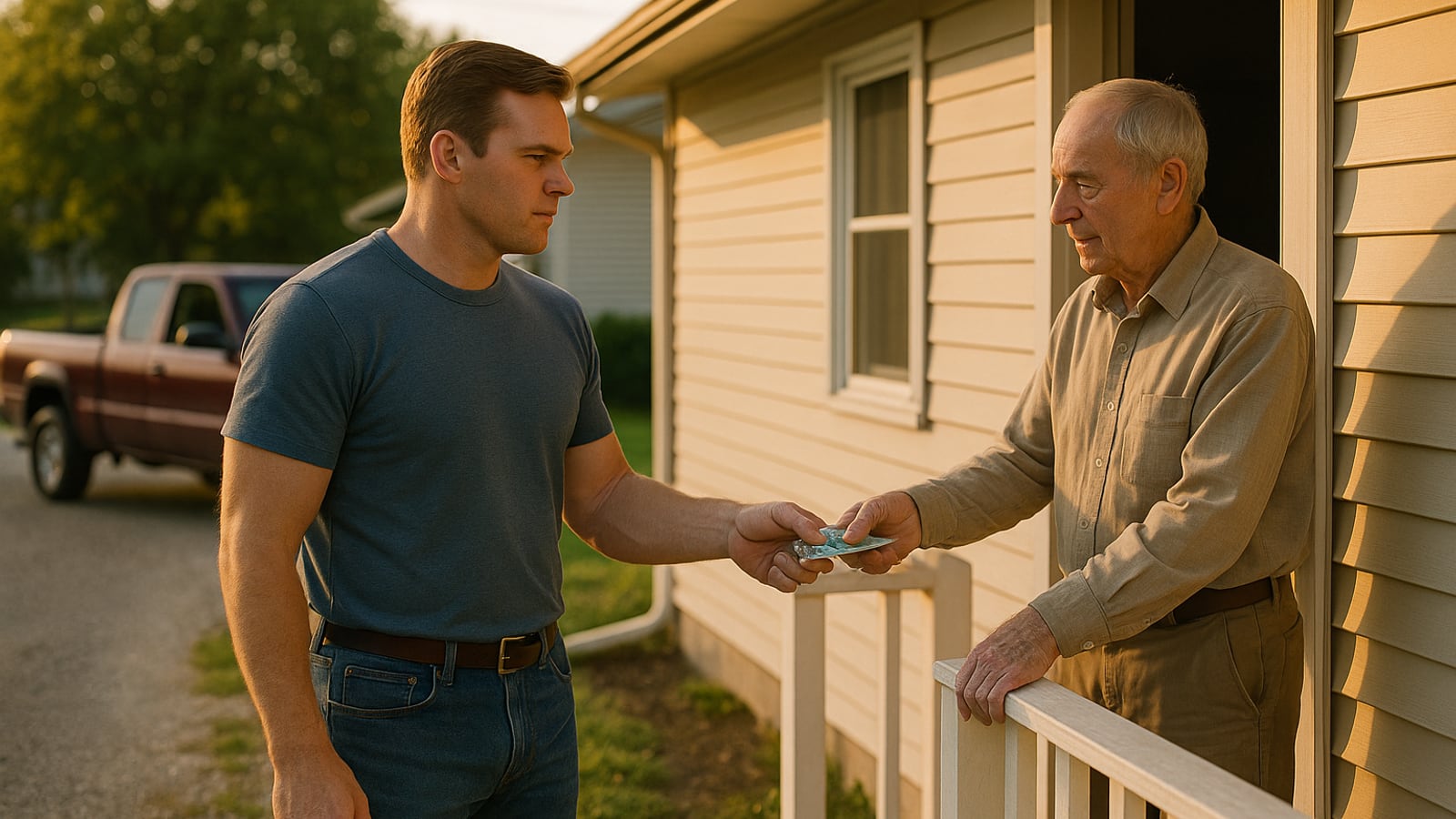
My grandfather once drove forty minutes on a Saturday to hand a man sixty dollars. The loan was from a job they'd worked together years before, back when a wheel bearing went out on the way home and the other guy had cash and he didn't. The man had forgotten about it entirely. He tried to wave it off at the door. My grandfather put the bills on the porch rail, said "no, that's yours," and drove home.
I was maybe fourteen, sitting in the truck the whole time, annoyed that we'd missed most of a ballgame for it. On the way back he said the only thing he ever said to me about it: "A debt doesn't expire because the other fella's polite."
That's the whole code, more or less. It was never written down anywhere and nobody in his generation would have called it a philosophy. It was just a short list of things a man did so that other men would work with him, hire him, lend to him and let him near their daughters. Most of it still holds. Some of it needs a translation for a world where the handshake happens over text.
Your word is a calendar entry, not a feeling
The old line was "a man's word is his bond." People say it now like it's about sincerity. It wasn't. It was about records. Before contracts and credit scores reached down into ordinary life, what you said out loud was the only enforcement mechanism there was, and a man who said "I'll be there Tuesday" and wasn't there Tuesday was, in a real economic sense, uninsurable.
So the first rule is boring and mechanical. Write down every promise you make, in the moment you make it. Not in your head. In your phone, with the person's name in the entry. "Call Dave back re: trailer — Thu."
Most broken promises in your twenties and thirties aren't betrayals. They're forgetting. But the guy waiting on you can't tell the difference between "he lied to me" and "he forgot about me," and honestly, neither one is flattering. Forgetting is just lying with worse organization.
Pay it back before they have to ask
The asking is the injury. Not the money.
When someone has to text you "hey, no rush, but…" you've already made them spend something worse than forty dollars, which is their dignity. They rehearsed that text. They softened it twice.
So: same day, every time. If a buddy covers your lunch, send it before you're out of the parking lot. If it's bigger and you can't pay it in one shot, you say the terms yourself, out loud, unprompted. "Two hundred a month starting the first, done by March." Then hit the first payment early. Nobody worries about the guy whose first payment came four days early.
And if you can't pay it on time, you call before the date, not after. The call before is a man managing a problem. The call after is a man making an excuse.
Borrowed things come back better than they left
My grandfather returned tools clean, sharpened and with the gas topped off, and he returned them fast, usually before the guy had thought about needing them. Trucks came back washed. A chainsaw came back with a new chain if the old one was dull when he was done with it.
The thinking is simple. Lending you something cost the other person a small amount of risk and convenience, and the only way to make that trade fair is to hand it back with a little more value in it than there was before. That's not generosity. It's arithmetic.
The modern version: return the borrowed truck with more fuel than you found. Bring back the dish with food in it. If you borrow someone's time — an hour of a busy man's expertise — send the follow-up telling him what you did with the advice. That's the fuel in the tank.
Quote it, then eat the difference
If you say you'll do a job for four hundred and it turns out to be a six-hundred-dollar job because you misjudged it, you do it for four hundred. You learn the lesson in your own pocket, where lessons stick.
The exception, which every honest tradesman knows, is a genuine change in the work. Rotten subfloor under the tile nobody could see. Then you stop, you show the customer, and you re-price before you touch another thing. What you never do is finish the job and surprise somebody with the bill at the end.
Same principle at a salary job, where it costs you nothing but pride. When you blow an estimate, say so early and specifically. "I said Friday. It's going to be Tuesday, and that's on me for not checking the vendor lead time." No one in the history of work has been fired for that sentence. Plenty have been fired for the Friday that quietly turned into a Tuesday nobody was warned about.
Say no in one sentence
Half the promises men break were never promises they wanted to make. They were "yeah, maybe, let me see" said to a guy standing right there in front of them, because no is awkward for four seconds and maybe is comfortable for four seconds.
Then maybe curdles. The other guy plans around it. And you've cost him more than a straight no ever would have.
"I can't do that one." Full stop. No elaborate reason, because a reason invites negotiation. The old men who were pleasant to deal with were often the quickest to decline. They knew their yes was worth something precisely because they didn't hand it out to be nice.
Admit it plain, without the lawyer voice
"Mistakes were made." "I'm sorry you took it that way." Every generation invents new ways to apologize without confessing, and everybody sees through all of them.
The old version was three parts and took about eight seconds. What you did. No excuse attached. What you're doing about it. "I backed into your mailbox. No excuse, I was in a hurry. I'll have a new post in Saturday morning."
Notice what's missing. No explanation of the circumstances, no mention of the sun being in your eyes, no reference to how the mailbox was arguably too close to the driveway.
Don't say it behind him
The rule my grandfather actually enforced with a look across the table: never tell a story about a man you wouldn't tell with him sitting there.
It's a better filter than it sounds, because it kills gossip without requiring you to be a saint. You can still say the hard thing. You just have to be willing to say it to his face, which usually means you end up saying it to his face instead, which is where it belonged.
The honest trade-off
The code has a cost, and it's worth naming, because the men who lived it knew it and nobody ever mentions it in the sentimental version.
A man who keeps every promise becomes the man everybody asks. You'll get leaned on. You'll be the first call for the move, the jump start, the loan, the ride to the airport at 5 a.m. Some people will read your reliability as a resource to be mined.
The fix isn't to get cagey with your word. It's to make fewer promises and keep all of them. Reliability is a reputation, not a contract of servitude, and "I can't do that one" is part of the code, not a violation of it.
One more thing, since it's the part the old code is quietest about. If you're genuinely underwater on debt — collectors calling, balances you can't see the end of — willpower isn't the tool for that job. Sit down with a nonprofit credit counselor or an attorney and get real numbers on the table. Honesty about a debt includes being honest that it's bigger than you.
My grandfather's ledger, if he'd kept one, would have been two pages long and mostly blank. He didn't owe many people. That was the point. The sixty dollars stuck in his head for years not because he was tormented by it, but because it was the only thing on the list.
Keep a list that short and you'll never have to drive forty minutes on a Saturday to clear it.
Dean Shaw
Gear & Garage
Tests things until they break, then reports what broke first. Trucks, tools, watches, and the cheap version that costs more.

Watch
Worth an hour of your evening
More from Old School.
From channels we rate. Plays on YouTube.
Read next