Picture the showroom. It's a Tuesday morning, three days after, and your wife is standing in a carpeted room with twenty caskets in it, running on four hours of sleep and a cup of gas station coffee. A polite man in a dark suit is explaining the difference between an 18-gauge steel and a solid poplar. Your son is standing behind her with his arms crossed, and what he says is, "Mom, get the nice one. Dad would have wanted the nice one."
You wouldn't have wanted the nice one. You'd have wanted the cheap one and the rest of the money in her account. But you're not there, and nobody knows that, so they spend four thousand dollars they didn't need to spend because grief and guilt are hard to tell apart in a room like that.
That's the problem you're solving. Not death. Paperwork.
Write it down where they'll actually find it
Don't put your funeral wishes in your will. This is the single most common mistake, and it's a quiet one. Wills often aren't located and read until a week or two after the burial, sometimes longer. The decisions get made first, the instructions get read second, and everybody feels terrible.
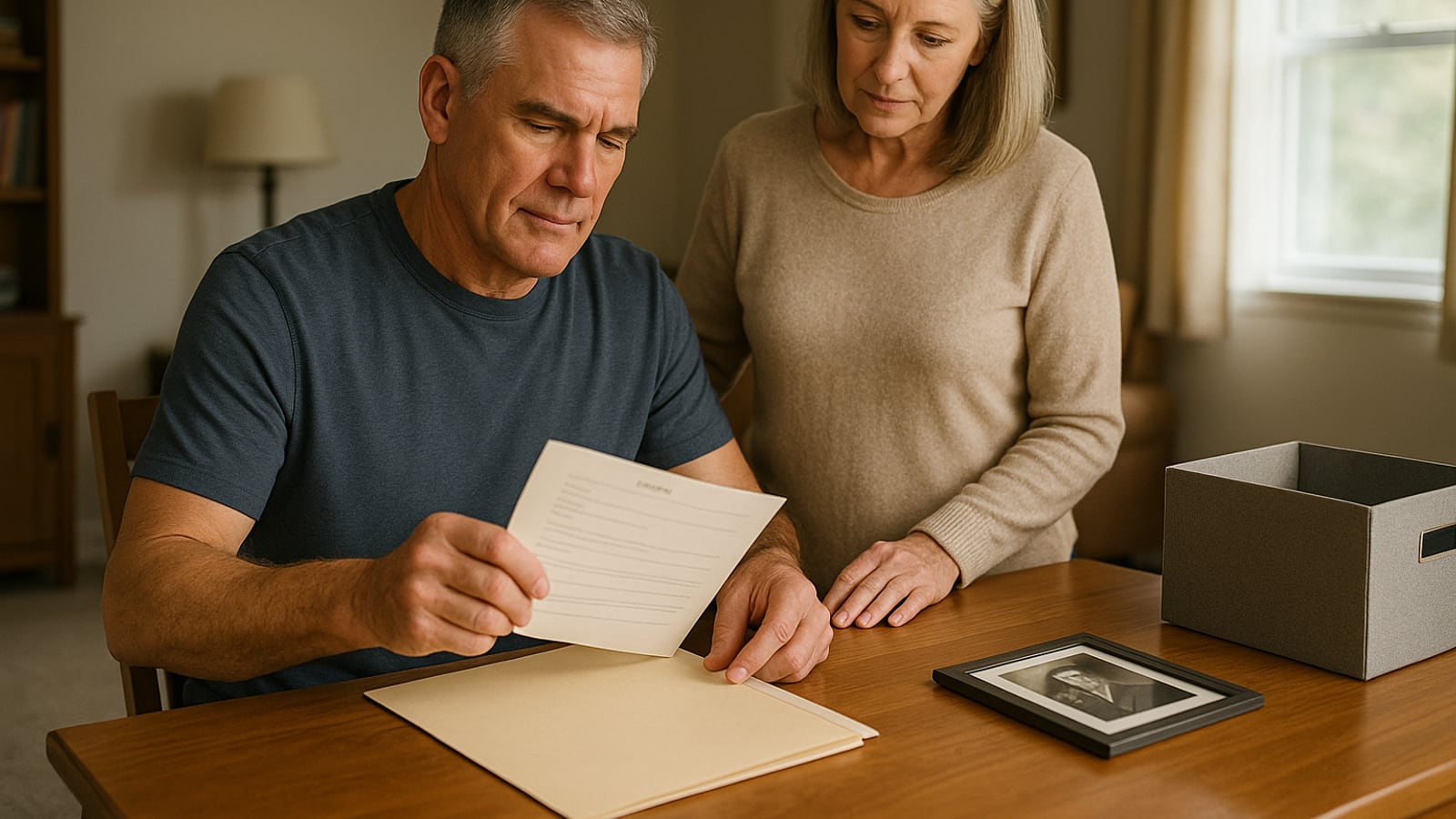
Put it in a plain folder. Label it. Tell three people where it lives: your wife, one adult child, and one person outside the household who won't be flattened by the news. A brother, a neighbor, the friend you've had since 1974. Somebody has to be able to think on Tuesday morning.
Most states let you name an agent for the disposition of your remains, on a short signed form. If your family agrees on everything, you may not need it. If you've got a blended family, an ex-spouse, or two kids who don't speak, you need it. Name one person. Not a committee.
Say what you want, in about a page
Burial or cremation. That's the fork, and everything after it's detail.
Write down the rest in short lines, not paragraphs:
- Open casket or closed
- Church, funeral home chapel, graveside only
- Who preaches, who speaks, who absolutely doesn't speak
- Two or three songs by name
- Six pallbearers, plus two alternates, with phone numbers
- What you want done about flowers, or where donations should go instead
- Where the reception is, and whether you want the church ladies doing the food
The pallbearer list is a bigger gift than it sounds. Your wife doesn't know which of your friends would be honored and which one has a bad back. You do.
And here's the concession: don't script the whole hour. The funeral isn't really for you. Say what matters to you, then write one line giving them permission to add whatever they need. If your daughter wants to read something, let her. You won't mind.
Get the actual prices before anybody's crying
Federal law is on your side here and almost nobody uses it. Under the FTC's Funeral Rule, a funeral home has to give you an itemized General Price List as soon as you sit down to discuss arrangements, and they have to quote prices over the phone if you call and ask. You can buy a casket anywhere you like, and they're required to accept it without charging you a handling fee. They also can't require embalming for a direct cremation or an immediate burial.
So call three. Do it on a weekday afternoon when you're in a good mood. Ask each one for the price list, in writing, by email.
Then look at the line items people never see coming. Opening and closing the grave, which the cemetery bills separately from the funeral home. The vault or grave liner most cemeteries require. The honorarium for the pastor and the musician. Newspaper obituary placement, which can run real money for a long one with a photo. Certified copies of the death certificate, priced per copy.
Order ten or twelve of those copies. Every bank, insurer, pension office and title company wants an original, and reordering later is an afternoon your family shouldn't have to spend.
Prepaying isn't the same as preplanning
Preplanning costs you nothing and solves most of the problem. Prepaying is a financial decision, and it cuts both ways.
The upside is real: you lock the price, the money's set aside, and nobody has to find eight thousand dollars in a hurry. The downside is also real. Preneed contracts vary wildly by state on whether the money sits in trust or an insurance policy, how much of it is refundable, and what happens if you move to Arizona or that funeral home gets bought by a chain. Read the contract for two words: guaranteed and portable. If neither appears, ask why.
The simpler alternative is a payable-on-death account at your bank with your wife or executor named as beneficiary. It skips probate, it's available in days, and you can move it, spend it or change it anytime. Ask an estate attorney which fits your situation and your state. That's not a question to settle from an article.
If you served, use what you earned
If you're an eligible veteran, burial in a VA national cemetery costs your family nothing. The gravesite, the opening and closing, the government headstone or marker, the burial flag, perpetual care. Your spouse and dependent children may be eligible to be buried there too. You can apply for pre-need eligibility now and get a determination letter in the folder, so nobody's hunting for proof on the worst week of their life.
Military funeral honors are available on request for eligible veterans. At least two uniformed service members, the flag folded and presented, Taps. If you want that, write it down, because your kids may not know to ask.
Find your DD-214. Make a copy. Put it in the folder. If it's lost, request a replacement from the National Archives now, not in an emergency.
Write your own obituary, at least the skeleton
Not the tribute. The facts. Dates, places, unit, employer, the church, the names of every grandchild spelled correctly. Somebody is going to try to assemble that at midnight from memory and they will get the middle initial wrong and it'll bother your wife for a decade.
Leave out your home address and your mother's maiden name. Obituaries get read by people who aren't mourning you, and identity theft after a death is a genuine problem.
Then, if you've got it in you, write the other thing. One page, handwritten, to your wife. One to each kid. Nothing profound required. What you were proud of. What you're sorry about. Where the good tools are.
The last item in the folder
A single sheet at the front, before all the rest: account numbers, insurance policies and their phone numbers, pension and Social Security survivor contacts, the attorney, the accountant, the safe combination.
Then go do something else. You've bought them a week of not guessing, and they'll only find out what that was worth when they open the folder and everything's already decided.
That's the last practical act of a man who ran his own life. Signed, dated, and filed where they can find it.
Marcus Vale
Editor-in-Chief
Twenty years in magazines, most of it deciding what to cut. Writes about work, discipline and the decisions that compound.

Watch
Worth an hour of your evening
More from BRO Seniors.
From channels we rate. Plays on YouTube.
Read next