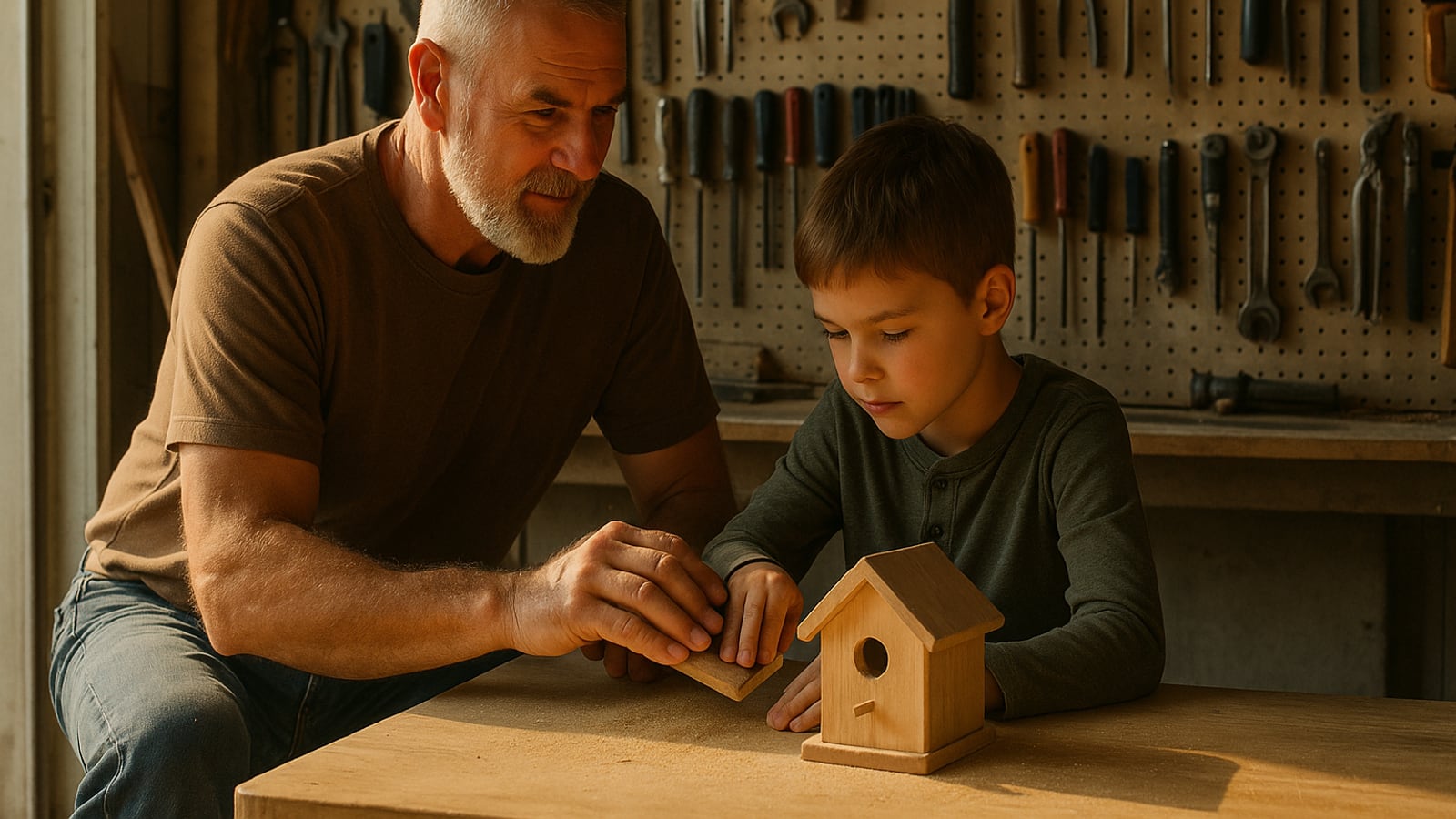
The single biggest factor in whether your grandchildren want to be around you isn't money, trips, or how many games you make it to. It's whether your face changes when they walk in the room.
Kids read that instantly. They can't articulate it, but they know who's glad to see them and who's tolerating them. If you get nothing else right, get that right.
Everything below is downstream of it.
Predictable beats spectacular
A week in Florida once every three years does less for the relationship than a phone call every Sunday at four.
Children bond to rhythm. They like knowing that Saturday morning means pancakes at your place, or that Grandad calls when they get home from school on Wednesday. Small, repeated, reliable. That's the shape of it.
Pick something you can actually sustain for a decade. Not what sounds impressive. If a weekly call is too much, make it fortnightly and never miss one. A promise you keep at half the frequency is worth more than an ambitious one you break.
And when you set the rhythm, protect it. Kids notice the pattern before they notice the content. The message they take from a call that happens every single week isn't "Grandad likes talking about soccer." It's "I'm worth showing up for."
Back the parents, every time
You have one job in the room when a rule is being enforced, and it's to be quietly on the parents' side.
No sighing. No "oh, let him have it, it's only a biscuit." No eye contact with the child that says the two of us know this is silly. That little conspiracy feels warm for about four seconds and costs you enormously with the person who decides how often you see that child.
If you think your son or daughter is getting something wrong, say it once, in private, without an audience, and then let it go. You raised them. You had your turn.
The grandfathers who get the most access are the ones the parents trust completely. Trust is built by returning children in roughly the state you received them, honoring the bedtime, honoring the allergy, honoring the no-screens rule even when it makes the afternoon harder for you.
Be the easy grandparent to say yes to.
Have a thing
"Hanging out" doesn't work with children. Activity does.
You need something specific that belongs to the two of you. A shed and a workbench. A fishing spot. A card game you play every visit. Saturday breakfast where they order whatever they want. Feeding the birds. A model that takes eleven visits to finish.
The activity isn't the point. It's the container. Kids talk sideways, not face-to-face, and a shared task gives them somewhere to put their eyes while they tell you the thing they weren't going to tell anyone.
This is why car rides are so effective with teenagers. No eye contact, nowhere to escape to, twenty minutes. Volunteer for the drive to practice. You'll learn more in those drives than at any Christmas dinner.
If you're far away, the thing can still exist. Read the same chapter book over video call, one chapter a week. Mail actual letters — children who get almost no physical mail treat an envelope with their name on it like a small event.
One at a time
Grandchildren in a group are a crowd. Grandchildren alone are people.
Take one out on their own. Make it a thing that happens. The quiet middle child who never gets a word in at the family table will talk for two straight hours in a diner booth, and you'll discover a person you had no idea was in there.
Rotate it fairly, and don't let it become a reward system. It's not for good behavior. It's just their turn.
Learn their world, and don't grade it
Ask about the specific, not the general. "How's school" gets you "fine." "What's your history teacher like" or "who did you sit with at lunch" gets you something.
Learn the names. The best friend, the rival, the dog, the coach, the video game, the team. Write them down if you have to, and bring them up next time. A child who realizes you remembered the name of their friend from six weeks ago has just learned something permanent about how much you pay attention.
Then leave the judgment out of it. Whatever they're into is going to seem unserious to you. Say so, and you'll get nothing next time.
That goes double for their appearance. Don't comment on weight, hair, clothes, piercings, grades, or how much they're on their phone. You get maybe one of those observations per decade, and you should probably save it.
Stay able
You can't be much use on the floor with a four-year-old if you can't get up off it.
Getting down and up unassisted, carrying a sleeping child from the car, walking a zoo at toddler speed for three hours, lifting a bike into the trunk. That's the functional list. If any of those are borderline for you now, that's worth raising with your doctor and, if it's appropriate for you, a physical therapist who can build something specific to it.
The motivation matters here. "Exercise" is abstract. "Be able to take my granddaughter to the aquarium when she's eight" isn't.
Tell them about their parent
Children are fascinated by the idea that their mother was once nine years old and got in trouble.
You're the only one who has those stories. Tell them, generously, and tell the ones where the parent was funny or brave or afraid — not just the embarrassing ones, though a few of those go a long way.
Tell them about yourself, too, and don't sand it down into a lesson. Kids can smell a moral coming from thirty feet. Tell them about the job you lost, the thing you were scared of, the mistake that cost you. The point of an honest story is that it gives them permission to be a person who struggles.
The teenage years, when they go quiet
Around thirteen, a lot of them go dark. Shorter answers, less enthusiasm, phone in hand.
Don't take it personally and don't withdraw in response. That's the mistake that ends things. Keep showing up at exactly the same frequency, keep the offer open, expect nothing back for a couple of years.
They're not rejecting you. They're doing the work of becoming separate, and they're doing it to everyone. The grandfather who keeps calling through that stretch is the one they call at twenty-two when something's gone wrong and they can't tell their parents yet.
Say the things out loud
Don't assume they know. Tell them what you see in them. Tell them you're proud, and be specific about what — "you were patient with your brother today" beats "you're a great kid."
If faith is part of your home, pray with them when the parents are fine with it, and let them see you do it when nobody's watching. Don't ambush anyone. A grandfather who's obviously at peace preaches better than one who lectures.
Write some of it down while you're able. A letter for each of them, sealed, dated, handed to their mother for safekeeping. It doesn't need to be profound. What they'll want, in thirty years, is the sound of your voice on paper.
They won't remember most of the trips. They'll remember that you were pleased to see them, every single time, without conditions.
That's not a small thing to be. That might be the whole thing.
Cal Brennan
Fitness
Strength coach. Trains fathers, tradesmen and desk workers, which means programmes that survive a bad week.

Watch
Worth an hour of your evening
More from BRO Seniors.
From channels we rate. Plays on YouTube.
Read next