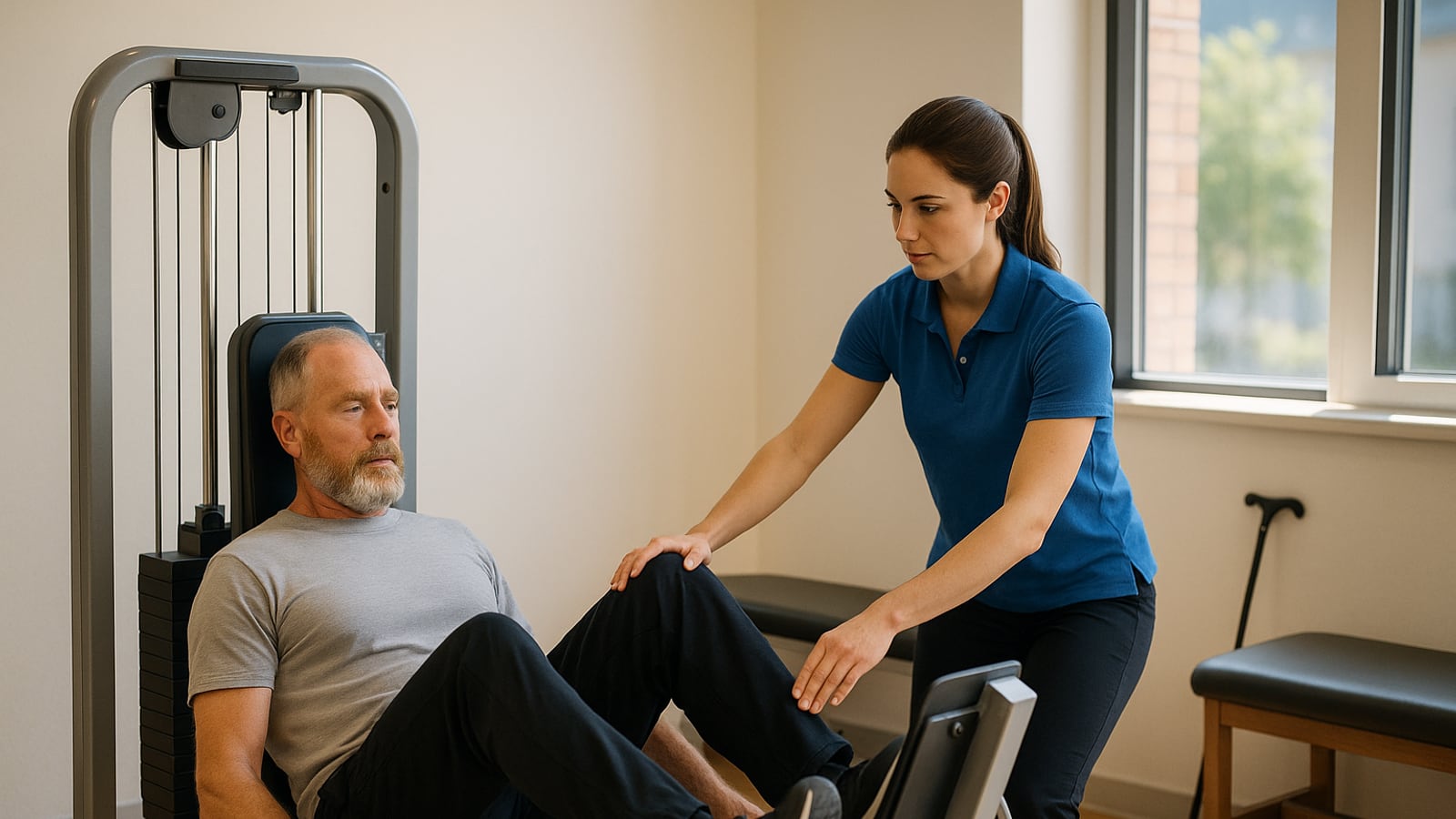
The single most useful thing you can do for an aching knee is make the muscle above it stronger. Not rest it. Not wrap it. Not buy a better chair.
That goes against almost everything a sore knee tells you to do, which is why so many men spend their sixties slowly withdrawing from the things that would have kept them walking into their eighties. The knee hurts on the stairs, so they take the lift. The hip stiffens on the long walk, so they shorten the walk. Two years later the leg is smaller, the joint is less supported, and the pain is worse.
Joints aren't tires. They don't have a fixed number of miles in them. Cartilage responds to loading, muscle protects the joint underneath it, and the whole system gets thinner and more fragile when you leave it alone. The men I know who still hike at seventy-five aren't the ones who protected their knees. They're the ones who kept using them.
Strength is the treatment
If you only take one thing from this: your quadriceps, glutes and calves are your joint's shock absorbers. When they're strong, the joint takes less punishment per step. When they waste away, every stair, kerb and slope goes straight through the cartilage.
Quadriceps strength is closely tied to how knees feel and function, and it's one of the first things a good physiotherapist goes after when someone limps in with arthritic knees. Glute strength matters just as much for hips, because a weak backside lets the pelvis drop and the femur roll inward on every step.
Both are trainable at any age. Muscle responds to resistance training in your seventies. Slower than in your thirties, yes. But it responds.
Twice a week is enough to change things. Three times is better if your schedule allows. Here's what a session looks like, and no, you don't need a gym for most of it.
- Sit-to-stand. From a dining chair, no hands, stand up and sit down slowly. Three sets of eight to twelve. When that's easy, hold a weight at your chest or use a lower chair.
- Step-ups. One foot on a stair or a low box, drive up through the heel, step down under control. Three sets of eight each leg. The lowering is the part that builds the knee.
- Calf raises. Off a stair edge, holding the rail. Three sets of fifteen. Slow down, full stretch at the bottom.
- Hip bridges. On your back, feet flat, lift the hips and squeeze. Three sets of twelve. Progress to one leg.
- Side-lying leg raises or a band walk. Three sets of fifteen per side. Boring. Non-negotiable for hips.
Twenty to twenty-five minutes. If you finish feeling like you could have done a fair bit more, add weight or reps next time. The muscle only grows if you ask it to.
The stairs aren't the enemy
Stairs get abandoned early, and it's a mistake. Going up builds strength. Going down builds control, which is what stops the stumble at the kerb three years from now.
If stairs hurt, don't quit them — shrink them. Take one step at a time, both feet on each tread, hand on the rail. Do four. Then six. The joint that gets loaded a little every day tolerates far more than the joint that gets loaded once a fortnight when there's no alternative.
Same with hills. Same with getting down to the floor and back up. If you can't get off the floor without furniture, that's a strength and mobility problem, and it's the one I'd fix first, because it's the one that decides whether a fall is an inconvenience or a catastrophe.
Keep the hip open
Sitting for most of the day shortens the front of the hip. A short hip flexor means you don't extend fully behind you when you walk, so you take shorter steps, load the knee differently and put more work on the low back. It creeps up on people over decades.
Two minutes a day handles most of it.
Half-kneeling stretch: one knee down on a cushion, the other foot forward, squeeze the backside of the down leg and gently shift forward. You should feel it in the front of the hip and thigh, not in the knee. Thirty to sixty seconds each side.
Then ankles. Face a wall, foot about a hand's length back, drive the knee forward over the toes without the heel lifting. Stiff ankles push extra bend into the knee on every stair and every squat. Thirty seconds each side.
Which pain matters
General rule used widely in rehab: pain up to a mild, tolerable level during exercise that settles within a day is acceptable and not a sign of damage. Pain that climbs during the session, or that's still elevated the next morning, means you did too much. Reduce the load, don't stop the movement.
Signs to get in front of a doctor or physiotherapist rather than working through:
- The joint locks, catches or gives way
- Swelling that appears quickly or won't settle
- Redness and heat, or fever with joint pain
- Pain at rest and through the night
- Pain after a fall
That list isn't a diagnosis, it's a prompt to book an appointment. A physiotherapist is the right first call for most stiff, aching joints. A GP is the right first call for anything hot, swollen or sudden.
The honest bit about weight
Your knees carry many times your body weight with every step, and more going downhill. Losing even a modest amount takes real load off the joint, and men who lose weight and build leg strength at the same time usually do better than men who do either alone.
That's not a lecture about appearance. It's arithmetic. The cheapest joint surgery is the one you don't need.
Protein helps here, because building muscle while eating less requires enough of it, and older adults generally need more protein per meal than younger ones to get the same muscle-building response. If you've got kidney disease or you're on a restricted diet, ask your doctor or a dietitian what the right number is for you. Don't guess from an internet argument.
If a replacement is coming anyway
Hip and knee replacements are among the most successful operations in modern medicine. Getting one isn't a failure of discipline.
But the strength you take into surgery predicts a lot about what you walk out with. Surgeons and physios call it prehab, and it's exactly the work above. A strong leg recovers faster than a wasted one. Someone who can already do a sit-to-stand without hands has a much easier first fortnight than someone who can't.
So the training isn't wasted even in the worst case. It's either the thing that delays surgery or the thing that makes surgery go well.
Twenty years is a long time to sit down
The men who lose their mobility rarely lose it in one dramatic event. They lose it in small surrenders. The stairs, then the garden, then the walk to church, then the floor.
Every one of those is reversible for longer than most people think. But only by the same route it was lost: a little load, most days, patiently, while it's still an option.
Get down on the floor with your grandchildren this week. If getting back up is harder than it should be, you've just found your training program.
Marcus Vale
Editor-in-Chief
Twenty years in magazines, most of it deciding what to cut. Writes about work, discipline and the decisions that compound.

Watch
Worth an hour of your evening
More from BRO Seniors.
From channels we rate. Plays on YouTube.
Read next