Strong at seventy starts with getting off the floor
Four benchmarks worth defending, why your tendons need longer than your muscles, and what to stop doing the week you feel great.
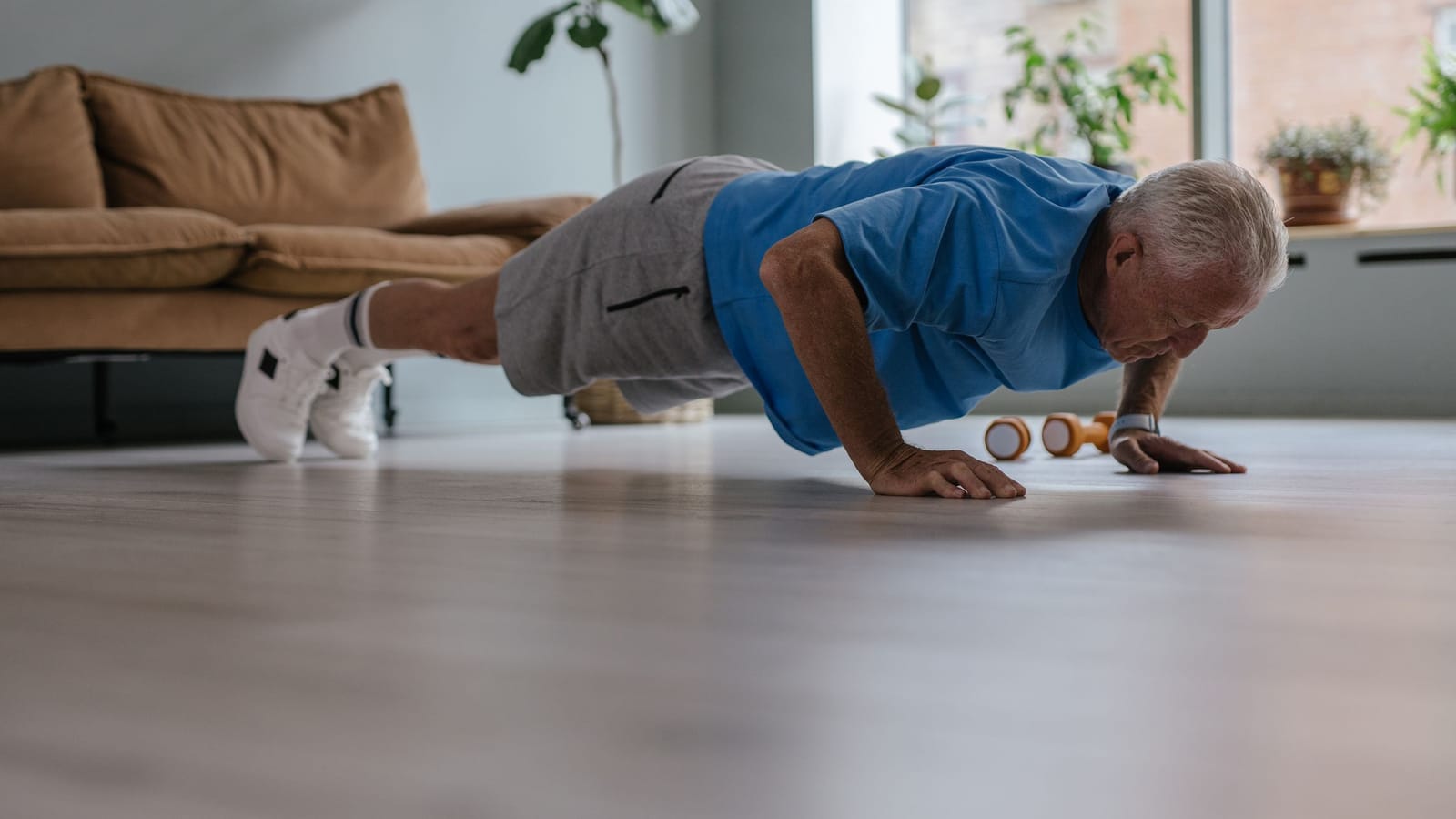
Sit down on your living room floor. Cross-legged, on your backside, however you like. Now stand up without using your hands, without a knee going down, without grabbing the coffee table. Do it five times.
If you managed five, you're in better shape than you think and this piece is about keeping it. If you managed two and the third one turned into a rock-and-roll manoeuvre with a hand on the sofa, that's your training program telling you what it wants. Not more cardio. Not a new supplement. That.
What actually changes, and what doesn't
The thing that fades fastest isn't strength in the abstract. It's speed under load. The fibres that fire quickly, the ones that catch you when a paving slab is half an inch proud of the next one, go before the slow ones do. That's why a man can still push a respectable weight on a leg press and then stumble stepping off a kerb.
Tendons change too. They get stiffer and they adapt more slowly than muscle does. Your quads will happily take a 20 percent jump in load and feel fine on Tuesday. Your patellar tendon will send you the invoice three weeks later.
What doesn't change is the basic bargain. Load the tissue, feed it, rest it, and it gets stronger. That mechanism doesn't switch off at a birthday. It just runs slower and it punishes impatience more than it used to.
The four benchmarks worth defending
Forget your one-rep max. Nobody's asking. These are the things that decide whether you keep running your own life.
Floor to standing, no hands. The one you just tried. It's a combined test of leg strength, hip mobility and balance, and it's the difference between a fall being embarrassing and a fall being the start of a hospital admission.
Twenty-five kilos, thirty meters, one hand. A sack of dog food, a bag of sand, a full watering can in each hand. If you can carry real weight a real distance without setting it down, you can still load a car, move a suitcase and help somebody shift a wardrobe.
Thirty seconds on one leg. Eyes open, arms down, shoes off. Then try it with your eyes shut and find out how much of your balance was coming from your vision rather than your ankles.
Sit to stand from a dining chair, ten times, in under thirty seconds. No arms. It's unglamorous and it maps directly onto getting out of a low car, a garden bench, an aeroplane seat.
Test all four this week. Write the numbers on a bit of paper and put it in a drawer. Retest in twelve weeks. Not because the numbers are magic, but because your memory of how you used to move is unreliable, and paper isn't.
Train for the benchmarks, not around them
Squat to a box and stand up. Start with a chair height that's comfortable, and over the months lower the surface. A kitchen chair, then a garden step, then a low crate, then the floor. That progression alone rebuilds the floor test.
Carry things. Pick up two heavy objects, walk to the end of the garden, walk back, put them down. Thirty to forty meters a set, four sets. Grip strength is one of the better rough indicators of how the rest of you is doing, and you can't fake it.
Stand on one leg while the kettle boils. Both sides. When that's easy, close your eyes. When that's easy, stand on a folded towel. This costs nothing and it's the single most neglected thing men over sixty-five skip, because it doesn't feel like training.
Push and pull something. Press-ups against a kitchen worktop if the floor is too much for now, and rows with a band anchored in a door. Shoulders that can still get a bag into an overhead locker are worth having.
The week you feel great is the week you get hurt
Here's the pattern, and it's so consistent you can set a calendar by it. Four weeks in, you feel twenty years younger. The weights have gone up, you're sleeping better, and you decide to add a big jump. Two weeks after that your elbow, your Achilles or your lower back has opinions and you're out for a month.
Add roughly 5 percent when you add. Not 20. If you're carrying two ten-kilo weights, the next step is eleven, not fifteen. It feels absurdly cautious. Do it anyway, because at seventy an injury costs you three months, not three weeks, and it's the layoff that does the real damage.
Give hard sessions seventy-two hours, not forty-eight. Most men in their seventies need the extra day and don't take it. Some don't, and if you're recovering fully in two days and the numbers keep rising, carry on. You'll know which you're within a month of honest record-keeping.
Eat enough, and eat it early
Older muscle responds less readily to a given amount of protein than younger muscle does. The practical version of that: a slice of toast at breakfast, a sandwich at lunch and a proper dinner tends to leave most of the day underfed for anyone trying to build.
Put protein at breakfast. Eggs, Greek yoghurt, leftover chicken, whatever you'll actually eat at seven in the morning. Do the same at lunch. Dinner usually takes care of itself.
Ask your GP or a dietitian for a number that fits you, especially if you've got any kidney involvement, because that's one of the few places where general advice genuinely doesn't apply to everybody.
Two things worth raising with a professional
If you're on blood pressure medication and you get lightheaded standing up from a squat, that's worth a five-minute conversation with your pharmacist. It's common, it's manageable, and guessing about it on your own is how people end up on the floor.
And if you've had a hip or knee replaced, the joint has rules that override anything written here. Ask the surgeon or the physio what ranges and loads they're happy with. Then train hard inside those limits, because "replaced" doesn't mean "retired".
The part that isn't about you
A six-year-old wants to be picked up. Not helped up, not lowered gently. Picked up, swung, carried to the car asleep with a coat over her.
That's roughly twenty-two kilos, held at arm's length, going up a flight of stairs in the dark. It's a genuine strength task and there's no substitute for being able to do it. The grandchildren won't remember that you could squat a hundred kilos. They'll remember whether Grandad was the one who carried them.
Nobody announces the day the heavy end of the sofa quietly becomes somebody else's job. It just moves, and it doesn't move back on its own. Go and test the four. Write the numbers down.
This is general information to help you think things through, not medical, legal or financial advice. Please check with your doctor, pharmacist or a qualified adviser before making a change.
Marcus Vale
Editor-in-Chief
Twenty years in magazines, most of it deciding what to cut. Writes about work, discipline and the decisions that compound.

Watch
Worth an hour of your evening
More from BRO Seniors.
From channels we rate. Plays on YouTube.
Read next