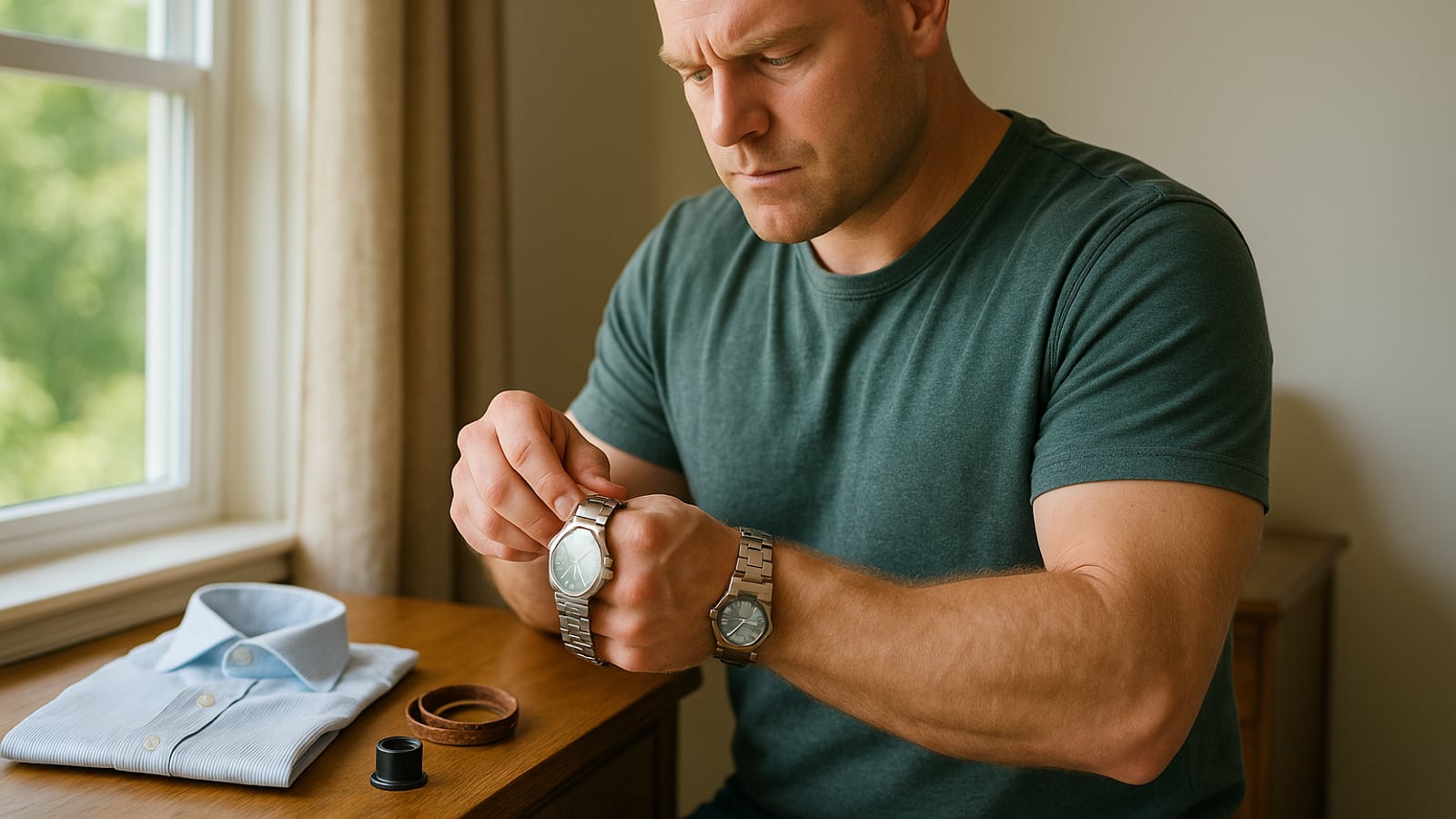
The number on the listing that matters isn't 40mm. It's lug-to-lug: the distance from the tip of the top lug to the tip of the bottom one. That's the measurement that decides whether a watch sits on your wrist or hangs off the sides of it like a shelf bracket.
Measure the flat part of your wrist, across the top, from bone to bone. Most men land somewhere between 45mm and 55mm of usable flat space. If your lug-to-lug is bigger than that, the lugs lift off, the strap angles down hard, and the whole thing rocks when you type. A 38mm dress watch with long straight lugs can wear bigger than a 42mm diver with short curved ones. Diameter is marketing. Lug-to-lug is fit.
Second number: thickness. Anything over about 13mm starts fighting a buttoned shirt cuff. You'll know because you'll catch the crown on your sleeve every time you reach for something, and eventually you'll stop wearing it. Nobody admits this is why a watch ends up in the drawer, but it's usually why.
Get the fit right before you argue about movements
A watch that fits a 7-inch wrist and a watch that fits a 6.25-inch wrist are different objects, and no amount of movement snobbery fixes the gap.
Three things to check before you spend a dollar:
- Lug-to-lug against your flat wrist span. Overhang looks borrowed.
- Thickness against your cuff. Slide it under one in the store, or under your own if you're buying online and can return it.
- Bracelet adjustment. Most steel bracelets adjust in whole links, which move in jumps of roughly 5mm. That's the difference between a bracelet that slides an inch and one that doesn't move at all. Look for half-links or a clasp with micro-adjust holes. It's the single most overlooked spec on any watch under a thousand dollars.
Your wrist swells during the day. Size the bracelet in the afternoon, not first thing in the morning, and leave enough room to slide a fingertip under the clasp.
Quartz, plainly
A battery-powered quartz watch keeps better time than almost any mechanical watch ever made, costs less, is thinner, takes a knock, and asks nothing of you. You set it once and check it a year later and it's basically right.
The trade: a battery every couple of years, and a dead watch the morning you need it. Batteries don't warn you. When you change one, have the gaskets checked at the same time if the watch has any water resistance worth keeping, because the case has to open and the seals are the part people skip.
Quartz is the honest answer for a guy who wears a watch three times a month. It's also the honest answer for a guy who works with his hands and doesn't want to think about it. A Casio digital on a resin strap survives things a mechanical watch simply won't, and it never asks for a service.
The snob read on quartz is wrong and it's also boring. Nobody across a conference table has ever identified your movement.
Automatic, plainly
An automatic winds itself from the motion of your arm. No battery. Put it on, wear it, it runs. Take it off Friday and by Monday it's stopped, unless it has a long power reserve, and then you pull the crown and set it again.
Accuracy is worse. A good, unregulated modern automatic in the affordable range might run fifteen or twenty seconds off a day depending on how you store it overnight. Chronometer-certified movements are held to a much tighter window, roughly minus four to plus six seconds a day, and they cost accordingly. If a watch gaining a minute a week will bother you, you now know something important about yourself, and you should buy quartz.
Servicing is real money. Makers generally suggest a full service every five to seven years, and it isn't a twenty-dollar errand. Plenty of people stretch it until the watch runs badly. That's their call, but it's how movements die.
What you get for all that's a machine with no off switch that your son can wear in thirty years. That's not nothing. It's just not a feature you can measure.
Two habits that save automatics: don't set the date between about 9 p.m. and 3 a.m., when the date mechanism is engaged and the gears are vulnerable, and don't wind the crown while the watch is on your wrist. The angle bends the stem over time.
Smartwatch, plainly
If you train seriously, a GPS sport watch earns its place on your arm every single week. Pace, distance, heart rate, a route you can follow when you're four miles into unfamiliar country. That's genuine capability, not a gadget.
If you don't train, be honest about what a smartwatch is doing for you. It's mostly a second phone strapped to your body, buzzing at you during dinner, and you already carry the first one. There's a real cost to being reachable at the wrist. You feel it at the table with your kids, and they feel it too.
The other trade is obsolescence. A smartwatch is a computer, and batteries lose capacity, and support windows end. You're renting it. Fine, as long as you've priced it that way and you're not calling it an investment.
Charging cadence decides everything here. A watch you charge nightly works only if you have a nightly routine. A sport watch that runs a week or two between charges is a different kind of object, and it's the one that stays on the wrist.
Matching it to your actual week
Look at your last month, not your imagined one.
Job site, warehouse, shop floor. Quartz, resin or nylon strap, nothing you'd cry about. Steel bracelets collect grit and pinch. Keep the crown screwed down.
Office, meetings, church, weddings. One clean quartz or automatic on a leather strap, thin enough to clear a cuff, under about 40mm across for most wrists. That's the whole requirement.
Hospital shifts, first responder, anyone gloving up. Something with a legible dial, a second hand you can actually see, and a strap that wipes clean. Silicone or a single-pass nylon, not leather.
Outdoors, hunting, hiking, water. GPS sport watch if you use the data. A dive-style automatic with real water resistance if you don't.
Two-watch answer. One quartz or automatic for everything social, one sport watch for training. That covers a whole life and costs less than one showy piece.
Fixes that cost almost nothing
Swap the strap. A watch you're bored of on a fresh leather strap in a tone that actually matches your belt and shoes reads as an entirely different purchase. Get the lug width right, get quick-release spring bars, and you can change it in forty seconds without a tool.
Brown leather for anything you'd wear with a jacket. Nylon for summer, because leather and sweat are a bad marriage and the smell doesn't wash out.
Get an automatic regulated by a watchmaker if it's running wild. It's a small job on most movements, and it can pull a sloppy performer into a few seconds a day.
And set the bracelet properly. A perfectly chosen watch swimming an inch up your forearm looks like it belongs to a bigger man.
Buy the one you'll strap on without thinking on a Tuesday. That's the whole test, and it has never once been passed by a watch bought to be noticed.
Dean Shaw
Gear & Garage
Tests things until they break, then reports what broke first. Trucks, tools, watches, and the cheap version that costs more.

Watch
Worth an hour of your evening
More from Style.
From channels we rate. Plays on YouTube.
Read next