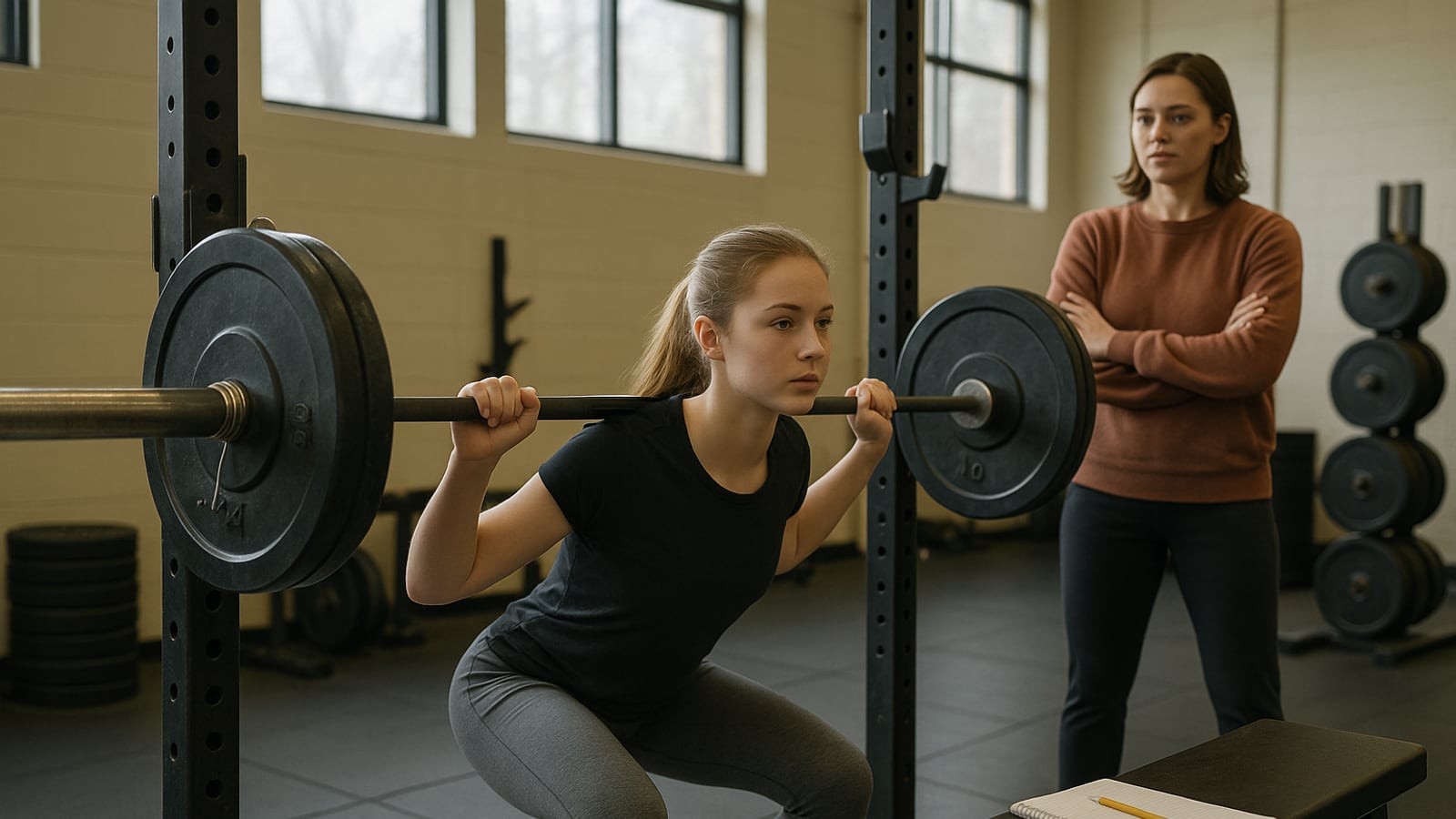
The standard barbell in most gyms weighs 20kg empty. That's the whole bar, no plates. A lot of gyms also keep a shorter one at 15kg, and plenty of school and club gyms have a light training bar at around 10kg.
Nobody tells you this, so you walk in, see a bar sitting in a rack, and assume it's a fixed thing you either can or can't lift. It isn't. It's a starting point with a number on it, and you can write that number down.
That's the actual first step. Not motivation. A notebook.
Your first session, in detail
Give yourself forty-five minutes and do four things.
- Goblet squat. Hold one dumbbell against your chest with both hands. Sit down between your feet, stand back up. Start with 6kg or 8kg. Three sets of eight.
- Dumbbell row. One knee and one hand on a bench, other hand pulls a dumbbell to your ribs. Three sets of eight each side.
- Press. Two dumbbells, from shoulders to overhead. Start light. 4kg is a real starting weight and there's nothing embarrassing about it.
- Carry. Pick up something heavy in each hand and walk thirty meters. Put it down. Do that three times.
That's it. You'll be done before you've had time to feel self-conscious about it, which is partly the point.
Write down every weight and every set. Next session, you're not starting from zero, you're starting from a page that says 8kg, 3x8, felt fine. Then you add a little. The 2.5kg plates on the rack are usually the smallest ones out, but most gyms have 1.25kg plates somewhere, and a 2.5kg jump on a press is a lot. Find the small ones.
The comments, and what they're actually about
Someone will say you'll get bulky. Someone will say it's a boy's thing. Someone at school will say it in a tone, which is worse than saying it outright, because there's nothing to reply to.
Three things are going on there, and none of them are about your training.
The first is that people are uncomfortable when someone their age starts doing something deliberate. It's a mirror, and mirrors are annoying. The second is that a lot of girls have been handed one narrow idea of what a girl's body is for, and you doing deadlifts doesn't fit it. The third is boredom.
You don't need a comeback. You need a boring answer you can say without your voice changing. "I like it." "I'm training for netball." "It's Tuesday, I always go on Tuesdays." Say it flatly, go back to what you were doing, and the conversation dies of natural causes.
The people who keep going after that are telling you something about themselves, and you should believe them.
The stunting-your-growth thing
You'll hear that lifting weights will stop you growing. It's been repeated for about forty years.
Don't take my word on it either way. Ask your GP or the school nurse, and ask your PE teacher what the club policy is where you train. They deal with this question constantly and they'd rather answer it than have you guessing. What you're most likely to hear is that sensible strength work with good technique is fine for your age, and that the risk is in bad form and stupid jumps in weight, not in the idea of picking things up.
Which is the actual safety rule. If a rep looks wobbly, the weight is too heavy today. Stop at the wobble, not after it.
Sharp pain is different from hard work. Hard work burns and shakes and stops when you rack the bar. Sharp pain is specific, it's in a joint, and it doesn't go away when you sit down. Tell a parent or a coach the same day. You won't be in trouble and you won't be dropped from anything for saying it.
Where to stand and how to ask
The gym floor has an etiquette nobody writes down, so:
You can ask for the rack when someone's between sets. "How many sets have you got left?" is a complete sentence and everybody uses it. You can work in on a bench, meaning you take turns. You put your plates back. You don't stand directly in front of somebody's dumbbell rack while they're mid-set.
If someone gives you advice you didn't ask for, "thanks, I'm following a plan" ends it politely. If someone won't leave you alone, or the attention feels like it's about you rather than your squat, go and tell the staff at the desk. That's what they're there for. Then tell a parent when you get home. Not because you did anything wrong. Because adults who make a teenager uncomfortable in a gym tend to do it more than once, and someone should know.
Going with a friend solves most of this in week one. So does going at a quieter hour. Saturday at nine is usually emptier than Saturday at eleven.
What progress actually looks like
Slow, and then suddenly obvious.
For the first month, the changes are almost entirely in your nervous system learning the movement. The weight on the bar creeps. You'll think nothing is happening. Then in week six you'll carry all four shopping bags from the car in one trip without thinking, or you'll get up off the floor differently, or you'll win a ruck you'd have lost in September.
That's the return. Not a look. Capability. Your notebook is the proof, and it's more reliable than a mirror or a scale, because it can't be argued with. Either you rowed 12kg in March and 20kg in June, or you didn't.
One honest trade-off: two sessions a week gets you a very long way, but it won't turn you into a county athlete, and it won't make you good at a sport you don't play. Training supports the thing. It isn't the thing.
And if you're starting because you want to change how your body looks, be straight with yourself about that, and take it to your parents or your GP rather than to the internet. That's a different conversation with different risks, and it deserves an adult who knows you. Eat proper meals. Sleep. Lifting on four hours of sleep and a packet of crisps is just being tired in a noisier room.
The part that decides it
Most people who quit don't quit dramatically. They miss a Tuesday, then the next Tuesday feels like a bigger deal than it should, and by the third week the whole thing has quietly become something they used to do.
So make the return easy. When you miss a session, go back and do less than you planned. Half the sets. Lighter bar. Twenty minutes and out. You're not trying to make up for it, you're trying to keep the habit alive until your enthusiasm comes back, which it will.
Six months from now some girl in Year 9 is going to watch you set up under a bar like it's completely normal for a girl to do that, because when she looks at you it's.
Nina Castellan
BRO for Her
Runs the women-facing desk. Same standard, same tools, written for a different reader — not a softer one.

Read next