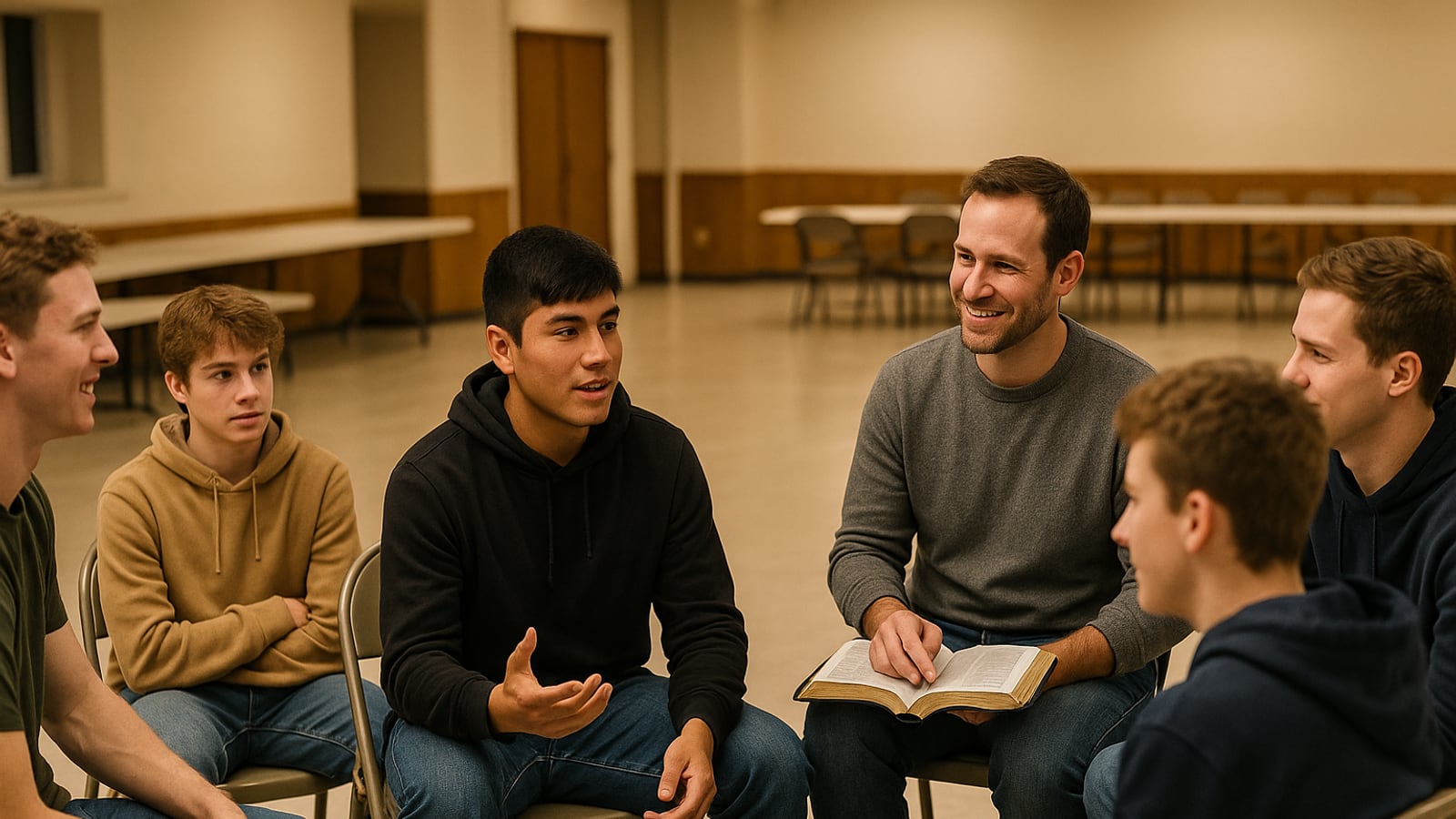
Most youth groups run about ninety minutes, on a weeknight, in a room that's not the main church sanctuary. There's food, usually cheap food. There's noise. Somebody talks for ten or fifteen minutes. Then you sit in a smaller circle with five or six guys and an adult leader and talk about it. Then it's over and people stand around in the parking lot for twenty minutes because nobody wants to leave.
That's the whole thing. If you've built it up in your head into something stranger, that's the reality you're actually walking into.
The shape of a normal night
It varies by church, but the bones are usually the same.
The first twenty minutes are unstructured. People arrive, eat, throw a ball around, sit on couches. This is the part that feels worst if you don't know anyone, and it's the part that gets easiest fastest.
Then something loud. A game, often a dumb one. Teams, a relay, something involving a ping pong ball. The point isn't the game. The point is that it's very hard to stay a stranger to someone you just lost a relay with.
Then music, at a lot of churches. Three or four songs, words on a screen, a band made of people who are mostly under twenty-five. Some guys sing. Some guys stand there with their hands in their pockets and read the words. Both are completely normal and nobody is taking attendance on your enthusiasm.
Then the talk. Somebody opens a Bible and speaks for ten to twenty minutes. Good ones are specific and honest. Weaker ones ramble. You'll be able to tell within two visits which kind you've got.
Then small groups. This is the actual engine of the whole thing, and it's the part most people don't expect to like.
Small group is where it either works or it doesn't
Six or so guys, roughly your age, one or two adult leaders, thirty minutes. Someone asks a question about what was just said. People answer, or don't.
You can pass. Every single time, you can pass. "I'll listen tonight" is a complete sentence and a decent leader will move straight on without making a thing of it.
Nobody will spring public prayer on you. If the group prays out loud, it usually goes around and you can say "pass" and they keep going. If someone asks you to pray and you don't want to, say so. Anyone who pushes after that's doing their job badly, and that's worth telling your parents about.
What to wear
Whatever you wore to school. Jeans, a T-shirt, sneakers. Hoodie if it's cold.
There's a real chance you'll be the best-dressed person in the room by accident. Youth pastors dress like they're about to help someone move.
What if you don't actually believe any of it
Say that. Out loud, in the small group, in week two.
This is the part guys get wrong. They assume the room is full of certain people and that showing up with doubts is a kind of fraud. It isn't. A decent chunk of that room is somewhere between "my parents make me come" and "I think this is true but I couldn't explain why to save my life." The guys who look most settled are often just quieter about the same questions you have.
And leaders who are any good would much rather hear "I don't know if I believe in God" than watch you nod along for two years. The honest question is the useful one. If you ask why God allows suffering, or whether the Bible's been changed, or what happens to people who never heard about Jesus, you won't be the first. You'll probably get a better answer than you expect, and sometimes you'll get "I don't know, let me think about that and come back to you," which is a sign of an honest adult.
Tell your parents, and let them look at it
Say where you're going, which church, who's running it, and when you'll be home. If your parents want to meet the youth pastor or walk in and look at the room, that's a good sign about your parents and a good test of the church. Any ministry worth your time will be glad to have a parent standing in the doorway.
One line that matters more than anything else in this piece. No adult at a church, or anywhere, should be texting you privately, meeting you one-to-one out of sight, asking you to keep something from your parents, or making you feel uncomfortable in any way. Not the cool young leader. Not the pastor. Nobody. If that happens, tell your mom or dad, or a teacher, or the school nurse, today. You won't be in trouble, and you won't be causing a problem. You'll be doing the right thing, and you'll be protecting people younger than you at the same time.
Going alone versus going with a friend
With a friend is easier and slightly worse. You'll default to each other, talk to nobody new, and leave knowing three names.
Alone is harder for about forty minutes and then better. You'll be forced into conversation, and people notice a new guy standing on his own and come over. Most youth groups are genuinely good at this. It's one of the few rooms in your life where being new is an advantage.
If you need a friend to get through the door, bring one. Just split up for the games.
Give it four visits, then decide
One visit tells you almost nothing. You spent the whole time managing your own nerves.
By the fourth, you'll know the shape of the night, you'll recognize faces, and you'll have a read on whether the leaders are the real thing. That's enough to decide honestly.
Signs it's healthy: leaders who ask you questions instead of performing at you; older guys who include younger ones without being told to; you're allowed to disagree; the group actually does something for people outside it, like serving at a food bank or showing up for a family in the church.
Signs it isn't: constant pressure to have an emotional experience; gossip; guys ranked by how spiritual they seem; anyone talking about girls in a way you'd be embarrassed to repeat in front of your sister. You can leave a bad youth group. There's usually another church twenty minutes away.
What to actually bring
Stack the chairs at the end. Carry the cooler in. Learn the name of whoever cooks the food and thank them.
This sounds small and it isn't. The fastest way to stop being the new guy is to be the guy who helps clean up. You'll be given real responsibility faster than almost anywhere else in your life, because these places run on volunteers and are always short. Within a year you could be running the sound desk, leading a game, or sitting with a thirteen-year-old on his first night doing for him what somebody did for you.
Show up on a Wednesday. Eat the cheap pizza. Say one true thing in the circle.
Ade Fisher
Young Men
Teaches the trades intake at a community college. Writes the manual he wishes his students arrived with.

Read next