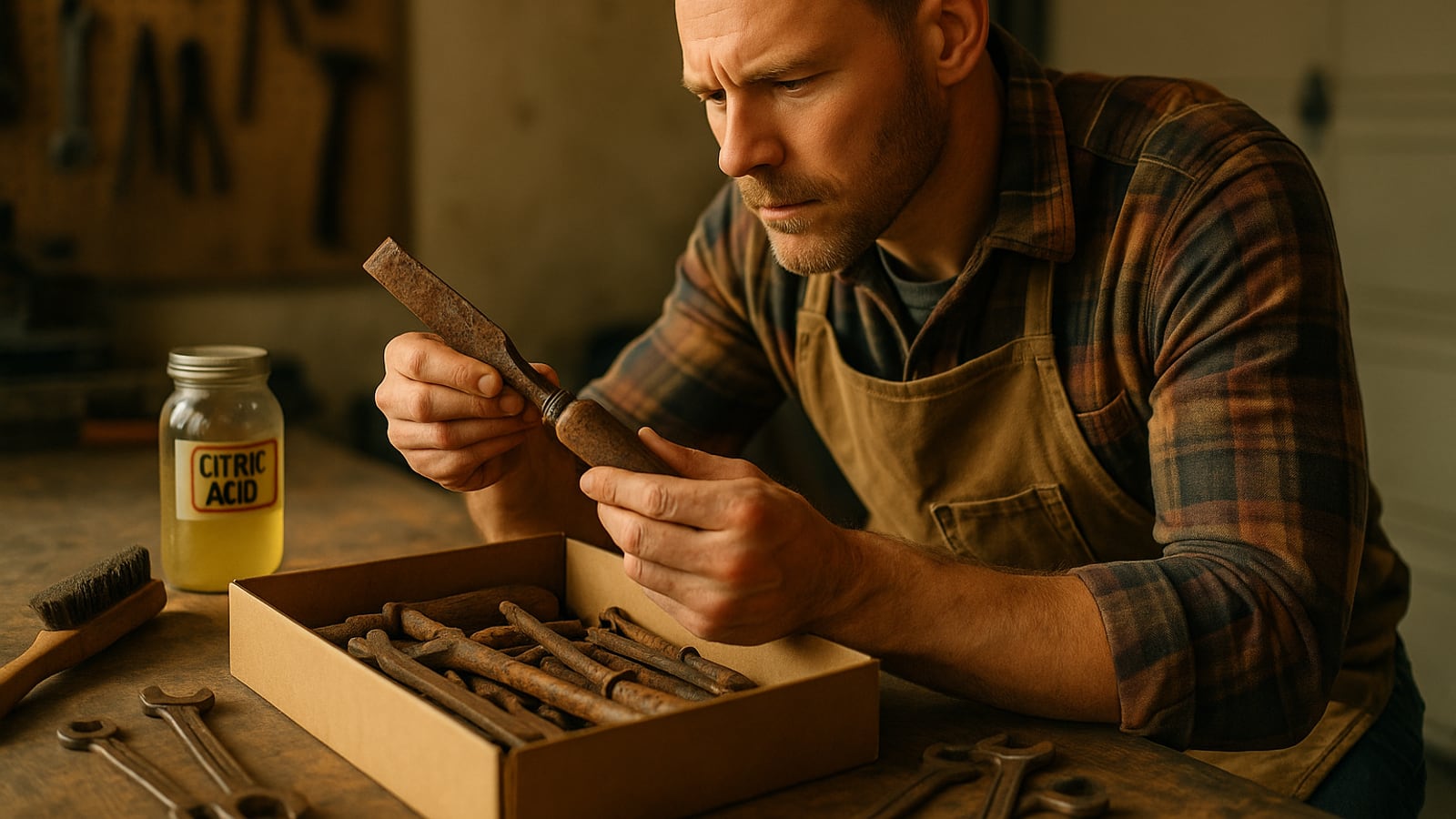
The coffee can under the table is where the money is. Nobody prices a coffee can. It's full of screwdrivers with chewed tips and a couple of things nobody could identify, and if you ask, you'll get it for two or three dollars because the family wants the driveway empty by four o'clock. I've pulled Stanley bits, a brace pad, and a perfectly good 1/2-inch Buck Brothers socket chisel out of cans like that.
The trick isn't cleaning rust. Cleaning rust is a weekend and about twelve dollars of citric acid. The trick is knowing, in the ten seconds you're standing over the box, which pieces will come back and which ones are lawn ornaments.
Surface rust is nothing, pits are permanent
Rust that looks like orange dust or flaky scale sits on top of the steel. It comes off. Under it you'll usually find gray metal with a little texture and the maker's stamp still readable.
Pitting is different. Pitting means the rust already ate into the steel and left craters, and no chemical on earth puts steel back. So the only question that matters is where the pits are.
Pits on a shank, a ferrule, a wrench's flat, the cheek of a hammer? Cosmetic. Buy it. Pits on a working surface are a different story. A chisel or plane iron needs a dead-flat back for the first half inch behind the edge, and a crater there means a nicked edge forever. A saw plate with deep pits will drag and can crack at the pit. A file with rust-blunted teeth is a paperweight, mostly.
Run your thumb across the back of the chisel. If it catches, put it down.
What I'll always carry home
Forged wrenches and sockets. Old Craftsman, Plumb, Herbrand, Snap-on, Williams. Steel that thick doesn't care about fifty years in a damp shed. A twelve-dollar box of rusty combination wrenches is one of the last real bargains in America.
Socket chisels. The kind where the handle sits in a cone instead of on a tang. The handle's usually rotted or missing, which scares people off and drops the price. A new handle is easy. A new chisel isn't cheap.
Hand drills and braces, if the chuck jaws are all present and the crank turns. Spin the chuck. If it grinds like gravel, that's dried grease and rust, and it'll free up. If a jaw's missing, walk.
Hammers and axes with clean eyes. Look at the eye from both ends for a hairline crack running out from the corner. Loose head means nothing. Cracked eye means scrap.
Screwdrivers with wooden handles. Cheap, and the tips regrind in two minutes.
Walk past these
Anything cast that's cracked, welded, or brazed. Vise bodies, plane bodies, pipe wrench jaws. Somebody already tried to save it and it failed, and cast iron that's been repaired once will go again, usually with your hand behind it.
Adjustable wrenches with sloppy jaws. Levels with a dry or cracked vial. Anything missing a part you can't name, because that's the part you'll spend six weeks hunting on eBay for more than the tool is worth. Plated tools with the plating bubbling off, which means the rust is already working underneath.
And measuring tools with pitted reference edges. A rusty combination square is decoration.
Take it apart before you soak it
Get it home, sit on a bucket, and disassemble everything down to the loose pieces. Screws and nuts go in a jar with a lid, sorted by tool, because you will absolutely mix up two sets of saw nuts and then spend an hour learning why they aren't interchangeable.
Pull every wooden handle and every scrap of leather out. Wood swells and splits in a soak, and leather turns to jerky. Then hit the whole pile with a stiff nylon brush and a rag to knock off the loose scale, so your solution isn't working on dirt.
Pick one soak and stick with it
Citric acid is the cheap way. A pound in the canning aisle costs a few dollars, and a rounded tablespoon per cup of hot water in a plastic tub will strip a rusty wrench overnight. Fast, and that's the problem. Leave steel in it for a day and a half and it'll start etching the steel itself, leaving a dull gray surface that looks sandblasted. Set a timer. Check at four hours.
Chelating removers like Evapo-Rust run around twenty-five to thirty dollars a gallon, don't attack good steel no matter how long you forget about it, and can be strained and reused for months. That's what I use on anything with japanning or a stamp I care about.
Electrolysis is the bulk method. A plastic tote, a tablespoon of washing soda per gallon of water, a chunk of scrap mild steel as the sacrificial anode, and an old manual battery charger. Red clamp to the scrap, black to the tool, and never let the two touch. Do it outside or with the garage door open, because it makes hydrogen. Never use stainless as the sacrificial piece.
Whatever you use, know this: after you rinse an acid-soaked tool, it will flash rust in front of your eyes. Five minutes, orange bloom, no exaggeration. Neutralize in a bath of water with a couple spoonfuls of baking soda, rinse hot, and then dry it fast. Compressed air, a heat gun, or twenty minutes in a toaster oven at 200 degrees. Oil it while it's still warm to the touch.
The wire wheel isn't your friend
A wire wheel on a bench grinder will clean a wrench in eight seconds and round over the crisp corner of a chisel just as quick. It'll also blur maker's stamps, burn through japanning, and fire individual wires across the shop at a speed you'll remember. Face shield, not glasses. Gloves, and keep the work below center on the wheel.
For anything with detail on it, use hand abrasives instead. A brass brush, then a maroon Scotch-Brite pad with a little oil on it, then 400-grit wet paper if you want it bright. Slower, and you keep the tool's history instead of sanding it off.
Handles, wedges, and the part people botch
A replacement hickory hammer handle runs fifteen to twenty-five dollars at a decent hardware store and takes an evening. Rasp the tongue to fit dry, no oil, until the head slides on with hand pressure and about an inch of wood standing proud. Saw the kerf if it isn't cut. Drive the head down, drive the wooden wedge, cut it flush, then set the small steel wedges across the grain of the wood one.
Never, ever fix a loose head with a screw or an epoxy pour. That's how heads come off mid-swing.
Socket chisel handles you can turn from a hickory scrap or buy for ten dollars. For old handles worth keeping, scrape the grime, sand at 220, and wipe on boiled linseed oil. Two coats, a day apart, rag hung outside to dry flat because oily rags in a trash can are a genuine fire risk.
Know when to quit
The failure mode isn't laziness. It's going too far. Polishing a 1940s wrench to chrome-show finish takes four hours and makes it worth less than the honest gray one next to it. Repainting japanning badly looks worse than worn japanning. And spending forty dollars of consumables reviving a ten-dollar tool is a hobby, which is fine, as long as you're honest that it's the hobby and not the savings.
Sharpen the edge tools, wax the bare steel with paste wax, and put them in the drawer.
Then hand the 1/2-inch chisel to your eleven-year-old and let him cut a mortise with a tool that's older than you're. That's the part that makes the coffee can worth two dollars.
Wes Dunbar
Country & Skills
Grew up on an acreage and never quite left. Covers trucks, trades, land, and how to do the thing yourself.

Watch
Worth an hour of your evening
More from Woodworking.
From channels we rate. Plays on YouTube.
Read next