The discharge nurse hands you a folder and you won't open it for three days. Open it now and find the page with the phone number on it. Stick that page on the fridge. For the next fourteen days it's the most useful thing you own, and calling it doesn't make you a baby. Surgical offices would rather answer a dumb question on Tuesday than see you in the ER on Friday.
Everything else in the folder is a list of restrictions. The restrictions aren't the hard part. The hard part is that you'll feel decent around day nine, decide you're basically fine, carry a laundry basket up the stairs, and spend day ten swollen and furious.
The two-week goal is small and boring
You're not building anything in these two weeks. You're protecting a repair while your body does the work, and your only jobs are pain control, moving a little and often, keeping the incision clean, and not tearing anything.
That's it. No progress. No PRs. The win is that on day fifteen your surgeon looks at the site and says it looks how it should.
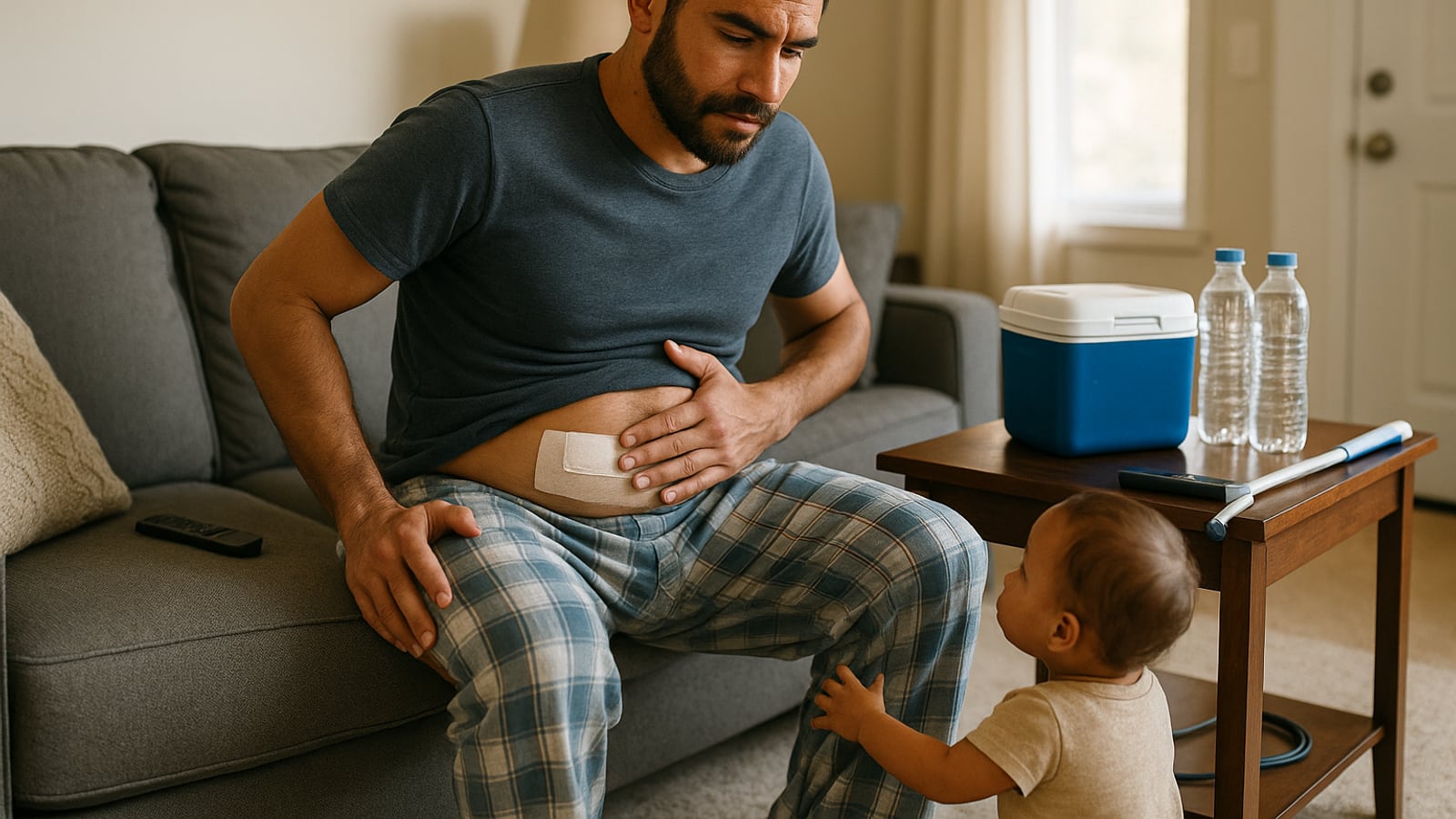
If you still have a day or two before the procedure, spend an hour setting up. Put a small cooler next to wherever you'll sit, and fill it with water bottles and something you can eat one-handed. Move the phone charger, the remote, a book and your meds within arm's reach. Get a long-handled grabber from the drugstore if your surgery is anywhere below your ribs, because bending to pick up a dropped sock is the single most common way people wreck a good week. A plastic stool in the shower is worth more than any supplement you'll buy this year.
Stay ahead of the pain, then get off the pills
For the first two or three days, if your surgeon told you to take pain medication on a schedule, take it on the schedule. Chasing pain after it's already an eight means you spend an hour underwater waiting for relief, and you won't walk, won't breathe deeply, and won't sleep. All three of those matter more than toughness does.
Then start stepping down. Most people can move off the stronger stuff within a few days and finish the two weeks on whatever over-the-counter option their surgeon approved. Ask specifically, because some operations rule out certain common painkillers.
Now the part nobody warns you about with enough urgency: pain medication plus low activity plus low food intake equals constipation, and constipation after abdominal or pelvic surgery is genuinely miserable. Ask the pharmacist at pickup what stool softener is appropriate with your prescription, and start it the same day you start the pain medication, not four days later when you're in trouble. Water helps. Walking helps more.
Move small, move often
The dose that works is five to ten minutes of easy walking, several times a day. Laps of the hallway count. Down the driveway and back counts. One heroic forty-minute walk on day four doesn't count, and you'll pay for it that night.
Ankle pumps in bed, every hour you're awake. Ten to twenty per side. They're dull and they're protecting you from a clot, which is the actual danger of lying still for a week.
Breathe deep on purpose, ten times an hour. If they gave you a spirometer, use it even though it's annoying. If you have a chest or belly incision and you need to cough, press a folded towel over the site first. It hurts less and it protects the closure.
Sleep wherever you can actually sleep. For chest, shoulder or abdominal work, that's often a recliner or a wedge of three pillows. For hip or back, it might be flat with one pillow under the knees. Two bad nights in a row makes everything hurt more, so treat the sleeping setup as medical equipment.
Ten pounds is less than you think
A gallon of milk is about eight and a half pounds. A full backpack clears ten easily. A two-year-old is three times that and doesn't hold still.
So if your limit is ten pounds, the toddler is off the table, and you need to decide that before he's already running at your legs with his arms up. Say it out loud to your kids on day one, in words they can use. "Dad has a cut on his belly that's healing. No climbing, no jumping on me, no hanging on my arm. You can sit next to me and we'll read." Then have your wife or whoever's helping enforce it for a few days, because a four-year-old will test the rule twice an hour for the sheer joy of the experiment.
Give the older kids a real job. Carrying the laundry basket, getting the mail, hauling the trash can to the curb. Kids are far better at this than adults expect, and it beats them hovering and worrying.
And let people help. If somebody from work or the neighborhood asks what they can do, have a list ready: a ride to the follow-up appointment, a grocery run, an hour of watching the kids so your wife can take a shower without an audience. Being a martyr about it isn't strength, it's just a slower recovery and a spouse running on four hours of sleep.
The incision, the shower, and the drive
Look at the site once a day in decent light. You want to know your own baseline so you can tell if something changes.
Ask when you can shower and follow that answer exactly. When you do, let water run over the incision, don't scrub it, and pat it dry. No baths, no pools, no hot tubs, no lake until you're cleared, because soaking a healing wound is asking for an infection.
Driving deserves its own rule. You don't drive while you're taking narcotic pain medication, period, and even after that you need to be able to slam the brake pedal hard without hesitating. If you're guarding, if you'd flinch, you're not ready. Ask your surgeon for the specific number of days for your specific procedure, and check whether your state or your insurer has anything to say about it.
Day nine is the trap
Somewhere between day eight and day eleven, you'll wake up feeling like a person again. Pain's down, energy's back, and the house looks like it needs you.
That feeling isn't tissue strength. Skin closes long before what's underneath gets strong, and the repairs that fail usually fail in week two, done in by a guy mowing a small patch of lawn because it was "only ten minutes."
Hold the restrictions to the letter until someone in scrubs releases you. Then start with what your surgeon or physical therapist actually names, and expect the first real session back to feel humiliating. You'll lose conditioning in two weeks. You get it back in three or four, every time, as long as you didn't blow up the repair.
Call the office for any of these
- Fever, or chills with a fever
- Redness spreading out from the incision, new warmth, or drainage that's cloudy, thick or foul
- Edges of the wound pulling apart
- Calf pain, swelling or tenderness on one side
- Shortness of breath or chest pain, which is a 911 call, not a voicemail
- Pain that's suddenly much worse instead of slowly better
- Can't urinate, can't keep fluids down, or haven't had a bowel movement in several days and you're bloated
None of this is medical advice for your situation. Your surgeon's instructions beat anything you read anywhere, including this.
Nobody's handing out medals for week two. What you get is a repair that holds, which is the only outcome that was ever on the table.
Cal Brennan
Fitness
Strength coach. Trains fathers, tradesmen and desk workers, which means programmes that survive a bad week.

Watch
Worth an hour of your evening
More from Fitness.
From channels we rate. Plays on YouTube.
Read next