The bit that gives you away isn't the coat. It's the back of your trouser legs.
Everyone thinks about the shell and forgets that your own heel throws water up the back of your calf with every step. Ten minutes from the station and you've got two dark stripes from hem to knee that won't dry until lunch. Nobody looks at your jacket in the lobby. They look at you shaking your umbrella out and they see the trousers.
So start at the bottom and work up.
Shoes decide the whole thing
A leather sole is finished in about four minutes of proper rain. It soaks, it goes slick on tile, and if you do it often enough the sole gets soft and wears through at the ball of the foot in a season.
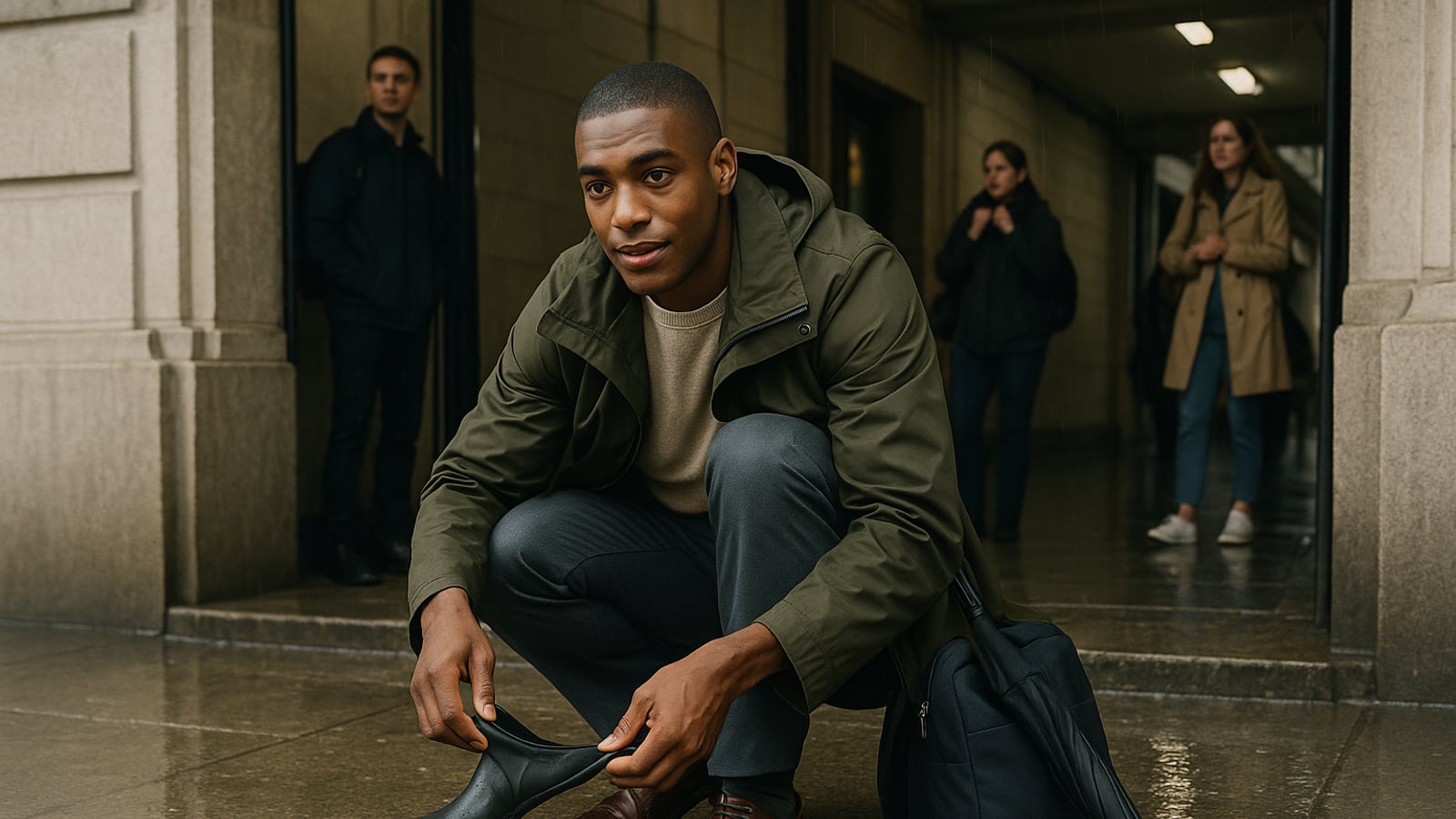
You've got three sensible options. A dedicated wet-weather pair with a rubber sole, something like a studded Dainite or a low-profile commando. A pair of rubber overshoes that pull on over your normal shoes and roll up small enough for a bag pocket. Or the old office trick of keeping a decent pair under the desk and commuting in something you don't care about.
Overshoes look faintly comic in the street and superb the moment you take them off and walk into a meeting in dry, clean leather. Swims made this a thing and there are plenty of copies now. Expect to spend somewhere between forty and a hundred pounds depending on how much rubber you want.
If you buy a wet pair, go dark brown or black and go for a plainer shape. A chunky lug sole under a suit trouser reads as walking boot. A studded rubber sole at the right thickness reads as a normal shoe from three feet away, which is the only distance that matters.
And dry them properly. Away from the radiator, shoe trees in, forty-eight hours before they go back on. Heat is what cracks the leather across the vamp, not water.
Trousers, and the hem you should shorten
Wool handles rain better than cotton. It sheds the first few minutes of it, it dries without going stiff, and it doesn't hold a watermark the way a chino does. If you have any say in the matter, wear the flannel or the worsted on the wet days and save the cotton for dry ones.
Turn-ups collect water. They hold it against your ankle for the whole morning and they take twice as long to dry. If you're having something made or altered for a commute that involves actual pavement, a plain hem sitting a touch higher than you'd normally have it will save you more grief than any coat.
Skip the waterproof overtrouser. In a city context it's a lot of rustle and faff for a fifteen-minute walk, and you'll end up carrying it wet all day.
The coat: length first, fabric second
Most technical shells stop at the hip. That's fine on a hill. In a city it means the rain lands straight onto your thighs and runs down, so you arrive with a dry top and wet legs, which is worse than being uniformly damp because it looks accidental.
Go to the knee, or just above. If you wear a suit jacket under it, the coat needs to cover the jacket completely. A raincoat that leaves two inches of suit hanging out the bottom is the single most common mistake here.
For fabric, you've got a few honest choices.
- Coated or bonded cotton. The classic mac. Matte, drapes well, looks like clothing rather than equipment. Not fully waterproof in sideways rain for an hour, but fine for a commute.
- Rubberised cotton. The Mackintosh construction. Genuinely waterproof, heavy, doesn't breathe at all. You will be warm. Beautiful thing to own if your walk is short.
- A technical membrane in a plain cut. Gore-Tex or similar, but cut like a coat instead of a jacket. This is the practical answer for anyone with a real distance to cover.
- Waxed cotton. Sheds water well, ages nicely, and it will mark the back of a pale car seat and rub onto light trousers in warm weather. Know that before you buy.
What makes any of them look wrong is the detailing, not the material. Reflective piping. A logo on the chest. Elastic cord toggles at the hem. A hood with a wired brim that sits up like a periscope. Bungee cuffs.
What makes them look right: a matte face, a hood that stows in the collar or comes off, cuffs that close with a tab, a color in the navy-to-charcoal range. Olive works. Stone is the classic trench color and shows every splash from a passing bus, so be honest about your route.
Fit over what you actually wear
Try the coat on over the thickest thing you'll wear under it. Not a t-shirt. A suit jacket, or a jacket and a crewneck if that's your winter.
Then do two checks. Cross your arms in front of you as if you're reaching for a seatbelt. If the shoulders pull, it's too small and you'll tear out the lining in a year. Second, sit down. A lot of knee-length coats are cut for standing and ride up into your lap the moment you're on a train.
A raincoat wants a bit more room than a normal overcoat because air movement is the only thing keeping you from sweating through your shirt. Slim is the wrong ambition here.
Umbrella, bag, head
Buy a full-length stick umbrella and keep a compact one in your bag permanently. That's the system. The compact lives in the bag and never comes out except in rain, because the moment you start carrying it in and out you'll leave it somewhere.
Look for a vented canopy, a fibreglass or mixed frame rather than cheap steel, and rounded tips if you ever walk in a crowd. Blunt made their name on exactly that. Fulton's cheaper models are everywhere in Britain for a reason. A twelve-pound umbrella from a station kiosk will invert on the first real gust and go in the bin the same week, which is how most people end up buying six a year.
Leather bags drink water. If yours is unlined vegetable-tanned anything, it will spot and darken and you'll never get it even again. Either accept the patina or carry something coated. A supermarket bag around the laptop inside the bag isn't elegant, but it's free and it works, and I've done it plenty.
Hoods beat hats for keeping rain off your head and lose to hats on how you look while wearing one. A flat cap keeps the rain out of your eyes and does nothing for the back of your neck. Pick your problem.
When to ignore all of this
If your commute is a ninety-second dash from a car park, don't buy a six-hundred-pound rubberised coat. Keep a cheap packable shell and a folding umbrella in the boot and spend the money on shoes instead, because the shoes are the thing that gets destroyed either way.
The test is simple. Take the coat off at your desk, hang it on a hanger rather than a hook, and see whether anything about the outfit underneath suggests you came in through weather. If it doesn't, you got it right.
Tobias Reed
Style & Grooming
Spent a decade in menswear retail watching men buy the wrong size. Believes fit is ninety per cent of it and says so weekly.

Watch
Worth an hour of your evening
More from City Style.
From channels we rate. Plays on YouTube.
Read next