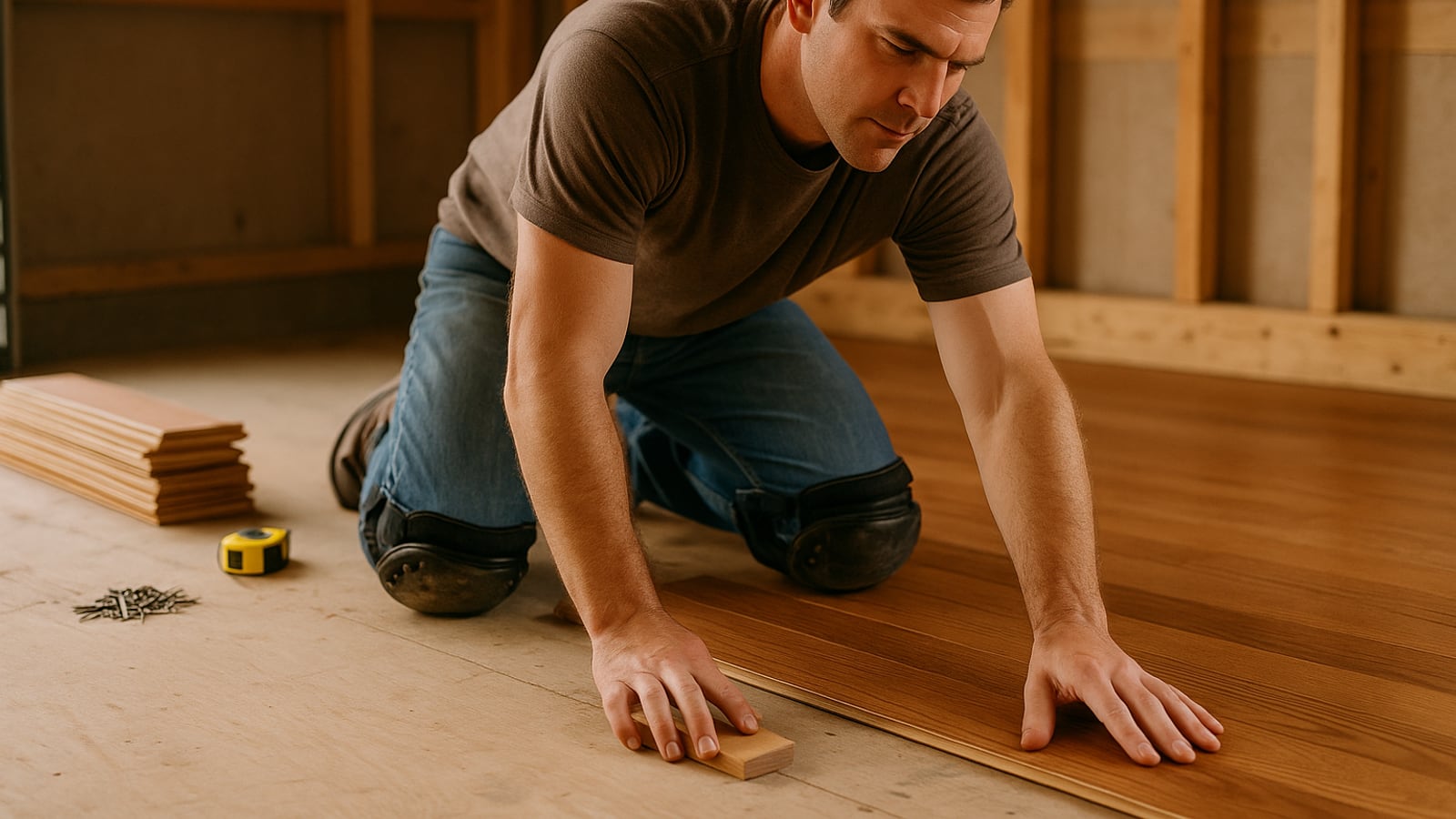
The damage isn't the kneeling. It's the pivot.
Watch a flooring guy set a plank. He's down on both knees, he reaches left for the tapping block, and his whole upper body rotates while his kneecaps stay welded to the subfloor. That twist has to go somewhere, and it goes into the soft tissue under the patella. Do it four hundred times a day, five days a week, and you've got a knee that swells every Thursday and nobody can tell you why.
Gel pads make this worse. They grip. That's what the marketing likes about them, and it's exactly the problem on hardwood and LVP, because a pad that grips forces your knee to do the swiveling that the pad should be doing. If you work on smooth floors, you want a hard plastic cap that slides. If you work on shingles, gravel or a crawlspace vapor barrier, you want something that doesn't slide at all. Same guy, two jobs, two different pads in the truck.
Buy the pad for the surface, not for the price tag
Strap-on foam pads from the checkout aisle run maybe fifteen dollars and they're a waste of fifteen dollars. The foam packs flat in a week and then you're kneeling on a nylon sleeve.
Hard-cap pads with a hinged or "stabilizer" cap are the ones worth owning. Klein, Milwaukee and ToughBuilt all make versions in roughly the forty-to-seventy-dollar range, and the thing you're paying for is a cap wide enough that the load spreads past your kneecap instead of sitting on it. Put one on the shop floor and press down with your thumb. If the cap deflects until your thumb feels the concrete, it's going to do the same to your knee.
The straps are where most pads fail you. Anything that cinches tight across the back of the knee squeezes the soft hollow behind the joint, and by hour three you get pins and needles down the calf. Guys assume that's a knee problem. It's a strap problem. Look for pads where the straps sit above and below that hollow, not across it, and slack them off every time you stand up.
The better answer, if you can swing it, is pants with built-in knee pockets. Blaklader and Snickers built their reputation on them, Duluth and a few of the domestic brands have caught up, and the pad drops into a pocket in the leg. Nothing wraps your leg at all. The pad can't rotate around your shin, which is the other thing the strap guys deal with fifty times a day.
Flooring: the kicker is worse than the kneeling
Carpet layers know this and hardwood guys learn it late. A knee kicker transfers the impact straight through the patella into the femur, and a long day of it does more damage than eight hours of plain kneeling ever will. On any stretch longer than a closet, use a power stretcher. It's slower to set up and faster overall, and it's the single biggest favor you can do for a knee you'd like to keep.
For the kneeling itself, get a rolling knee creeper. You kneel on a padded deck with casters under it, you push yourself down the run, and you stop grinding your caps across the subfloor every time you move a foot. They run about a hundred dollars. On a big open install they pay for themselves in the first day just in speed.
And sweep. A drywall screw or a staple sitting under your pad will press a hole into the cap, and then it lives in that cap and drives into the same spot on your knee every time you kneel for the next month. Flip your pads over at the end of the day and pick the debris out. Takes twenty seconds.
Roofing: stop kneeling, start standing
Most roofers skip pads on shingles, and they're not being tough about it. Hard caps slide on hot granules, and sliding on a 6/12 is how you end up in the driveway.
The fix isn't a better pad. It's roof jacks and toe boards, set often enough that you're standing or squatting instead of down on your knees at all. Guys resent the setup time because it's twenty minutes of nailing brackets that don't put shingles on the roof. Twenty minutes is cheap. Also, in July, those shingles are hot enough to cook you through a pad, and knee burns are a real thing that nobody talks about.
When you do have to kneel on a low-slope, a soft pad with a textured, non-marring face beats anything with a plastic cap. You're trading slide for grip on purpose.
Plumbing: you kneel on whatever's there
That's the whole trade. Gravel, a broken slab, a crawlspace with a vapor barrier laid over fist-sized rock, the inside lip of a bathtub. No pad on earth handles all of that.
Keep a two-foot square of scrap carpet or a folded moving blanket in the van, face down over the rock, pads on top of that. It weighs nothing and it's the difference between a bad crawl and a fine one.
Under a sink, half-kneel instead of double-kneel. One knee down, the other foot flat on the floor. You lose a little reach and you gain the ability to push with the front leg when you're leaning on a wrench, which keeps you from torquing through the down knee. Alternate which leg is up. Everybody has a favorite side and everybody's favorite side is the one that goes first.
The part that isn't gear
Kneeling deep, heels under your backside, requires ankles that bend. If yours don't, your body gets the range from somewhere else, and that somewhere else is the knee.
Test it. Face a wall, put your toes four inches back from the baseboard, and drive your knee forward to touch the wall without lifting the heel. If you can't, that's your tightest link, and it's fixable with a couple of minutes of loaded calf stretching a day. Front foot on a step, heel dropping, slow.
The other thing worth your time is single-leg work. Split squats and step-ups, done with control, build the quad and the hip that hold the kneecap in its track. Strong legs make kneeling a position instead of a collapse. You'll also notice you stop dropping onto your knees and start lowering onto them, which is the whole game.
Get up every twenty minutes or so. Not for a break. Just stand, take four steps, and go back down. Sustained pressure on one spot is what turns into the fluid-filled lump on the front of the kneecap that the old-timers call carpet layer's knee.
When it stops being a gear problem
Swelling that's gone by morning is a signal. Swelling that's still there at breakfast is a message.
If the front of your knee is hot, red and tight, go in the same day. That one can be an infection in the bursa, and it doesn't resolve by toughing it out. If the knee locks, catches or gives way under you on a ladder, that's a meniscus conversation with an orthopedic doc, not a conversation with the guy at the counter selling you thicker pads. A physical therapist is the cheaper first stop for the achy, stiff, no-drama version, and most of them will have you doing the ankle and quad work above.
Nobody retires from the trades because their hands gave out. They retire because they can't get down to the work anymore and back up again. That's a gear decision and a twenty-minute-a-day decision, and you're making both of them right now whether you meant to or not.
Cal Brennan
Fitness
Strength coach. Trains fathers, tradesmen and desk workers, which means programmes that survive a bad week.

Watch
Worth an hour of your evening
More from Country Bro.
From channels we rate. Plays on YouTube.
Read next