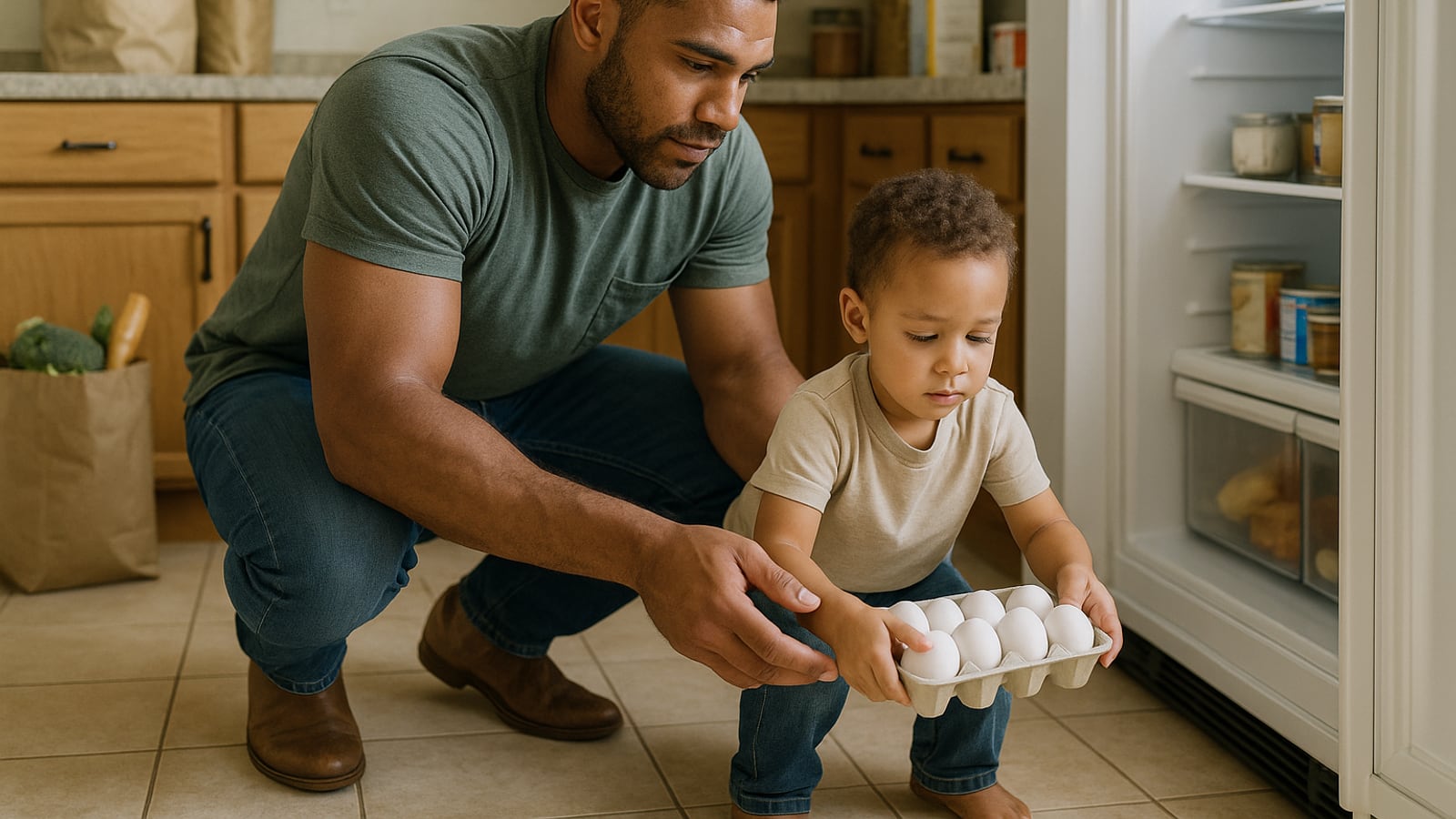
Six bags of shopping. Alone, I can have it away in about ten minutes, cold stuff first, tins last. With a three-year-old helping, it's closer to thirty-five, and at some point a box of eggs is going to be carried across a tiled floor at chest height by someone who walks like a drunk sailor.
Hand over the eggs.
Not because it builds character in some vague way. Because the alternative is a child who spends four years watching you work and then, at seven, has no idea that a full bin is something a person empties. Helpfulness isn't a trait that arrives. It's a habit that gets laid down early, badly, and slowly, in the years when the help is worse than no help at all.
That's the honest deal. For roughly the first three years of it, you're not saving time. You're spending it.
The job has to be real
Toddlers can tell the difference between a job and a distraction. Give a two-year-old an empty bowl and a spoon and tell them they're "helping", and they'll stir it for ninety seconds and then wander off to unroll the loo paper. Give them the actual bowl with the actual flour in it and they'll stay.
Real jobs that a two-year-old can genuinely do: carrying things from the boot to the kitchen, putting tins on a low shelf, throwing a nappy in the bin, taking their plate to the worktop, feeding the dog if you've measured the scoop, wiping a table with a damp cloth, pushing the button on the washing machine.
Real jobs for a three or four-year-old: sorting cutlery out of the dishwasher with the knives already removed, pairing socks, watering plants with a small jug, cracking eggs into a separate bowl before they go in the main one, sweeping crumbs into a dustpan you hold, carrying folded towels to the airing cupboard.
Notice what's missing. Nothing hot, nothing sharp, nothing that involves standing on something above knee height without you touching them. A spray bottle of plain water and a cloth gets you almost all of the cleaning jobs without a single chemical in reach.
Make it small enough to finish
"Tidy your room" means nothing to a three-year-old. It's not defiance, it's that the sentence doesn't describe anything they can picture.
"Put the blocks in the blue box" describes something. So does "carry these two tins to Mum" and "find all the socks under your bed."
One instruction. One object or one category. A visible end point, so they know when they've won. If the room needs eight things doing, that's eight separate sentences over ten minutes, and you're going to say all eight. It feels absurdly laborious the first fortnight. It stops feeling that way once they start anticipating the second instruction before you give it.
And give the instruction as an instruction. Not "would you like to help me?" They're allowed to say no to a question, and you've then either accepted the no or overruled it, and both are worse than just saying "bring me the blue box, please."
Set the house up so they can reach
Most of the resistance you'll get isn't attitude. It's that the thing is forty centimetres too high.
A sturdy step stool at the kitchen sink changes what a three-year-old can do more than any amount of encouragement. Twenty quid, roughly, for a decent wooden one that doesn't skate on tiles. Put their plates and cups in a low drawer instead of an overhead cupboard. Hang a coat hook at their shoulder height rather than yours, which is about the height of a light switch. Keep a small dustpan and brush somewhere they can get it without asking.
Do this once and you stop being the bottleneck. A child who can reach their own cup can fetch their own cup, and then can fetch their sister's cup, and the whole thing compounds.
The small broom is worth mentioning separately. A full-size broom is unusable for a three-year-old, and handing them one is the same as saying no.
Don't fix it in front of them
This is the hard one, and it's where most of us fail.
They fold the towel into a crumpled lump. They put the tin on the shelf with the label facing backwards. They wipe the table and leave a dry patch the size of a dinner plate. And your hand moves, entirely without permission, to put it right.
They see it. Every time. And what they learn is that their work is provisional, that the real version happens after they leave the room, and that there's no point trying very hard because the standard is one they can't hit.
So let the towel stay crumpled. If it genuinely can't stay, fix it later when they're not there. I've refolded a lot of towels at ten o'clock at night, and I'd do it again before I'd take one out of a four-year-old's hands and demonstrate the proper method.
There's a version of this that does work, but the timing matters. You show the method before they start, once, slowly, and then you shut up. Corrections mid-job are what kills it.
What to say afterwards
"Good boy" and "good job" are about you approving. They wear out fast and they turn the job into a performance.
Say what happened instead. "You carried the whole basket by yourself." "The table's clean." "You did that without me asking." It's more specific, it's true, and it points at the work rather than at your opinion of them.
Then, occasionally, say nothing. Not every act of competence needs a response, and a household where every small contribution triggers applause is a household where no applause means it wasn't worth doing.
The days you skip it
There are mornings when you have eleven minutes to get out of the door and a dentist appointment that took six weeks to book. On those mornings, put the shoes on the child yourself and go.
Don't build a rule you can't bend. The principle holds across a year, not across every single instance, and a father who insists on the slow way while the whole house runs late has swapped one lesson for a worse one.
Same with the jobs that shouldn't be shared at all. Hot oil. Ladders. Anything with a blade. "You can't do this one, it's not safe, you can do the bit after" is a complete and reasonable sentence.
When they go off it
They will. Somewhere around three and a half, the child who loved carrying tins will flatly refuse to carry tins.
Don't fight it head-on. Stop asking for a week or two. Then do the job yourself, nearby, without inviting them, and talk about what you're doing while you do it. Most of the time they turn up. Toddlers want in on whatever you're clearly enjoying and haven't offered them.
If they still refuse after that, it's often the job, not the principle. Swap it. Sweeping is boring. Spraying water on a window isn't.
What you're buying
Not a tidy house. The house will be less tidy for years.
You're buying a nine-year-old who notices the recycling is full. A thirteen-year-old who can cook two things without being asked. A grown man or woman who walks into a friend's kitchen after dinner and starts stacking plates without thinking about it, because the alternative never occurred to them.
That's a long way off, and you won't see the moment it happens.
Hand over the eggs anyway.
Cal Brennan
Fitness
Strength coach. Trains fathers, tradesmen and desk workers, which means programmes that survive a bad week.

Watch
Worth an hour of your evening
More from Dads.
From channels we rate. Plays on YouTube.
Read next