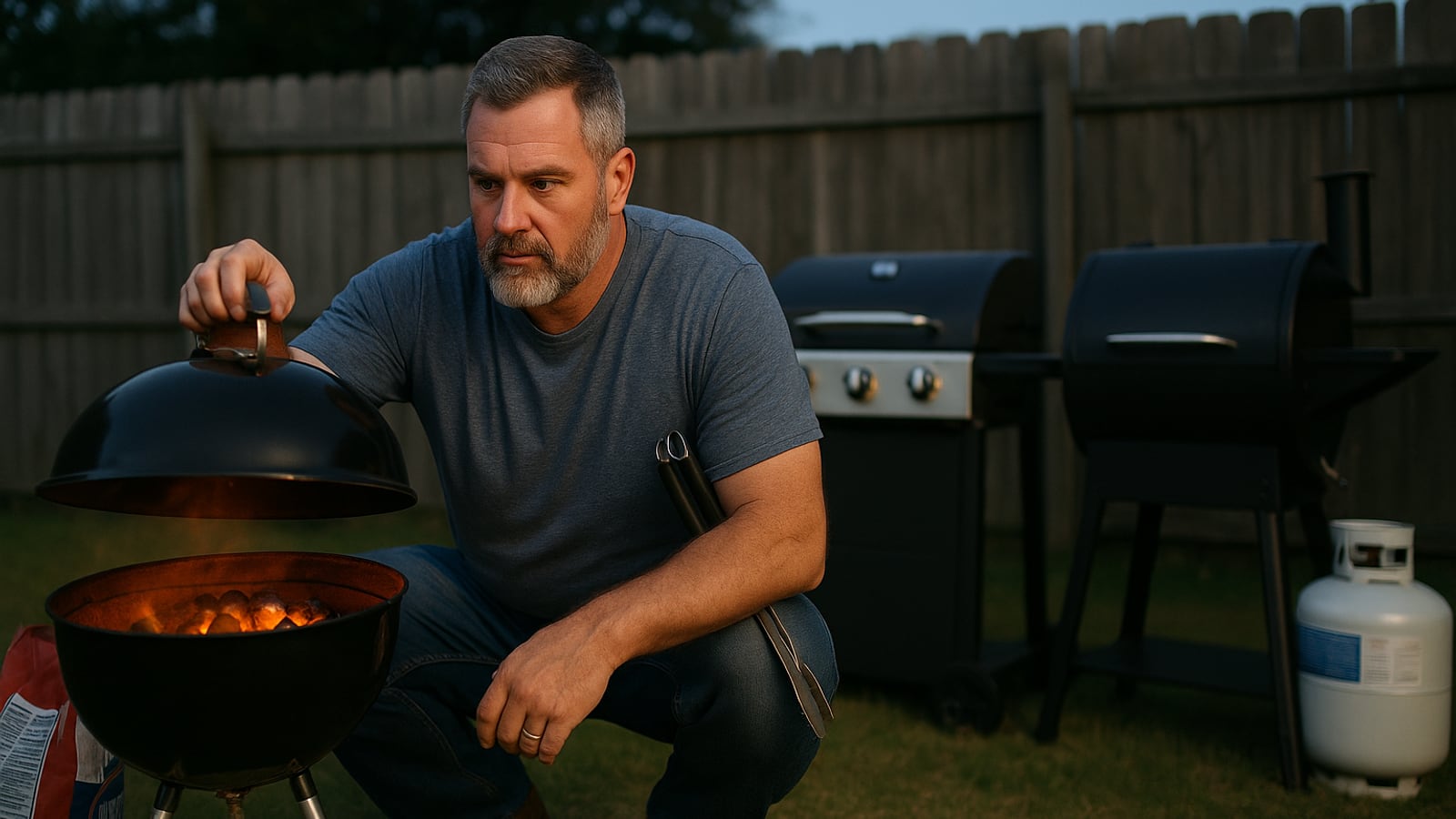
Before you compare a single spec sheet, answer one question: how many Tuesdays a year are you going to cook outside?
Not Saturdays. Anybody will light a fire on Saturday. Tuesday is the test, 6:40 p.m., dark at five, kids need to eat, and the thing had better be hot in twelve minutes or you're using the stove. Your honest Tuesday number decides more about which grill belongs on your patio than BTUs, grate material or how many people the brochure says it feeds.
If the answer is "most weeks," you want gas, and you can stop reading the pellet reviews. If it's "almost never, but I cook big on weekends," charcoal will make you happier and cost you a third as much. If you want to smoke pork butts while you're at church and come home to them, that's the pellet rig, and you should know what you're giving up.
Charcoal: the cheapest path to food that tastes like something
A 22-inch kettle is still the best value in outdoor cooking. Somewhere around a hundred and fifty to two hundred bucks new, less than that on Facebook Marketplace where they show up every spring because somebody's wife wants the deck back. It'll sear better than a gas grill costing five times as much, because a bed of coals four inches under the grate puts out radiant heat that no burner under a set of bars can match.
What goes wrong with charcoal is almost never the charcoal.
You're cooking on one zone. Dump the chimney across the whole grate and you've built a broiler with no off switch. Chicken thighs char black and run pink. Pile every coal on one half instead. Sear over the hot side, slide to the empty side, close the lid. That single change fixes about eighty percent of bad charcoal cooking.
Your bottom vent is packed with ash. Charcoal breathes from underneath. Two cooks of ash sitting in the bowl chokes the intake, your fire goes sullen, and you decide charcoal is "inconsistent." Sweep it out cold, every time, before you load.
You're using lighter fluid. A chimney starter costs about twenty dollars, takes one sheet of newspaper, and is ready in fifteen minutes. Fluid tastes like fluid. People can tell.
The real cost of charcoal isn't money, it's the twenty-five minutes between "I'd like a steak" and "the fire is ready," plus ash disposal, plus the fact that you can't walk away from a hot kettle with a five-year-old in the yard. Briquettes burn predictable and leave more ash. Lump burns hotter, sparks, and gives you less control. Start with briquettes until vents make sense to you.
Gas: the appliance, and stop apologizing for it
Gas doesn't taste like gas. Whatever your uncle says, the smoke flavor on a grilled steak comes from fat hitting hot metal and vaporizing, and gas does that fine. What gas can't do is a real smoke ring or nine hours at 250 degrees. Buy it knowing that.
Ignore the BTU number on the placard. A cheap grill with a thin firebox will happily push 40,000 BTUs straight out the seams. What holds heat is mass: thick cast iron or heavy stainless grates, a lid that doesn't rattle, burner tubes made of something better than the aluminized steel that rusts through in three summers. Pick the grill up by the lid handle at the store. If it flexes, walk.
Two failures own the gas category.
The regulator trips and you think the grill is dying. Open the tank valve fast and the excess flow safety thinks you've got a leak. It cuts you to a trickle and your grill tops out around 300. The fix takes forty seconds: burners off, lid open, tank valve closed, disconnect the hose, wait thirty seconds, reconnect, then open the tank valve slowly, one turn at a time. Do that every time and you'll never see it again.
Grease. The tray under the firebox fills, a flare-up finds it, and now you own a grease fire on a wood deck. Scrape the tray when you swap tanks. Keep the lid closed to smother a flare, never water.
Buy a spare tank. Twenty pounds of propane always runs out at minute six of a cook, never at the end.
Pellet: an outdoor convection oven that happens to smoke
This is the honest description and the manufacturers won't print it. A pellet grill is a fan-forced oven burning compressed hardwood, run by a thermostat, holding a set temperature for as long as there are pellets in the hopper. That's genuinely wonderful for ribs, pork shoulder, whole chickens and anything you want to walk away from.
It's mediocre at steak. Most units struggle past 500 degrees at the grate, and the fan means you're cooking in moving hot air rather than radiant heat. Searing plates or a cast iron skillet on the grates get you partway there. If steak and burgers are your main event, don't buy a pellet grill and then buy a griddle to fix it.
Things that will ruin your day:
- Wet pellets. They swell, the auger jams, the cook stops. Store them in a sealed bucket, not the bag, not the hopper through a rainy week.
- Relighting without emptying the burn pot. Unburned pellets stack up, then all catch at once. That's the fireball you've seen on video. If a startup fails, shop-vac the pot before you try again.
- No power, no cook. Igniter, auger and fan all run on 110 volts. Camping means an inverter or a generator.
- Cold and wind. Below freezing, an uninsulated pellet grill fights to hold 225 and eats pellets doing it.
You'll also get less smoke than you expect. The sweet spot for flavor is 180 to 225 degrees, and plenty of people run three hours low before bumping the temp for exactly that reason.
What to actually spend
Under $300, charcoal wins outright. A kettle plus a chimney plus a decent instant-read thermometer beats any gas grill in that price bracket, and it isn't close.
Between $400 and $800, gas becomes worth it if you'll cook on weeknights. Three burners is enough for a family of five. Look for a warranty on the burners and cook box measured in years, not months.
Above $800, the question is what you're chasing. Big pellet rigs, kamados, insulated cabinets. Pick the one that matches the cook you already do, not the cook you're imagining on the drive home from the store.
One more thing regardless of which you buy: the lid thermometer is a liar. It reads dome temperature, six inches above where your food sits, and on some grills it's off by seventy degrees. A leave-in probe at grate level costs less than two bags of charcoal and turns guessing into cooking.
And if your HOA or apartment rules bar open flame, the decision's already made for you. Check before you buy, not after the manager knocks.
Whatever ends up on your patio, put the first cook on the calendar this week. Grills don't get better in the garage.
Wes Dunbar
Country & Skills
Grew up on an acreage and never quite left. Covers trucks, trades, land, and how to do the thing yourself.

Watch
Worth an hour of your evening
More from Food.
From channels we rate. Plays on YouTube.
Read next