The line falls in two places. Light, and distance. If there's plenty of one and not much of the other, your phone will beat a camera you barely know how to operate. If you're forty feet away in a dim room and the subject is moving, the phone will lose, and no amount of megapixels will save it.
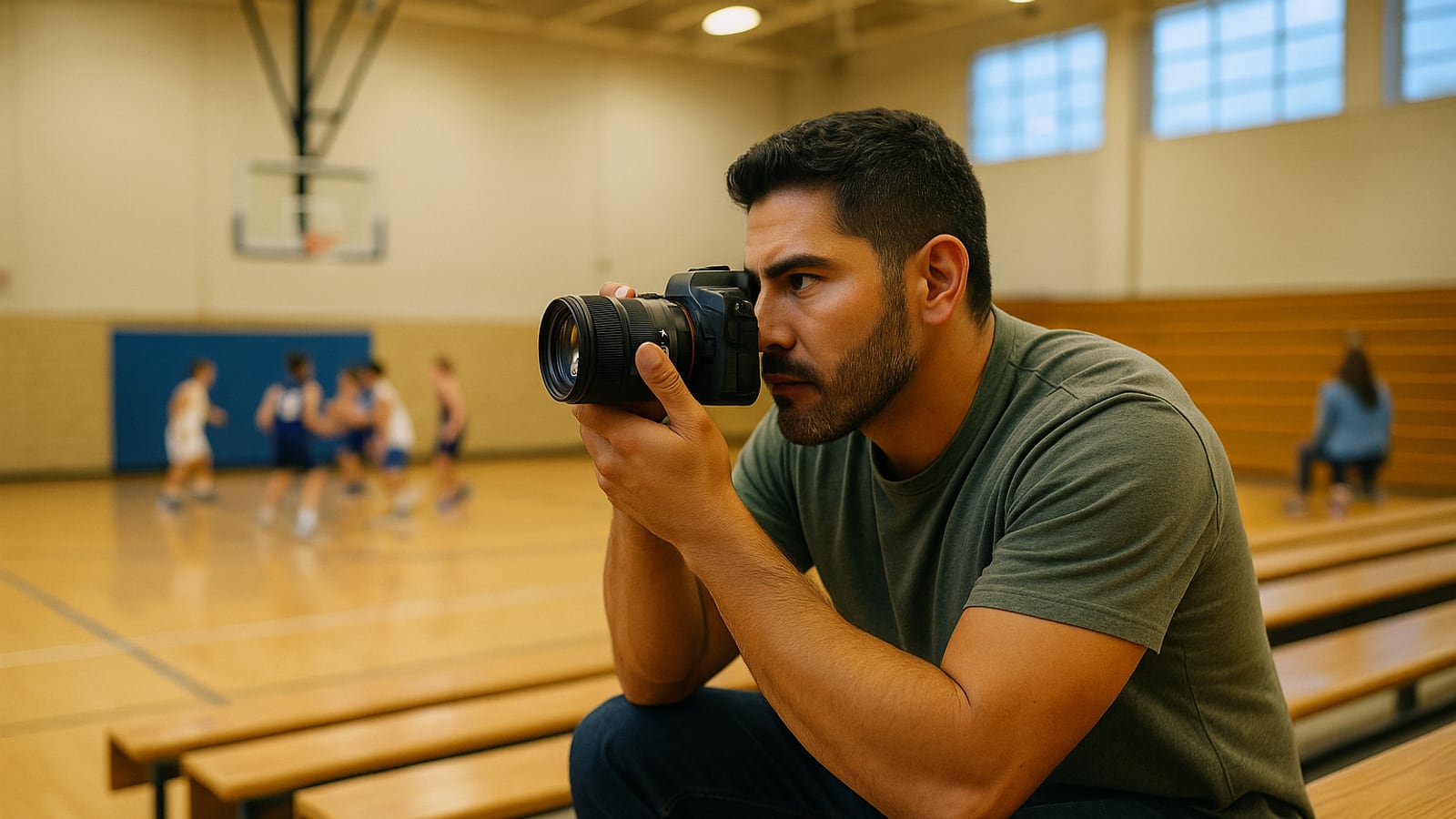
Hold that up against a real evening. A school gym, roughly 7 p.m., overhead lights that look bright to your eyes and are nothing to a sensor. Your kid is at the far end of the court. You're in the bleachers. That's low light and long distance at the same time, the exact corner where phone cameras fall apart, and it's also the single most common reason people finally buy a camera.
What the phone genuinely does as well as anything
Daylight. Any daylight. Outdoors on an overcast afternoon, a current flagship phone produces a file you can print at 8x10 and hang on a wall, and nobody will ask what you shot it on.
Close-range portraits in window light. Food on a table. Landscapes where the whole scene is in focus anyway. Documents, receipts, the serial number on the back of the water heater. Video of a birthday party. Anything where you have three seconds' notice and the alternative is no picture at all.
It also wins on the part nobody thinks about until later: the photo is backed up before you've put the phone in your pocket. A memory card in a drawer isn't a backup. I've met more people who lost a year of photos to a dead card than to a dropped camera.
The five places it breaks
Distance. Your phone has two or three actual lenses. On most, that's an ultra-wide, a main, and a telephoto somewhere between 3x and 5x. Past that number, you're cropping. The software fills in what it thinks should be there, and on a still subject in good light it does a decent job. On a kid running, it produces mush. If you find yourself pinching past the highest number your phone offers as a "lens," you've left the range where the picture will hold up.
Low light plus motion. These two together, not separately. A phone handles a dim restaurant fine because everyone's sitting still and the software can stack several frames. Add movement and the stacking breaks. You need a shutter speed around 1/500 of a second to freeze a running child, and the phone's sensor is too small to gather enough light that fast. You get a soft, smeary frame and you can't fix it later.
Big prints of anything shot in poor light. Phone files look great on a phone. At 20x30 on a wall, the noise reduction shows up as a plastic, painted texture in skin and hair. Good-light files enlarge fine. Bad-light files don't.
Consistent background separation. Portrait mode is a mask drawn by software. It's usually convincing. Then it isn't, and the failure is always in the same places: wisps of hair, the arms of eyeglasses, a hand held out toward the camera, a chair leg behind the shoulder. You won't notice until you're editing at 2 a.m.
Cold and long days. Shoot outdoors for three hours in December and your phone is also your map, your group chat, and your way home. A camera has a battery you can swap in eight seconds.
Getting more out of the phone first
Before you spend money, fix the free things.
Clean the lens. Actually clean it, on your shirt, every time. A film of pocket grease is the single largest cause of hazy, low-contrast phone photos, and people go years without connecting the two.
Stop using digital zoom. Walk closer. If you can't walk closer, shoot wide and crop later on a bigger screen where you can see what you're doing.
Tap and hold to lock exposure and focus, then drag to bring the brightness down slightly. Phones expose for the whole frame and blow out faces in backlight. Darker is recoverable. A white blown-out forehead is gone forever.
Turn off any skin-smoothing or "beauty" setting buried in the camera menu. It makes people look like wax.
Use burst for anything moving. Hold the shutter, take twelve, keep one.
Shoot in RAW or ProRAW if your phone offers it, but only when you intend to edit. The files are large and the phone's own processing is honestly better than most people's editing.
And put the sun behind you or put your subject in open shade, right at the edge of a building. Shade is the most flattering light available for free, and everyone stands in the sun instead.
If you do cross the line
You need reach, low-light ability, or both. That determines what you buy, and it's a narrower decision than camera forums make it sound.
For sports and wildlife, the lens matters more than the body. A used crop-sensor body from the last decade paired with a 70-200mm f/2.8 will beat a brand-new body with the kit zoom every time, indoors especially. Kit zooms are f/5.6 at the long end, which is why every gym photo taken on one is blurry.
For family, travel, and portraits, one camera and one fast prime is the whole answer. A 35mm or 50mm equivalent at f/1.8. You zoom with your feet. The discipline of a fixed lens will make you better inside a month, because you stop standing in one place.
Buy used. Camera bodies depreciate hard and a five-year-old mirrorless body from any of the major brands is enormously capable. Spend the savings on glass, which holds value and outlives four bodies.
Here's the concession, and it's a real one. A camera you leave at home photographs nothing. If you're honest with yourself and know you won't carry it, don't buy it. Learn your phone properly instead, and accept that you'll miss the gym shots. That's a legitimate choice, and it's the right one for plenty of people.
The part that actually matters in ten years
Your photos are almost certainly in one place, and that place is a phone that can be stolen, dropped in a lake, or locked out of an account you can't recover.
Get three copies. The phone, a cloud service, and an external drive at home that you plug in twice a year and drag everything onto. It takes an hour in January and an hour in July.
Then print some. Not a book you'll design for two months and never finish. Twenty-four 6x4s from a drugstore kiosk, once a year, in a shoebox. Kids go through a shoebox of prints. Nobody scrolls your camera roll.
The photo your family will care about in thirty years is the slightly crooked one of their grandfather laughing at the kitchen table, taken on whatever you had in your hand. Not the sharp one of the sunset.
Dean Shaw
Gear & Garage
Tests things until they break, then reports what broke first. Trucks, tools, watches, and the cheap version that costs more.

Watch
Worth an hour of your evening
More from Gadgets.
From channels we rate. Plays on YouTube.
Read next