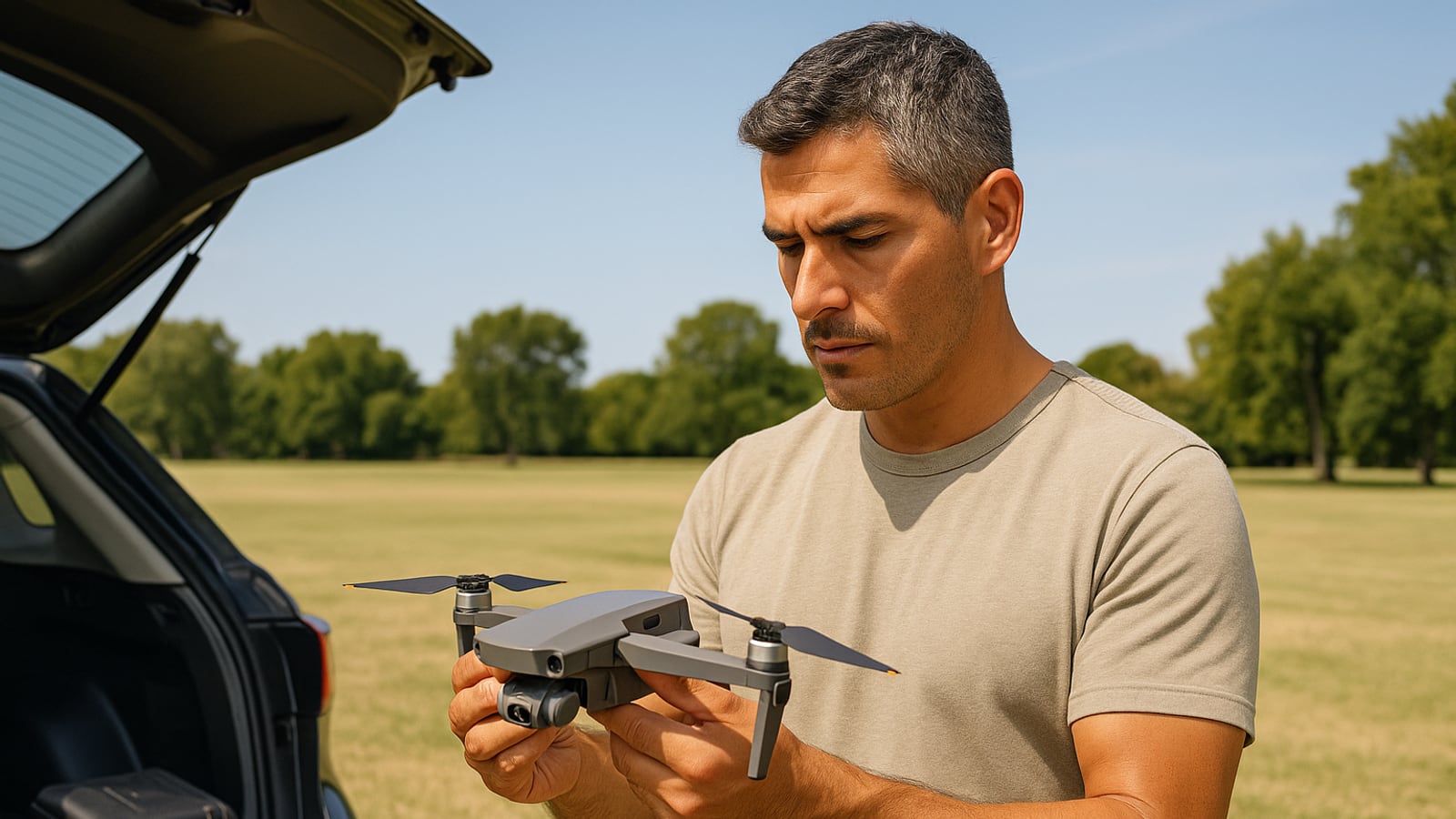
Buy the one that weighs less than 249 grams. That single number decides how much of your first year is spent flying and how much is spent on paperwork. In the US, a drone at or above 250 grams has to be registered with the FAA, and a registered drone has to broadcast Remote ID. Under 249 grams, flown for fun, you skip both. Manufacturers know this, which is why so many of the small folding models land at 248 or 249 grams on the nose.
That doesn't mean you're unregulated. People get this backwards constantly.
The free test you still have to take
Every recreational flyer in the US has to pass TRUST, the Recreational UAS Safety Test. There's no weight exemption. It's free, it's online, it takes about twenty minutes, and you can't fail it because it walks you back through any question you miss. When you finish, you get a certificate. Save the PDF, then email it to yourself and keep a copy on your phone, because there's no central database and no way to get it reissued. Lose the file and you retake the test.
Carry it when you fly. If you're asked for it, you're expected to produce it.
Rules move. Before your first flight, spend ten minutes on the FAA's own drone pages rather than a forum post from 2022. If you ever want to charge somebody for footage, even a neighbor's house listing, that's a different world entirely and you'll need a Part 107 certificate.
Where you can actually fly
The short version of the recreational rules: stay at or below 400 feet, keep the drone in your own line of sight, don't fly over people who aren't part of what you're doing, don't fly over moving vehicles, and give way to anything with a pilot in it. At night you need anti-collision lighting visible for three statute miles, and the little navigation LEDs on your drone almost certainly don't count.
Airspace is the part that catches people. Download B4UFLY or one of the other FAA-approved apps and check your spot before you leave the house. Controlled airspace around airports isn't a hard no, but it needs LAANC authorization, which the app can usually grant in under a minute. Fly there without it and you're the guy in the news.
National parks are a flat no. The Park Service prohibits launching, landing, or operating a drone from inside park boundaries. State parks, county parks, and city parks all set their own rules, and plenty ban it outright. Stadiums and large sporting events have their own restrictions. Wildfires have temporary restrictions that carry serious penalties, because your hobby drone grounds the air tankers.
If you live under a Class B shelf with a public park that bans drones on both sides of you, be honest with yourself about how often you'd actually fly. Some people should skip the purchase.
The camera spec that matters, and the one that doesn't
4K tells you almost nothing. Every drone worth buying shoots 4K. What separates them is sensor size and how the camera handles light.
The small sub-250 gram models generally use a sensor around half an inch. In good light they're genuinely impressive. At dusk, or in the shade of a canyon, they get noisy and mushy fast. Step up to a one-inch sensor and the low-light difference is obvious, but you've also crossed the weight line and bought yourself registration, Remote ID, and a bag that no longer fits in a jacket pocket.
Two things matter more than the megapixel count:
- The gimbal. A real three-axis mechanical gimbal. Digital stabilization on a cheap drone looks like footage shot through jelly, and no amount of editing fixes it.
- Fixed aperture. Most drone cameras can't stop down. In bright sun, that forces a fast shutter speed, and fast shutter gives you that stuttery, video-game motion. A set of ND filters lets you hold the shutter near double your frame rate, which is where footage starts looking like film instead of security cam.
A basic ND set is the cheapest upgrade you'll ever make to picture quality. Buy ND8, ND16, and ND32 and you're covered for most daylight.
Ignore the log color profiles for the first month. Shoot the standard profile, learn to fly, and add color grading when flying has stopped taking all your attention.
What you buy alongside it
Batteries. One battery gives you somewhere between fifteen and thirty minutes of advertised flight time and noticeably less in real conditions, because wind, cold, and hovering to frame a shot all eat power. Two spares and a charging hub turn a drive out to a good location into an actual afternoon.
A memory card rated V30 or better. The card that came in the box, if one did, isn't it.
Spare propellers, because you'll clip something. A hard case, because loose props in a backpack get bent, and a bent prop is a vibration you'll see in every frame.
One rule for travel: lithium batteries fly in your carry-on, never in checked luggage. Tape the contacts or use the little sleeves they shipped in.
The first flight
Update the firmware at home, on your own Wi-Fi, the night before. Updates can take half an hour and sometimes want a charged battery to complete. Doing this in a gravel lot with one bar of signal while your kids ask when it's going up is a specific kind of misery, and it's the single most common way a first flight gets canceled.
Pick a wide open field. Not a backyard. You want a hundred yards in every direction, no power lines, no trees on the downwind side, and wind under about ten miles an hour. Check the forecast for gusts, not just the average.
Launch from bare ground or a landing pad, not from the hood of your truck. Big metal surfaces and rebar in concrete can throw off the compass, and a confused compass is a drone that drifts sideways when you've told it to hover.
Wait for a solid GPS lock before takeoff so the home point records where you're standing. Set the return-to-home altitude above the tallest thing around you, because on a low-battery return the drone climbs to that altitude and flies straight back in a line that doesn't avoid a treetop.
Then hover at ten feet for a full minute and do nothing else. Watch how it holds position. Get your thumbs used to the sticks while the ground is close.
Here's the moment that gets everybody. You fly it out two hundred feet away, turn it to face you, and now left is right. Your brain knows this. Your thumbs don't. Practice that reversal at forty feet, over grass, until it's boring.
Land with 30 percent showing on the first few flights. The battery percentage falls faster at the end than the beginning, and hovering while you decide where to put down is the most expensive thing you can do with your last two minutes.
The neighbor conversation
A drone over a fence line reads as surveillance to a stranger, and they're not wrong to feel that way. Don't hover over somebody's yard. Don't point the camera at a window. If a person walks over and asks what you're doing, land it and talk to them like an adult. That thirty-second conversation is the difference between a neighborhood that shrugs at your hobby and a neighborhood that calls the police.
The best thing mine's ever done wasn't footage. It was fifteen minutes over the roof in October, finding the spot where the flashing had pulled away above the back bedroom, three months before that would have shown up as a stain on the ceiling.
Dean Shaw
Gear & Garage
Tests things until they break, then reports what broke first. Trucks, tools, watches, and the cheap version that costs more.

Watch
Worth an hour of your evening
More from Gadgets.
From channels we rate. Plays on YouTube.
Read next